What wine with eggplant parmigiana, fried, baked or light
Tomato, fried aubergine, melting cheese and basil: which wine to pair with parmigiana di melanzane, from Gragnano to Frappato, and what to avoid.
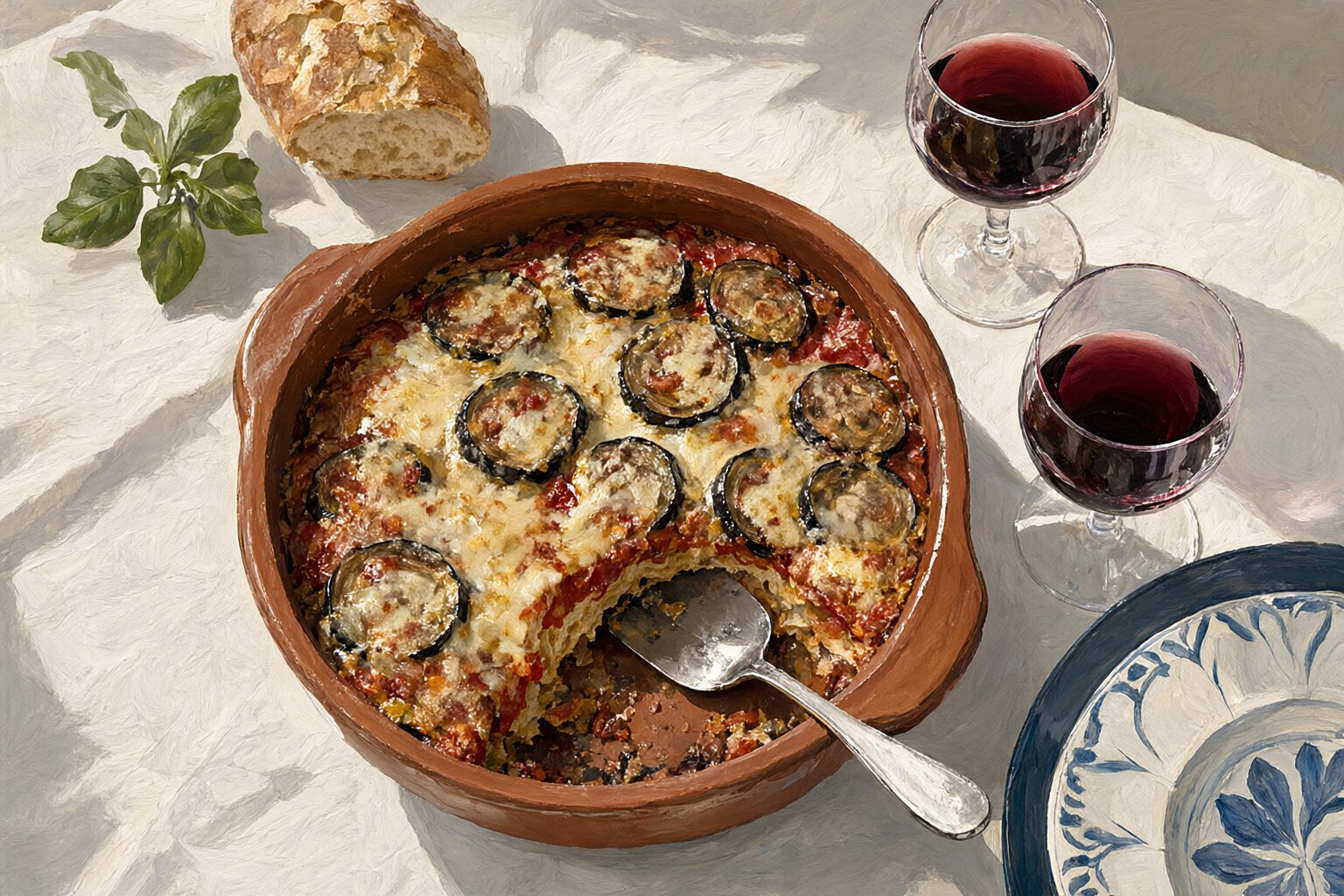
Parmigiana di melanzane, the layered aubergine bake that Americans call eggplant parmesan, is one of those dishes that unites everyone at the table and unsettles whoever has to choose the wine. It contains almost everything that usually complicates a pairing: acidic, slightly sweet tomato, frying, stringy cheese, salty parmigiano, basil, and often an abundance that forgives nothing. The short answer is this: a young, fresh red with little tannin, even better if lightly sparkling, or a rosé with character. The long answer explains why, and what changes from one parmigiana to another.
A southern dish with a northern name
Before the glass, a curiosity. The name seems to point to Parma, but parmigiana is a southern dish, claimed by Campania, Sicily and Calabria. The American food writer Clifford A. Wright, who has reconstructed its history, notes a recipe for aubergines “alla parmegiana” as early as Vincenzo Corrado’s Cuoco galante of 1786, still without tomato, and credits Ippolito Cavalcanti, in his Cucina teorico-pratica printed in Naples in 1837, with the first version with parmigiano and tomato sauce. As for the origin of the name, theories abound, from the cheese to the Sicilian palmigiana, the slats of shutters that the layers of aubergine are said to resemble: none is proven, and it is more honest to say so than to pick one.
Why a young red works
The main enemy is tomato. Its acidity makes wines that lack it seem flat and flabby, and its cooked sweetness makes big tannins taste bitter. A structured, oak-aged red next to a dish of parmigiana tends to seem hard and alcoholic, while the dish overwhelms it with flavour. You need the opposite: a wine with acidity at least equal to the sauce, crunchy red fruit and light tannin.
Then there is the fat, from the frying and the cheese. Here acidity works again, cleansing the palate, and bubbles do the rest. It is no coincidence that in Naples home tradition pairs these dishes with a sparkling red, Gragnano, which in Neapolitan cooking does the same job as Lambrusco in Emilia.
Fried parmigiana, the traditional one
In the classic Neapolitan version the aubergines are fried, sometimes floured or dipped in egg, and layered with sauce, fiordilatte or provola, parmigiano and basil. It is the richest parmigiana, and it calls for a wine that cuts through fat.
- Gragnano and Lettere. These are subzones of the Penisola Sorrentina DOC, created in 1994, and the production rules allow their reds only in the lightly sparkling version, from grapes such as Piedirosso, Aglianico and Sciascinoso. Bubbles, purple fruit, acidity: it is the home pairing, and it is hard to beat.
- Dry Lambrusco. A Sorbara or a Grasparossa made dry does a very similar job, with a sharper profile in the first case and a more tannic one in the second.
- Piedirosso. For those who prefer a still red, Piedirosso from the Campi Flegrei or Lacryma Christi del Vesuvio red, where it makes up at least half the blend, are soft, spicy reds that accompany without competing. Served at 14–16 degrees they show better.
Sicilian parmigiana and baked versions
In Sicily parmigiana changes accent: there are versions with pecorino or caciocavallo, sometimes with hard-boiled eggs or ham, and the tomato is often more concentrated. Here the island’s reds play at home. Frappato, pale and floral, and Cerasuolo di Vittoria, Sicily’s only DOCG, where Nero d’Avola joins Frappato, have just the right freshness. A young Etna Rosso works for its acidity, but it is wise to avoid the more tannic, long-oaked versions.
The “light” parmigiana, with grilled or oven-baked rather than fried aubergines, changes less than you might think: tomato remains the protagonist and the fat drops only a little. It does, however, become easier for a rosé. A Cerasuolo d’Abruzzo, a Salento rosé from Negroamaro or an Etna Rosato have enough body for the cheese and enough acidity for the sauce, and in summer, with parmigiana served warm or cold the next day, they may be the best choice of all.
What about white?
You can, with judgement. A light, neutral white disappears. A structured white, with lively acidity and a little salinity, holds up well, especially with white versions or ones heavy on mozzarella: a Falanghina from the Sannio or the Campi Flegrei, a young Fiano, a Greco di Tufo. Dry traditional-method sparklers also work, since they almost never go wrong with fried food, as long as you do not pick ones that are too aged and delicate: parmigiana is not a dish for nuance.
What to avoid, on the other hand, are very tannic and alcoholic reds, big aged Aglianicos, Amarones, the most concentrated Primitivos with a touch of sweetness: with tomato they turn heavy, and Sunday lunch becomes an endurance test.
Our choice
If we had to open a single bottle, it would be a young, dry sparkling red, served cool. Not out of lazy local pride, but because it answers the dish’s problems point by point: acidity stands up to the tomato, bubbles cleanse the fried food, light tannin quarrels with no one. Parmigiana is a generous dish with no pretensions to elegance. It deserves a wine that resembles it, not one that lectures it.
❦