Red wine stains: what really works and what doesn’t
Why red wine stains, how to treat clothes, tablecloths and rugs with cold water and sodium percarbonate, and which old wives’ remedies to forget.
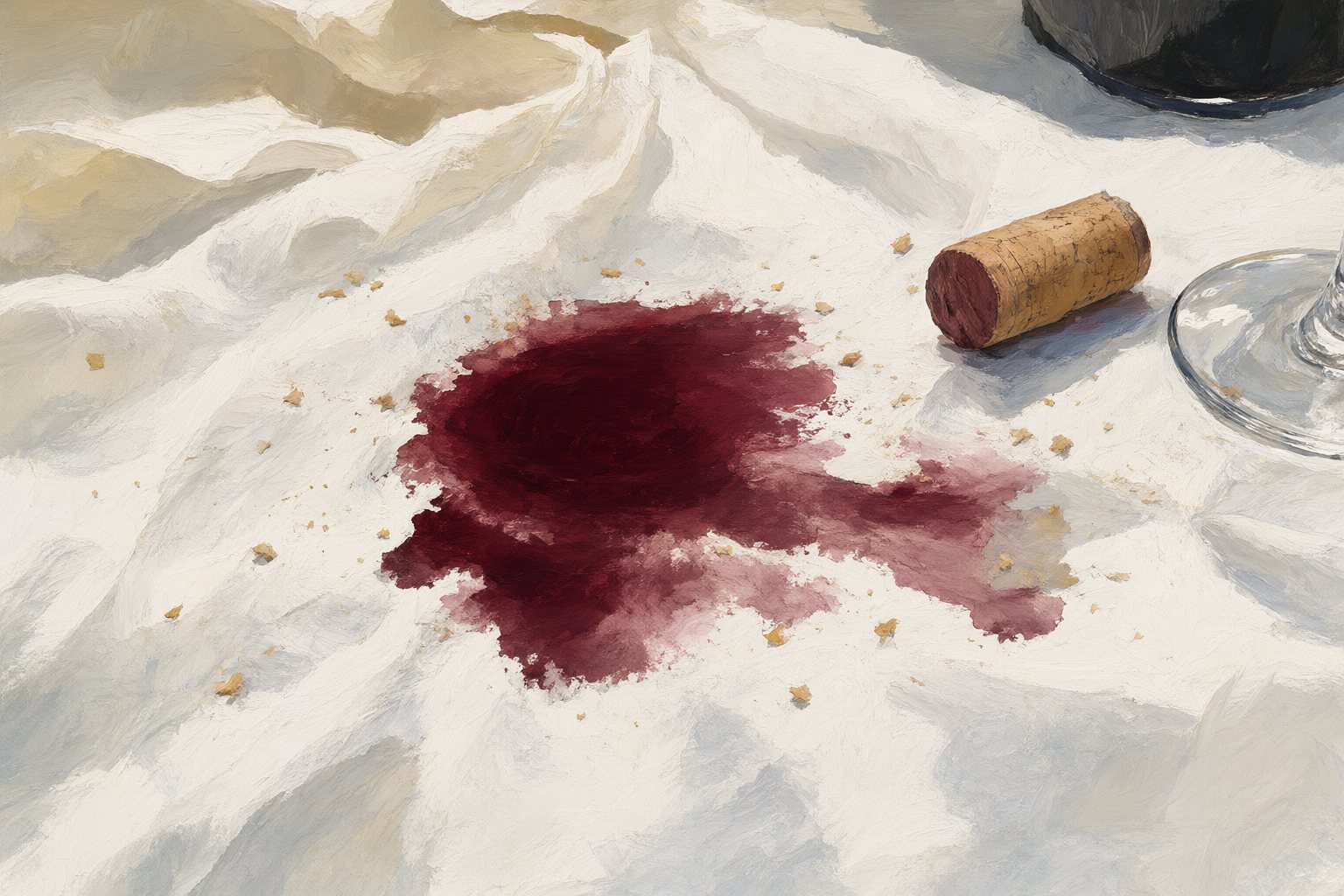
Sooner or later it happens. The slightly too enthusiastic toast, a neighbour’s elbow, the glass that slides across Grandmother’s best linen. And a moment later, as the stain spreads like a map of Chianti, the theories start flying round the table: salt, white wine, sparkling water, talcum powder, milk. Everyone has their own, and defends it with the ferocity usually reserved for football.
The good news is that a fresh red wine stain almost always comes out. The bad news is that many of the most famous remedies have nothing to do with why it goes.
Why red wine stains so badly
The colour of red wine comes from the grape skins, and in particular from a family of pigments called anthocyanins. They are the same ones that colour blueberries, blackberries and red cabbage, and they have a peculiarity familiar to anyone who did the red cabbage experiment as a child: they change colour with acidity. In an acidic environment, like wine, they are red; towards neutral they turn purple; in an alkaline environment they shift to bluish and greenish tones, almost disappearing when the alkalinity is very strong.
Alongside the anthocyanins are the tannins, the same molecules that dry out your mouth. In the glass they bind to proteins; on the tablecloth they cling to fibres, especially natural ones such as cotton and linen. The result is a double stain: a pigment that moves easily as long as it is wet, and a component that, if left to dry or heated, tends to set.
Almost everything else follows from this. The enemy is not the wine, it is time. And heat.
The first rules, the ones that matter
The first move is the dullest and the most effective: blot, don’t rub. A clean napkin or kitchen paper pressed onto the stain removes the liquid that has not yet entered the fibre. Rubbing, on the other hand, pushes the wine deeper and widens the ring.
Then cold water, and plenty of it. If the fabric can be lifted off the table, it is best to run the water through from the back, so that the wine leaves by the same side it came in rather than crossing the whole weave. Hot water at this stage is a bad idea: heat helps the tannins bind and risks turning a pink mark into a permanent ring.
Third rule, often forgotten: no iron and no tumble dryer until the stain has completely gone. It is the surest way to set it. Better to let it air-dry and check it in daylight.
The kit that really works
For washable fabrics, cotton and linen above all, the most serious ally is sodium percarbonate, the classic powdered oxygen bleach. Dissolved in water it releases hydrogen peroxide, which oxidises the pigments without the harshness of chlorine bleach. It is used as a soak and then in the washing machine, following the doses and temperatures on the label and those the fabric can take: it generally works best in lukewarm water, so the ideal sequence is cold water straight away, percarbonate afterwards. The packets usually advise against it on wool and silk, and on coloured fabrics a test on a hidden corner is always wise.
If there is no percarbonate in the house, a small emergency trick is diluted washing-up liquid: apply it to the still-damp stain, work it gently with your fingers and rinse with cold water. It doesn’t perform miracles, but it keeps the wine in suspension until the proper wash. For white cotton tablecloths, some add a few drops of ordinary hydrogen peroxide: it works on the same principle as percarbonate, but on a coloured fabric it can lighten the dye too.
On rugs and carpets the logic is the same, with one extra constraint: you cannot rinse them under the tap. Blot from the outside towards the centre, pour on a little cold water, blot again, and repeat until the cloth comes away almost clean. Over-wetting is a mistake, because the moisture seeps into the backing and can bring the stain back to the surface as a yellowish ring in the following days. For valuable rugs, hand-knotted wool or antique fibres, the honest advice is just one: blot with water and call a professional.
The myths to debunk
The most famous is pouring white wine over the red. The idea is that it “neutralises” the stain. There is no neutralisation whatsoever: white wine is itself acidic and contains sugars, so it does not change the chemistry of the anthocyanins. What it does is dilute the red, exactly as water would, with the disadvantage of adding more liquid and a certain stickiness. If it works, it works because it is wet. So you might as well use water, and keep the white in the glass.
Then there is salt. It has its uses, but not the one people credit it with: it absorbs liquid, rather like kitchen paper, and can help when there is nothing else to hand. It does not “draw out” the colour from the fibre, nor does it dissolve it. Left to dry on the stain for hours, moreover, it solves nothing and on some fabrics just leaves a crust to be brushed off.
Sparkling water is another classic. The bubbles give the impression that something is happening, but there is no chemical reason why fizzy water should work better than still. Here too the credit goes to the water and to speed.
Bicarbonate of soda deserves a separate word, because it deceives the eye. Being alkaline, it shifts the anthocyanins towards blue and grey: the stain seems to change and fade, and you get the impression you have won. But the pigment is still there, just a different colour. As an absorbent on a rug it can lend a hand, provided you vacuum it up thoroughly and don’t mistake it for a treatment.
That leaves milk, talc, shaving foam and the rest of the household arsenal: remedies for which there is no solid evidence, and which at best just add one more substance to remove.
A matter of keeping your cool
In the end, the secret is less fascinating than any family legend. Blot, cold water, no heat, percarbonate at the right moment. Four gestures, no magic ingredient.
But perhaps the real mistake is another one, and it is cultural: treating a wine stain as a little drama to be solved at once, even at the cost of leaving the table. A marked tablecloth is proof that someone had a good time at that dinner. Blot, pour on a glass of cold water, sit back down. The washing can wait until the next morning. The conversation cannot.
❦