Does unopened wine go off? What the label doesn’t tell you
Why wine has no expiry date, which bottles should be drunk young, which last for years, and how to tell whether an unopened wine has gone over.
Go ahead, turn the bottle round. On the back you’ll find the alcohol content, the sulphites, the lot number, perhaps a QR code, but there is one thing you won’t find: an expiry date. Yoghurt has one, mineral water too, even table salt often carries a “best before”. Wine does not. And from this absence springs a very widespread misconception: that unopened wine lasts for ever, or rather that it improves no matter what, as long as you forget it in a cupboard for long enough.
It doesn’t. Wine doesn’t expire, but it does come to an end.
Why the date is missing
The reason is written into European law. EU Regulation 1169/2011, which governs food information across all the countries of the Union, Italy included, sets out in its Annex X a series of exemptions from the obligation to state a minimum durability date. The list includes wines, liqueur wines, sparkling wines and aromatised wines, and more generally beverages containing 10% or more alcohol by volume. It is neither an oversight by the legislator nor a favour to producers: it is a recognition that for these products there is no moment at which they become risky to consume, and that their lifespan is too variable to be reduced to a date.
The labelling rules, incidentally, have changed recently. Since 8 December 2023, wines produced from that date must carry a list of ingredients and a nutrition declaration, which can largely be moved to an electronic label reached via the QR code. It is the most visible change of recent years on the back of the bottle. But the exemption from the expiry date has stayed where it was.
What remains compulsory, on the other hand, is the lot number, which serves traceability rather than the curious consumer: it tells you which batch the bottle comes from, not when it was filled or how long it will stay good. If a producer wants to indicate a recommended drinking window they may do so, but that is their choice.
Most wine is made to be drunk soon
With the expiry date out of the way, the real question remains: how long does a bottle have before it shows its best, and how long before it loses it? Here it pays to start from an often-forgotten fact: the vast majority of wine on sale is made to be drunk within a few years of the harvest, often within one or two.
This covers almost all rosés, young aromatic whites (a Vermentino, a current-vintage Falanghina, a fresh Sauvignon), sparkling wines made by the Martinotti method, like most Prosecco, and light, fruity reds. The extreme case is vino novello, which by definition lives in a hurry: you drink it in the months after release, no later than spring. For all these wines time adds nothing. It takes away the fruit, the liveliness, the aroma, that is, exactly the reasons they were bought.
That doesn’t mean they are fit for the bin after two years. It means you drink them tired: flatter, a little dull, sometimes with a colour that has taken on a darker tinge than it should. A light white opened three or four years after the harvest is usually not spoiled; it is simply past it.
A practical rule: if the wine was cheap, doesn’t make a big show of its vintage and talks on the label about freshness and fragrance, don’t put it aside. Put it in the fridge and drink it.
The ones that last for years, and why
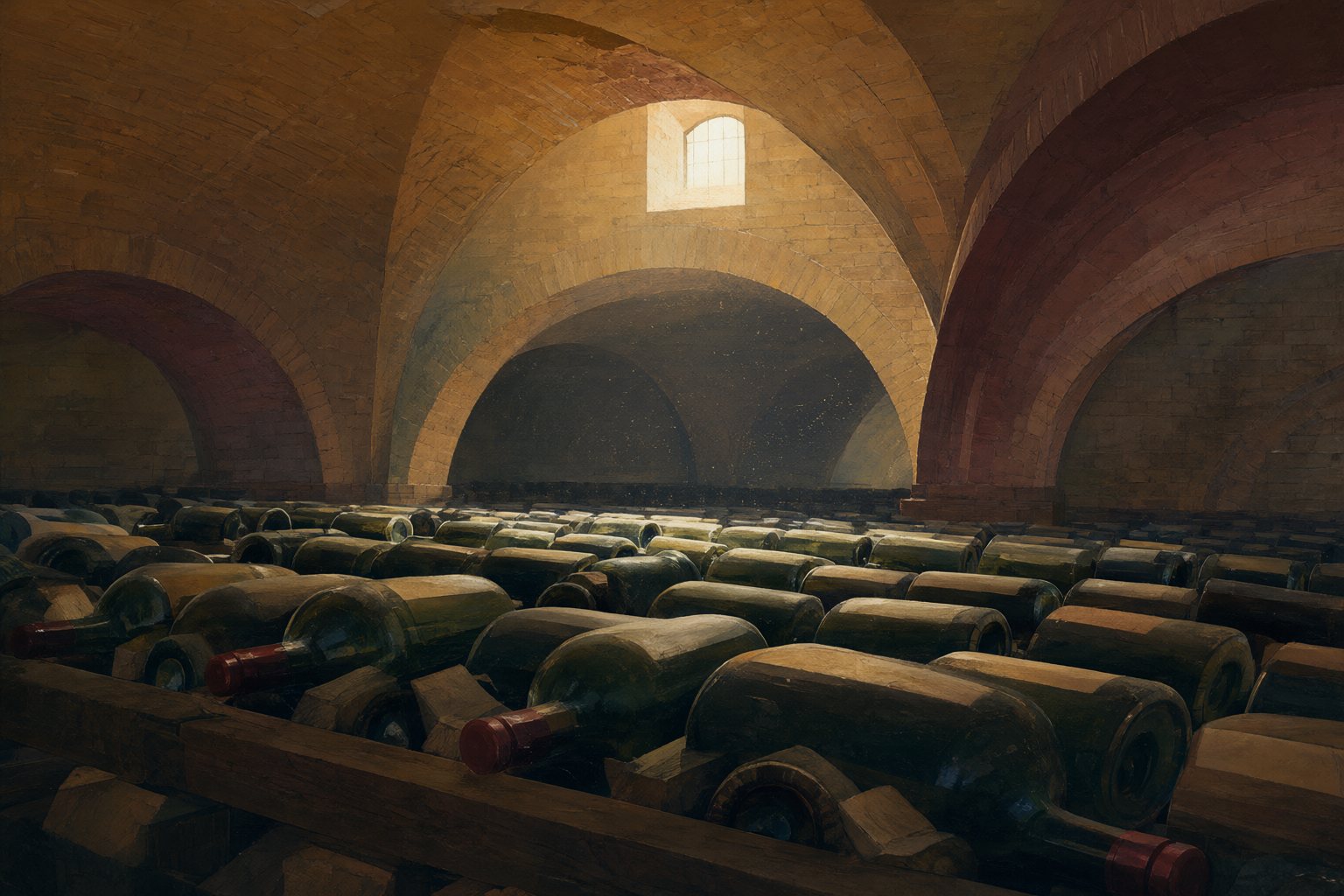
Then there is a minority of wines that genuinely change with time, and for the better. It isn’t magic, it’s chemistry: to age well a wine needs defences. High acidity, serious tannins, concentration, sometimes residual sugar or high alcohol. These are the elements that slow oxidation and give the wine the substance to transform rather than fade.
That is why the best vintages of Barolo, Barbaresco, Brunello di Montalcino, Taurasi or the great Bordeaux can last for decades. That is why some very high-acid whites, such as certain Rieslings or Loire Chenin Blancs, surprise those who open them after fifteen years. And that is why sweet and fortified wines are champions of longevity: sugar and alcohol protect them, and a vintage Port, a Sauternes, a Marsala Vergine or a Madeira can outlive the person who bought them.
Two caveats. The first: even the longest-lived wine follows a curve, not a straight line. It rises, reaches a plateau that may last for years, then declines. No wine improves indefinitely. The second: the appellation alone is not enough. There are Barolos designed to be drunk after just a few years and Chianti Classicos capable of ageing beautifully. Producer, vintage and style count at least as much as the name on the label.
How to tell if an unopened bottle has gone
Even without opening it, the bottle leaves a few clues. The first is the fill level: if there is much more space than normal between the cork and the liquid, some of the wine has evaporated and air has come in to take its place. In very old bottles some drop is natural; in a five-year-old bottle it is a warning sign. The second is the cork: if it is pushing out of the neck or there are sticky traces of wine that has seeped under the capsule, the bottle has almost always been exposed to heat. The liquid expanded, pushed the cork, and the wine will have suffered for it. The third is the colour, visible against the light in clear bottles: a young white turned amber, a rosé that has veered to orange.
Once opened, the nose decides. An oxidised wine smells of cut apple, walnut, stewed fruit, with an overall impression of tiredness; a wine “cooked” by heat has aromas of jam and prunes in syrup even when it shouldn’t. The best-known fault, so-called cork taint, has nothing to do with age: it is caused by contamination of the cork (the most common compound responsible is called TCA) and can be recognised by a smell of wet cardboard and mouldy cellar that smothers the fruit. It can happen to a one-year-old bottle just as to a thirty-year-old one.
What are not faults, on the other hand, are white crystals on the bottom or on the cork, which are salts of tartaric acid and do not alter the wine, nor the dark sediment in aged reds, which is colouring and tannic matter that has precipitated over time: just stand the bottle upright for a day before opening it and pour calmly.
Time is not a free ingredient
The absence of a date on the label has ended up feeding a romantic and mistaken idea: that every bottle deserves to be kept, and that waiting is always an act of respect. We think the opposite. For the overwhelming majority of wine, respect is shown by opening it early, while it is still what the producer intended. Time is a precious ingredient, but only for the wines that know how to use it. For all the others it is merely a slow way of losing them.
❦