Oltrepò Pavese, the vineyard Milan overlooks
South of Milan lies Lombardy's biggest vineyard, home to Bonarda, Buttafuoco, Pinot Nero and sparkling wine. Why it is overlooked and how it is changing.
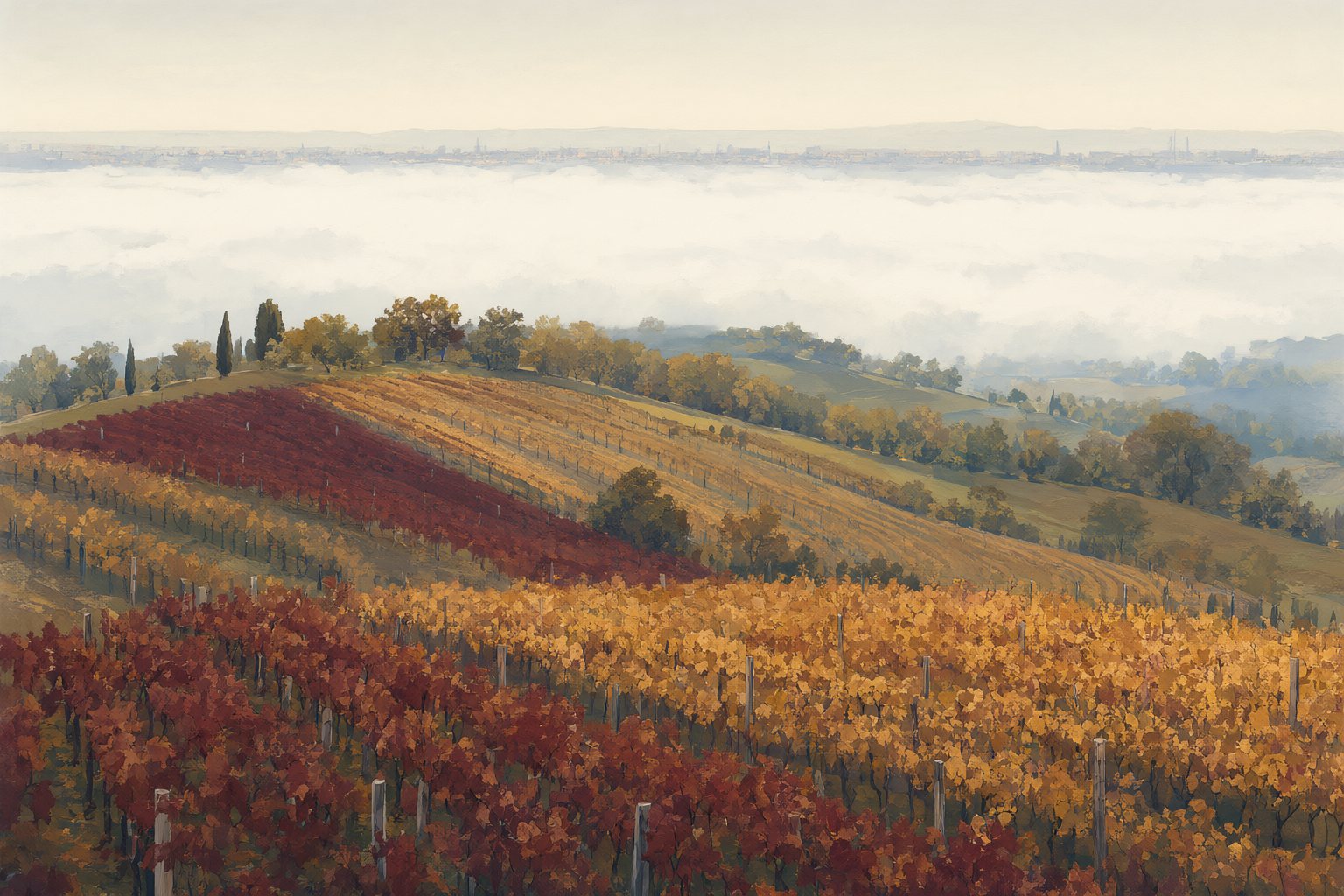
Milan has always drunk wine from far away and ignored what grows an hour’s drive from home. Cross the Po near Pavia and the hills begin to rise gently, thick with vine rows, while the autumn fog stays down on the plain like a sheet spread out to dry. This is the Oltrepò Pavese, Lombardy’s largest vineyard, and for most Milanese it remains the place you go to eat salami, not to ask questions about wine.
It is a pity, and a failure of perspective. Here is one of the strangest stories in Italian wine: a territory with every credential to be famous that spent decades being known for what it was not.
The red that tingles
Start with a misunderstanding over a name. The Bonarda of the Oltrepò is not Argentina’s Bonarda, nor is it a grape actually called Bonarda: it is Croatina, a dark red variety rich in colour and tannin, historically the most important in these parts. The wine in the glass, usually lively, with a violet foam and a scent of cherry and plum, is the natural companion to cured meats, risotto and the cooking of the Po Valley. Put plainly and without snobbery, it is not a wine for meditation but a wine for a proper table, and making it well is harder than it looks.
Then there is Buttafuoco, a name that sounds like a promise and which, by the most common explanation, comes from the image of a wine that “throws fire”. It is made from Croatina, Barbera and other local grapes such as Uva Rara and Ughetta, and it is still and structured. Some producers created the designation Storico, with stricter rules: in the figures I found, 36 months of ageing, at least 12 of them in wood and 6 in bottle, though the figure should be read as indicative and does not replace the rulebook currently in force.
And there is Sangue di Giuda, “Judas’ blood”, the most theatrical name in Italian wine. A sweet red, traditionally frizzante, made from the same grapes, it is the banner of a taste from another era that now makes sommeliers smile and wins over anyone who rediscovers it alongside a board of aged cheeses. It does not pretend to be anything else, and that is what saves it.
The Pinot Nero nobody expects
The real surprise lies elsewhere. In a land of Croatina and Barbera, Pinot Nero has claimed an enormous place. The figures should be treated with caution, but the sources I consulted speak of roughly 2,500 to 3,000 hectares out of a total area of around 15,000, a share that makes the Oltrepò one of Italy’s main reservoirs of the variety. Some is vinified as a still red, but its historic destination is another: sparkling wine.
Here Pinot Nero does what it does in Champagne, forming the backbone of metodo classico sparkling wines: second fermentation in bottle, long rest on the lees, taut freshness. It did not begin as a copy of anyone: the hills offer the altitude and the cool nights that Pinot Nero needs to hold on to its acidity.
A DOCG with a long name
Recognition came in 2007 with the Oltrepò Pavese Metodo Classico DOCG. The original rulebook required at least 70% Pinot Nero in the basic and rosé versions (85% for the Pinot Nero type), with the rest left to Chardonnay, Pinot Grigio and Pinot Bianco, and at least 15 months on the lees, 24 for vintage wines.
The trouble is the name. “Oltrepò Pavese Metodo Classico” is correct and charmless, impossible to pronounce in a crowded wine bar. So the territory has worked on a shorter brand for the denomination, Classese, and on stricter rules: according to press reports, hand harvesting, lower yields and at least 24 months on the lees for all. I found no confirmation of the final version of these changes or of when they take effect that would let me give a date, so I present them as a direction of travel, not an accomplished fact.
The image problem and the relaunch
Why does an area so close to a market of millions struggle to be recognised? The answer is partly structural. For decades the Oltrepò was a territory of quantity: a great deal of fruit, many cooperative cellars, a lot of wine sold in bulk or under other labels, and a fragmentation of designations that bewilders even insiders (the sources I read speak of more than forty types in the DOC alone). A place without a clear identity gets described by others, and others are not always generous.
The relaunch rests on three choices. The first is to bet on metodo classico, where the Oltrepò can play a game of recognisable quality and where, as we have seen, potential capacity far exceeds current production. The second is to give dignity to Bonarda and Buttafuoco, reds with a local character that no one else can copy. The third, and hardest, is to make the Milanese understand that the vineyard is on their doorstep.
An opinion
I think the Oltrepò has a problem that many regions would envy: too much variety, not too little. It has the popular reds, the serious red, the theatrical sweet wine, the sparkling wine with class. The temptation would be to tell all their stories at the same volume, and that would be a mistake. Better to choose one shop window, Pinot Nero and sparkling wine, and use it to draw the visitor in, who will then discover the rest alone. Anyone who wants to understand Lombard wine need not go far: all it takes is an October Sunday, a road between the vine rows and the courage to ask for something other than the usual.
❦