Pantelleria, where the vine hides from the wind to make Passito
Zibibbo, UNESCO-listed bush vines, hollows, dry-stone walls and drying in the sun: why Passito di Pantelleria is a wine that costs real toil.
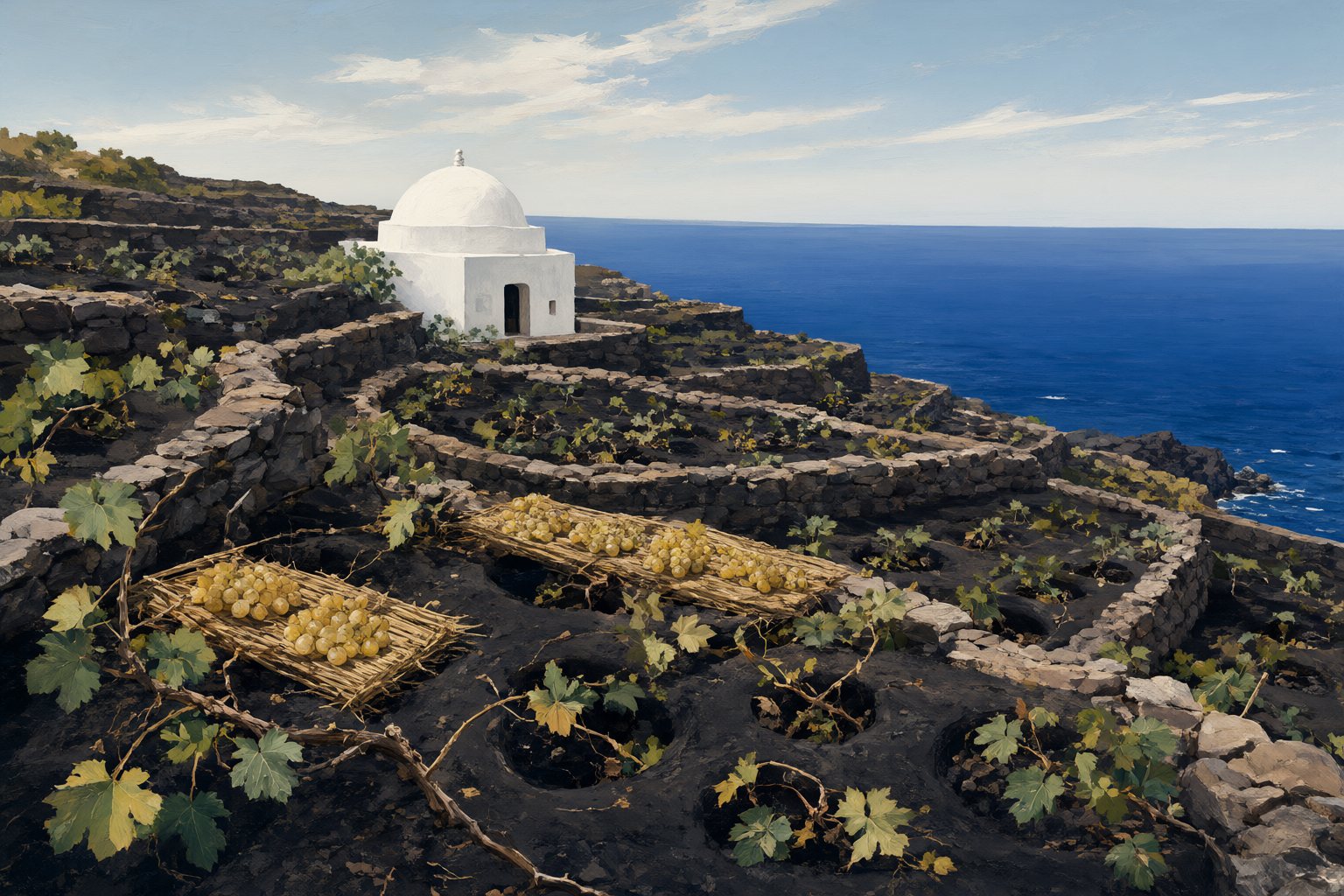
On Pantelleria the vine does not climb towards the sky: it stoops. It curls up inside a hollow dug into the black earth, its shoots spread out like the fingers of a hand laid flat on the ground, and waits for the wind to pass. Here the wind almost never passes. That is the first thing to grasp about a wine many know only as “the sweet one to drink with cannoli”: before it is a dessert, Passito di Pantelleria is a stubborn, ingenious answer to an island that did not want to be farmed.
An island more African than Sicilian
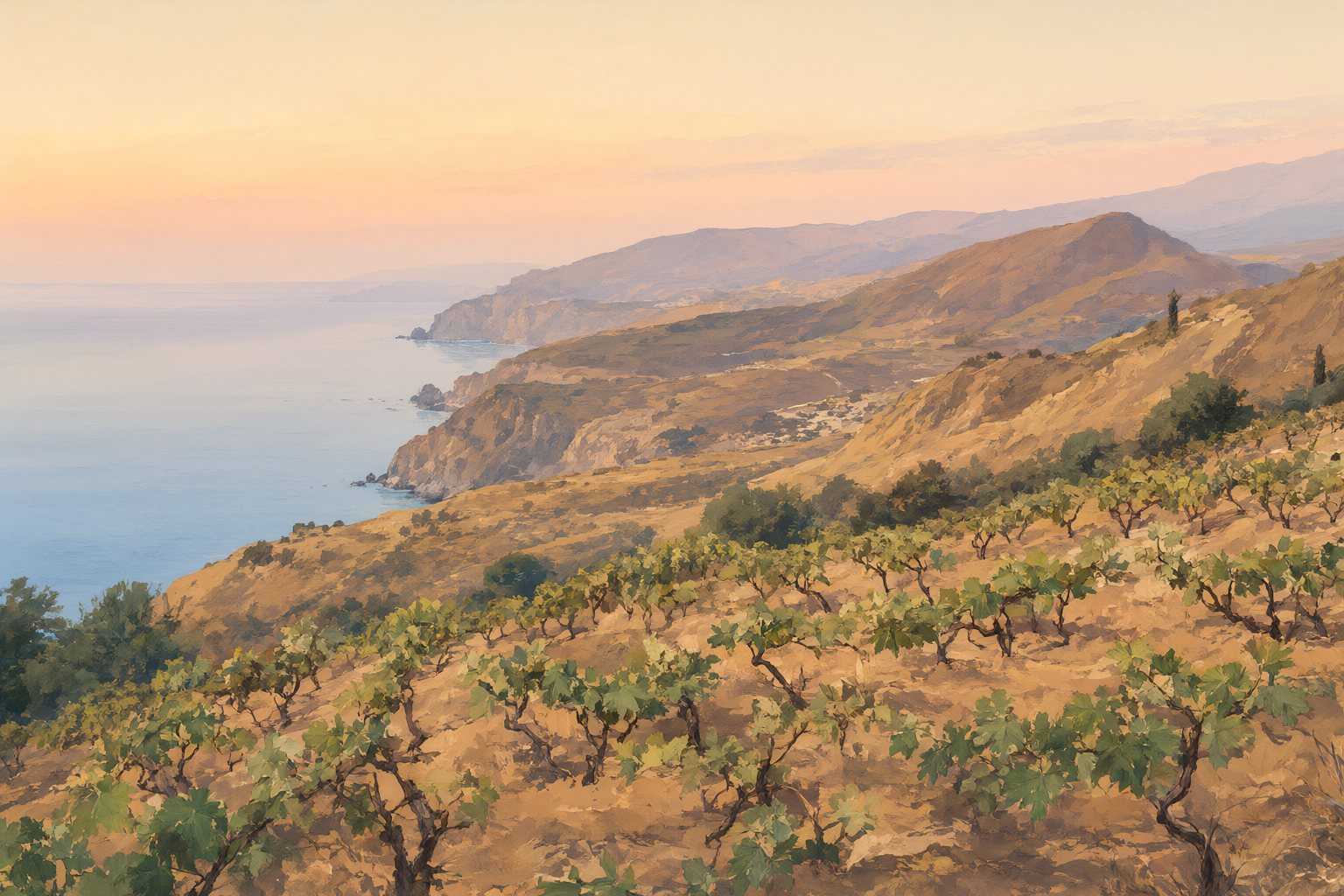
Pantelleria is a lump of volcanic rock of little more than eighty square kilometres, closer to Tunisia than to Sicily. No rivers, no springs worthy of the name, rainfall that is scarce and concentrated in the wrong months. What it has instead is wind from every direction, with the scirocco and the mistral in the lead, wind that dries, bends and burns. Anyone looking at a wind chart understands why the island has been called, for centuries, the “daughter of the wind”.
The grape that has learned to live here is Zibibbo, the local name for Muscat of Alexandria. The name almost certainly comes from the Arabic zabib, raisin: an etymology that already says everything about the destiny of these large, oval, thick-skinned berries. Tradition holds that the grape arrived from the eastern Mediterranean with Phoenician seafarers, and that it was the Arabs, during their long presence on the island, who organised its cultivation and drying. It is a plausible and much-repeated story, but the documents that prove it step by step are few: it is best taken as a founding legend rather than a chronicle.
The alberello pantesco, or the art of keeping low
The heart of the matter is the training system. The alberello pantesco is a bush vine pruned extremely short, planted at the bottom of a hollow some twenty centimetres deep or a little more. The hollow does three things at once: it shelters the plant from the wind, gathers the night-time moisture and what little water falls, and keeps the bunches close to the ground, which gives back its warmth at night. Every year the hollow must be rebuilt by hand, the vine pruned by hand, the grapes picked on one’s knees. No machine enters these vineyards, often clinging to very narrow terraces.
On 26 November 2014 UNESCO’s Intergovernmental Committee inscribed the “traditional agricultural practice of cultivating the ‘vite ad alberello’ (head-trained bush vines) of the community of Pantelleria” on the list of the Intangible Cultural Heritage of Humanity. It was the first time an agricultural practice, as such, had entered that list. The difference matters: what was protected was not a picture-postcard landscape but a know-how, that is, gestures, calendars, knowledge handed down from father to son. It is estimated that working a hectare this way takes around three times the hours of a vineyard on the plains, which is why the word “heroic”, usually overused, here sounds almost like a unit of measurement.
Stones, dammusi and gardens without a garden
The landscape of the vine cannot be understood without its stones. Pantelleria’s dry-stone walls, kilometre upon kilometre of lava stone fitted together without mortar, hold up the terraces, break the wind and clear the fields of rocks. The art of dry-stone walling also entered UNESCO’s intangible heritage list, in 2018, in a nomination shared by several European countries including Italy: it is not a recognition specific to the island, but here it finds one of its most spectacular expressions.
Among the terraces appear the dammusi, stone houses with very thick walls and whitewashed domed roofs, designed to collect rainwater and channel it into cisterns. And then there is the giardino pantesco, perhaps the most moving symbol of the whole island: a circular stone enclosure a few metres high, built to protect a single tree, usually a citrus. An entire piece of architecture for one plant. Anyone who thinks Pantelleria’s viticulture is a romantic exaggeration should look at those gardens and ask themselves what an orange was worth here.
The sun as cellar
Passito is born on terraces and on mats. Part of the grapes harvested in August is spread out in the sun, traditionally on racks or sheets, and left to dry for weeks, turned and watched over against damp and insects. The berries lose water and concentrate sugars and acidity, and Zibibbo’s thick skin, which elsewhere would be a flaw, becomes an advantage. In many cellars the dried grapes are then added, in several stages, to the must of fresh grapes picked later, which draws out their sugars and aromas. It is slow work, more a matter of patience than of technology.
The production rules of the Pantelleria DOC, recognised in 1971 and updated several times since, allow Zibibbo grapes only and require Passito di Pantelleria to come from grapes dried in the sun, wholly or in part, on the vine or after picking. The minimum total alcohol by volume is 20%, of which at least 14% must be actual: the rest stays in the glass as sugar. The wine cannot be released before 1 July of the year after the harvest. Other styles coexist under the same umbrella, from Moscato di Pantelleria to the fortified wines and even the dry white, but it is Passito that holds up the island’s wine economy: according to Consortium data reported in the trade press, in 2018 it accounted for more than 80% of the wine bottled.
In the glass, when it is well made, Passito has the colour of amber and old gold and aromas ranging from dried apricot to date, from fig to orange-blossom honey, with a briny trail and a freshness that stop the sweetness from becoming cloying. That tension between sugar and acidity is its signature, and the reason it holds up well even far from the pastry tray: with blue cheeses, for example, or on its own, at the end of the evening.
A heritage that is shrinking
Now for the less poetic part. In the 1960s the island produced hundreds of thousands of quintals of grapes; by 2018 the area under vine had fallen to around 400 hectares, with a few tens of thousands of quintals harvested. Abandoned vineyards are easy to spot: the hollows fill in, the walls collapse, the scrub takes everything back. The UNESCO recognition turned the spotlight on and a few young people have returned to work the land, but the numbers remain fragile, and the temptation to turn the island into a destination for luxury dammusi rather than a place where things are grown is very real.
So here is our opinion. Passito di Pantelleria is often sold as a vino da meditazione, a wine for contemplation, a phrase that sounds good and says nothing. It would be more honest to call it a wine of resistance: the product of a community that decided to bow to the wind rather than defy it, and to build walls for a single tree. Drinking it absent-mindedly, as the obligatory close to a lunch, is a small waste. Drinking it knowing how many knees were grazed to fill that bottle is, quite simply, the right way.
❦