Aosta Valley wine, grown while looking up
Prié Blanc, Petit Rouge, Fumin, Cornalin and Petite Arvine: heroic viticulture in the Aosta Valley, with high-altitude vineyards and a single regional DOC.
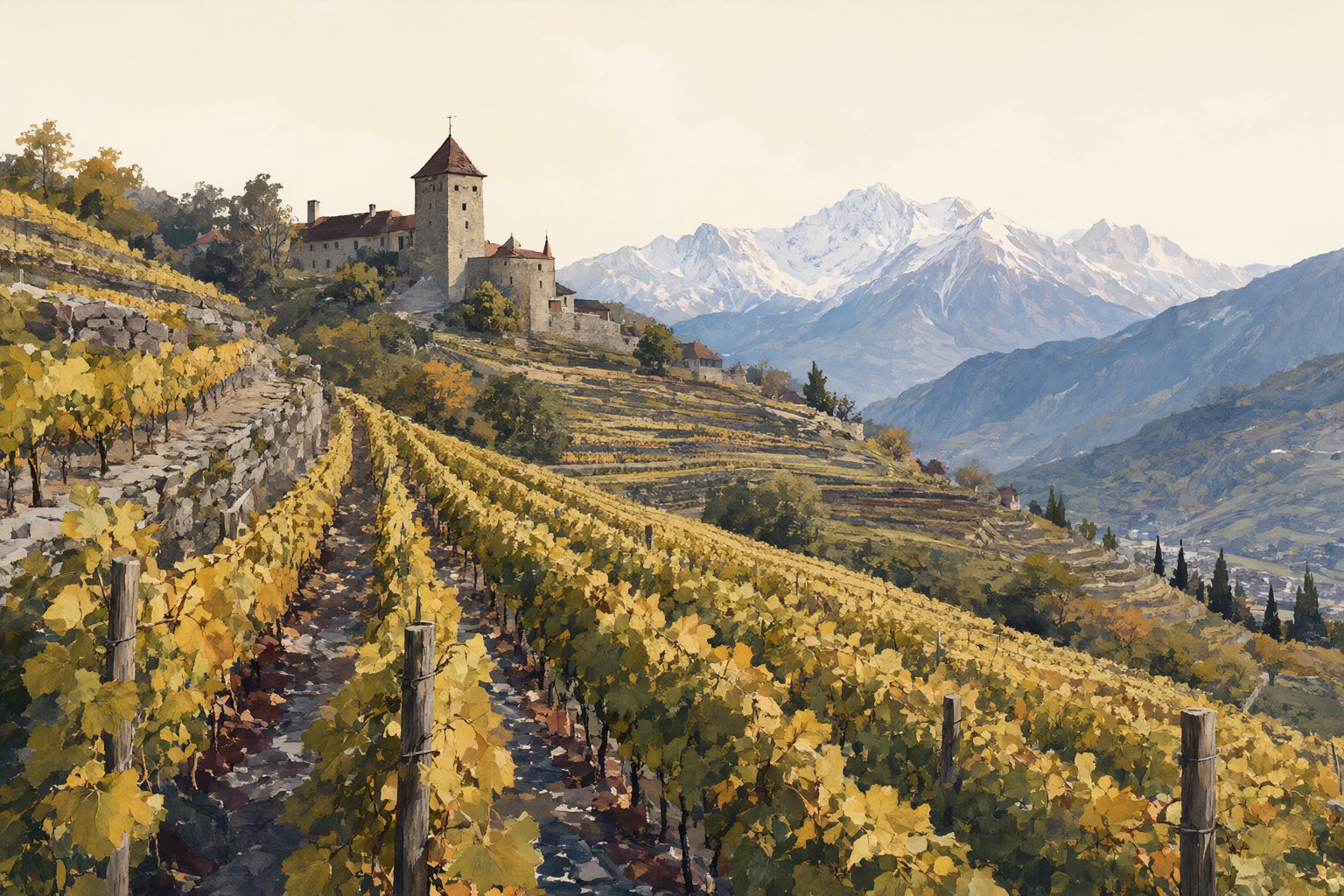
Here, you don’t look at a vineyard, you climb it. In the Aosta Valley the grower often works leaning into the slope, the hillside reaching almost to face height, with a castle and a ridge of snow overhead that have no intention of being noticed on his account. It is Italy’s smallest wine region, and for that very reason one of its most stubborn: it produces little, it costs effort, and it resembles nothing else.
One DOC for an entire valley
Almost everywhere in Italy, appellations multiply like mushrooms. Here the opposite holds: a single regional DOC, Valle d’Aosta (or Vallée d’Aoste), serving as an umbrella for everything. Under the umbrella sit seven subzones, named after villages or slopes: Morgex et La Salle, Enfer d’Arvier, Torrette, Nus, Chambave, Arnad-Montjovet and Donnas. Alongside them are the varietal versions, wines that carry the name of the grape on the label: Petite Arvine, Fumin, Cornalin, Petit Rouge and others besides.
The logic is that of a region too small to afford liturgy. To be honest, the sources I consulted do not agree on when the DOC was born. Some give 1971, others 1986, the year in which the earlier denominations are said to have been merged. Better not to fix a date and to remember the essential point: today the valley speaks with one voice, with production figures that remain microscopic next to the great names of the north-west.
The white that climbs into the clouds
If one Aosta wine makes outsiders raise their eyebrows, it is Blanc de Morgex et de La Salle, made from Prié Blanc. The vineyards lie at the foot of Mont Blanc, at an altitude that, according to the sources, reaches up to about 1,200 metres above sea level, which is why they are presented as among the highest in Europe. The exact figure varies from one source to another, so the superlative should be taken with due caution, but the substance stands: here the vine survives where elsewhere only meadows and obstinacy are cultivated.
Prié Blanc is a local variety that withstands the cold and ripens early. At these heights the climate is harsh, the summer short, and the swings between day and night temperatures severe. The vines are kept low, traditionally on a low pergola, close to a soil that gives back at night a little of the heat it has stored. It is also said that the cold kept phylloxera at bay: a widespread and plausible story, but one worth telling with the caution that stories this good deserve.
In the glass, expect a tense, fresh drink, with crisp acidity and a mineral, floral profile that tastes of thin air. It is a white that does not try to please everyone, and is right not to.
The reds: light only in appearance
Anyone arriving in the Aosta Valley expecting slender, slightly timid reds will do well to think again, and quickly.
Petit Rouge. The most important red grape of the valley, the backbone of many of the region’s wines and in particular of the Torrette area. It gives ruby-coloured, fragrant wines with crunchy fruit and medium structure.
Fumin. The strong character of the family. It ripens late, and is darker and more austere than the others, with a tannin that asks for time. It was once regarded as almost a variety to forget; today it is looked on with respect by those seeking mountain reds with some backbone.
Cornalin. A rare grape, deep in colour and surprisingly structured for these latitudes, with spicy notes and a woodland undertone. It should not be confused with other grapes of similar name grown in neighbouring areas.
Varietal wines carrying a grape name on the label must contain a minimum percentage of that grape: according to the sources consulted, at least 85% for Petite Arvine, Fumin, Cornalin and Petit Rouge. Blanc de Morgex, by contrast, gets straight to the point: it is 100% Prié Blanc.
Petite Arvine, the white you don’t expect
Among the whites, alongside Prié Blanc, Petite Arvine deserves a mention of its own. In the Aosta Valley it has made a name as a richer, more savoury white, with lively freshness and a saline side that makes it a table wine. It suits mountain cooking, alpine-pasture cheeses, dishes with butter and cream, the home flavours the valley has always known.
Why we should care
One could object that heroic viticulture is a luxury, and in some respects it is: terraces to maintain, dry-stone walls to repair, manual labour, minimal yields. But this very effort keeps alive a landscape and a diversity of grapes that elsewhere would have vanished under the weight of convenience.
My opinion is simple. The Aosta Valley is not a region to collect in order to feel original, but one to drink with curiosity, perhaps in a small village cellar. It does not need to become fashionable: it needs only not to be forgotten, and to hold tight to its eccentric grapes, its impossible slopes and the air of someone who knows they are right.
❦