Cirò and Gaglioppo, Calabria’s wine with an ancient soul
From the myth of Krimisa to the young growers who changed course: Cirò, Gaglioppo and a Calabrian wine scene that has stopped apologising.
If we had to pick the wine with the longest pedigree in Italy, the serious candidates would be few. Cirò, though, has an unfair advantage: it has a legend. The story goes that victors at the ancient Olympic Games were rewarded with Krimisa, the wine of the hills above Calabria’s Ionian coast, the shore the Greeks called Magna Grecia. Let us be honest from the start: this is a tradition, not a documented fact. Nobody has found the label. But a legend that has survived for centuries says something, if not about the wine, then at least about how much this land cares for its own history.
Even the name tastes of myth: tradition has it that Krimisa was a Greek settlement tied to the hero Philoctetes, and that the temple of Apollo Aleus, on the headland of Punta Alice, was where the first wine was offered. Plenty of people repeat these tales, with more enthusiasm than proof. Take them for what they are: an elegant way of saying that vines have been grown here for a very, very long time.
A coast, a grape
Cirò is born on the Ionian side of the province of Crotone, between the sea and the first hills. The denomination covers four communes: Cirò, Cirò Marina, Melissa and Crucoli. Only vineyards in Cirò and Cirò Marina may use the word Classico, which here marks the historic heart of the zone rather than a vague guarantee of quality.
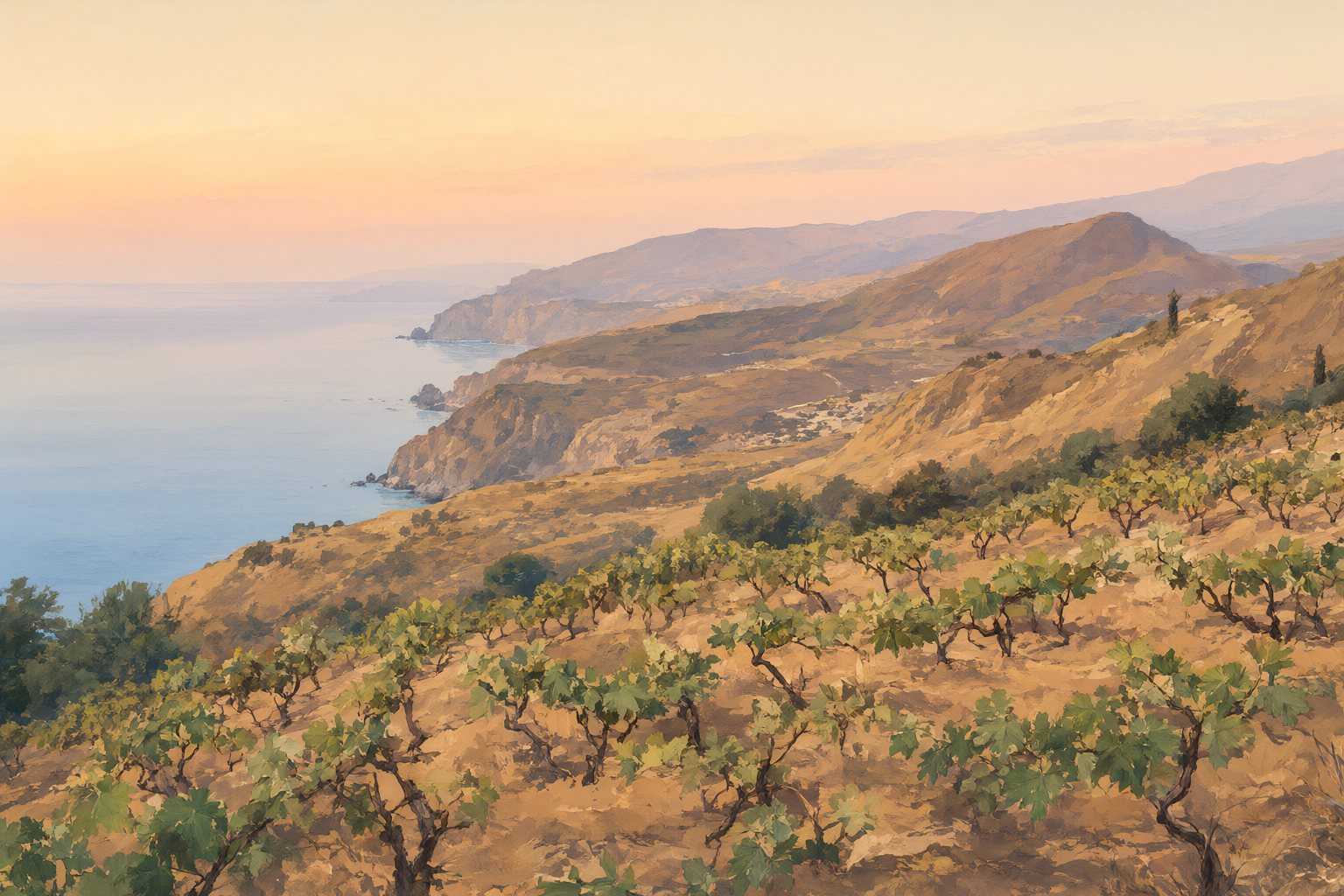
The climate is Mediterranean with no discounts: hot, dry summers, rain concentrated in autumn and winter, a sea breeze to cool the nights. Soils are mostly clay and limestone, with outcrops of sand. Here the vineyard has learned to do without almost everything, and the landscape has more to do with sobriety than with the postcard.
Gaglioppo, a grape to be understood
Gaglioppo is the protagonist, and it is not an accommodating variety. The regulations call for at least 80% Gaglioppo in both the red and the rosato, with a maximum of 20% of other authorised grapes. It gives wines of modest depth of colour, often paler than you would expect from a southern red, yet with firm tannins and an acidity that surprises anyone who thinks of Calabria as merely hot and sunny.
For years this character was treated as a flaw. The market wanted dark, round, easy reds, and Gaglioppo was softened, corrected and often worked with too much oak. The result was a wine without edges and, sadly, without identity. The grape is not to blame: it needs a light hand and patience, and for a while we had neither.
The “Cirò Boys” and the turning point
Then something changed. A group of young producers, dubbed the “Cirò Boys” by the press (the label is journalistic, not an official brand), decided to go back to Gaglioppo without disguises. Media attention clusters around 2019, the year the group also launched a micro-vinification project to understand the differences between sub-zones within the denomination.
Their choices are fairly consistent: organic or at least low-intervention viticulture, fewer corrections in the cellar, no chasing of international varieties. An association of producers, Cirò Revolution, has put in writing rules stricter than those of the denomination: 100% Gaglioppo and no barriques in the ageing. It counted eleven wineries in 2024. Not every grower in the area thinks the same way, and that is as it should be: a healthy denomination is also a place where people argue.
Rosso and rosato, two faces of one grape
The red is the flagship. The regulations provide for Classico and Superiore versions: the latter requires a higher minimum alcohol, at least 13.5% vol, while the Riserva has a minimum of two years’ ageing. But it would be a shame to stop there.
Gaglioppo rosato is a small discovery for anyone who overlooks it. The colour is delicate, but the structure is not that of an absent-minded aperitif rosé: it has tannin, it has tension, and it holds its own at table with dishes that elsewhere would call for a red. With oily fish, with the spicy preparations Calabrian cooking never spares, it works better than many whites.
There is also a Cirò bianco, made from at least 80% Greco bianco, but that is another chapter.
Why it matters
Cirò is not the perfect wine, and thank goodness. It is a red that demands attention, that can seem prickly when young and composes itself with time. It tells the story of a region that for decades exported grapes and imported inferiority complexes, and that has now stopped doing so.
My opinion, for what it is worth: Calabrian wine does not need to become the new Tuscany, nor to look modern at all costs. It only needs to stay faithful to a difficult grape and to a coast that smells of salt and sun. Whether the legend of Krimisa is true or not matters less, in the end. What matters is that today, for once, the wine has stopped chasing its fame and begun to deserve it.
❦