Italy’s great sweet wines, a map from the Alps to the islands
Dried grapes, noble rot, late harvest and fortified wines: a guide to Italian sweet wines from north to south, from Recioto to Moscato di Noto.
Italy has more sweet wines than it drinks. It is a paradox that has lasted for decades, a treasure kept in attics, cellars and islands and served, at best, in a small glass next to the panettone. Yet behind every bottle lies a precise technical choice, almost always a laborious one, to stop the sugar before it becomes alcohol or to concentrate it to excess. So it is worth looking at them not by region but by method, because it is the method that explains the glass.
Drying the grapes
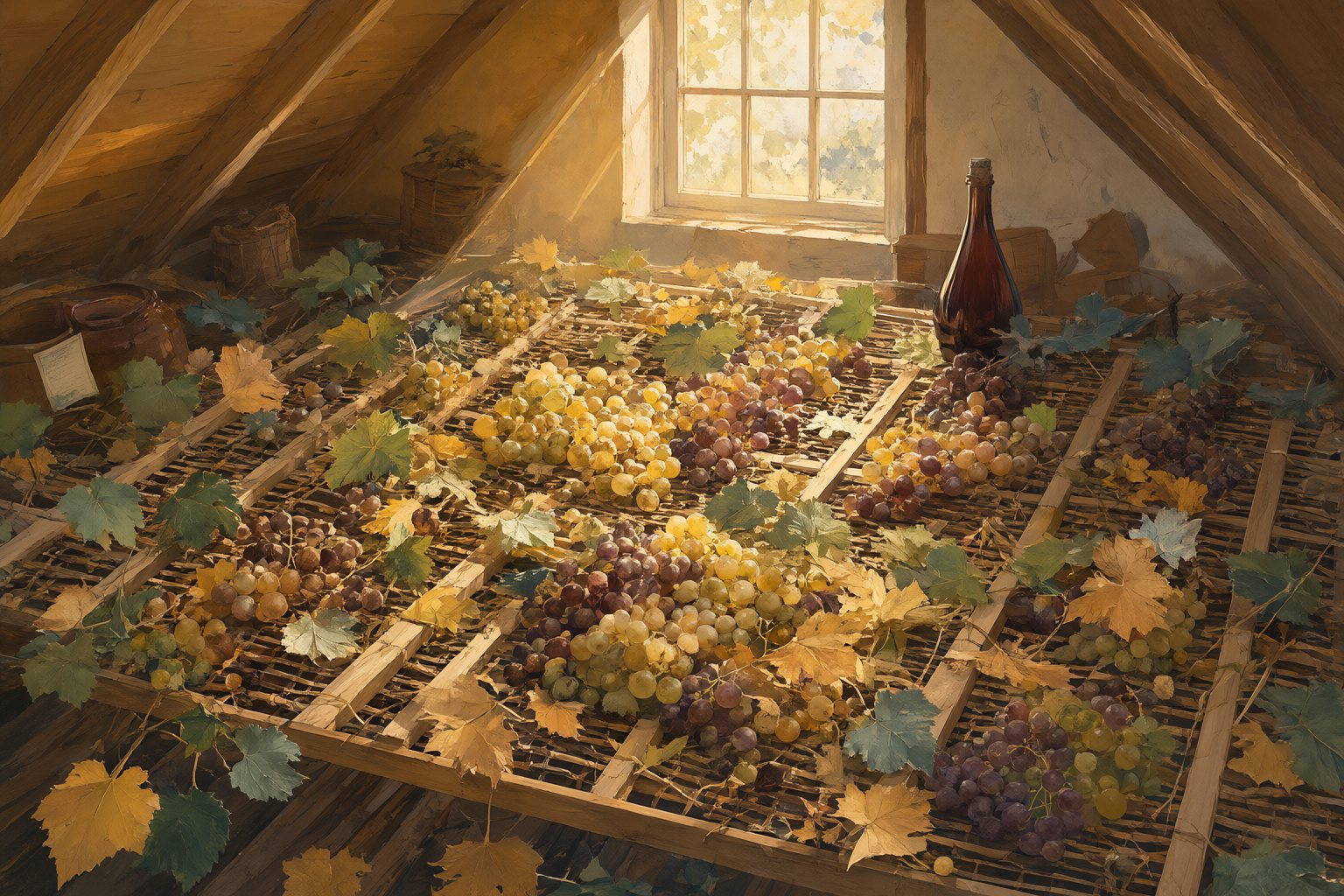
The Italian technique par excellence is appassimento: you harvest, leave the grapes to lose water for weeks or months, and press them when the berries have become little caskets of sugar and acidity. The supports change, racks, crates, cane mats, wires strung between the beams, but the principle stays the same.
In the Verona area, Recioto di Soave is born from Garganega left to rest on the arele, the traditional drying racks. The name, according to the most frequently cited etymology, comes from recia, dialect for ear, meaning the upper parts of the bunch, the most exposed to the sun and the ripest. It was the Veneto’s first DOCG, in 1998, a recognition that says a great deal about the esteem in which sweet wines were once held.
A little further north, at Breganze, Torcolato does the same thing with Vespaiola, a white grape with good acidity. The name describes the gesture: the bunches are braided and hung from ropes under the roofs, twisted, torcolati precisely, to dry through the winter. The result has an acid backbone that saves the sweetness from cloying, and this is perhaps the quality that separates a great passito from a syrup.
In Friuli things get more complicated. Picolit is a capricious variety, prone to acinellatura, an incomplete fertilisation that leaves just a few scattered berries on the bunch. Naturally tiny yields, to which drying is often added. In the eighteenth century it was a wine for the courts of Europe; today it has been a DOCG since 2006 and remains more talked about than drunk. A few kilometres away, on the hills of Nimis, Ramandolo, a DOCG since 2001, uses Verduzzo Friulano, a grape whose skins are rich in tannins. What emerges is a sweet wine with a certain roughness, and that is a virtue.
Heading south, appassimento runs the length of the peninsula. There is Sciacchetrà from the Cinque Terre, from grapes spread out on terraces that look like staircases, Caluso Passito from Erbaluce in the Canavese, and the tiny Moscato di Scanzo near Bergamo, red and aromatic. In Umbria, Sagrantino di Montefalco reminds everyone that passito was its original form, before the dry version, rough and tannic, took centre stage. Sagrantino passito is a sweet wine with the tannin of a serious red, a rare combination and not for everyone.
Further south you reach the islands, where the sun does much of the work. On Salina and the other Aeolian islands, Malvasia delle Lipari is made from grapes laid out in the sun on cane mats, and it has a scent of dried apricot and Mediterranean scrub that few wines in the world can imitate. Pantelleria, with its Zibibbo dried in the wind, would deserve a chapter to itself, and indeed it has one of its own on these pages. The same goes for Tuscan Vin Santo, which follows its own logic of small caratelli casks and years of patience.
Leaving it to the mould
Noble rot is Botrytis cinerea when it behaves itself. It needs misty mornings and dry afternoons: the fungus pierces the skin, water evaporates, sugars and acids concentrate, and notes of honey, saffron and candied fruit appear in the wine. It is the path of Sauternes and Tokaji, and in Italy it is more an exception than a widespread tradition.
The best-known case is Orvieto, where the mists rising from the rivers below the crag create favourable conditions in some vintages. Here sweet whites are made from botrytised grapes, in minimal quantities, and production depends entirely on the autumn weather. The rot does not come every year, and when it does it does not strike evenly, so the harvest is carried out in several passes. That is one of the reasons these wines cost what they cost and remain rare.
A close relative is late harvest, which simply means leaving the grapes on the vine beyond normal ripeness. In Alto Adige it is practised above all with aromatic varieties such as Gewürztraminer, and in several areas of the north the term vendemmia tardiva appears on the label. The result is generally less concentrated than a true passito, fresher and easier to pair.
Stopping in time
Then there is Moscato d’Asti, of all these the simplest to explain and the hardest to make well. The grapes are not dried: ripe Moscato Bianco is harvested and fermentation is stopped when the alcohol is still around five degrees, leaving much of the grape’s sugar in the wine along with a light fizz. It is a wine that lives on freshness and aroma, sage, peach, white flowers, and should be drunk young. It is often confused with Asti spumante, which shares the grape and the designation of origin but is a different wine, more sparkling and more alcoholic.
Moscato d’Asti is also the only wine on this list that can make sense in the middle of the afternoon, which is not a flaw.
When the alcohol goes in
The last family is the fortified wines. Here fermentation is interrupted by adding alcohol, which stops the yeasts and preserves the residual sugar. It is the logic of Port, and in Italy the obligatory reference is Marsala, whose commercial history and repertoire of styles are so broad as to deserve an article of their own.
But there are other, less told fortified wines. Malvasia delle Lipari also provides for a liquoroso, fortified, version, alongside the natural and the passito. Around Siracusa, Moscato di Noto, one of the historic wines of south-eastern Sicily, comes in various versions, including a liquoroso, and it is an example of how the same variety can give wildly different wines depending on the method. As for the versions currently provided for by the production rules of these two appellations, it is worth checking case by case, because the rules have been revised over time.
Why it is worth persisting
People who talk about wine in Italy tend to treat sweet wines as a footnote, stuff for the end of the meal, for gifts, for grandmothers. It is an error of perspective. These wines tell the story of the landscape better than many celebrated reds: the mists of Orvieto, the wind of Salina, the attics of Breganze where the grapes spend the winter hanging like laundry. They are also, almost always, the most expensive wines to produce for every litre that reaches the bottle.
The advice, if it can be called that, is to stop waiting for dessert. A Recioto di Soave stands up beautifully to a blue cheese, a Ramandolo goes well with foie gras, a Moscato d’Asti works miracles with fruit. And a good passito, drunk on its own, at the end of the evening, with nothing alongside, remains one of the most civilised ways to close a day.
❦