What wine goes with chocolate, the most hostile pairing at the table
Dark, milk or white? Why chocolate throws almost every wine into crisis, and which styles, from Port and Banyuls to Barolo Chinato, can withstand the impact.
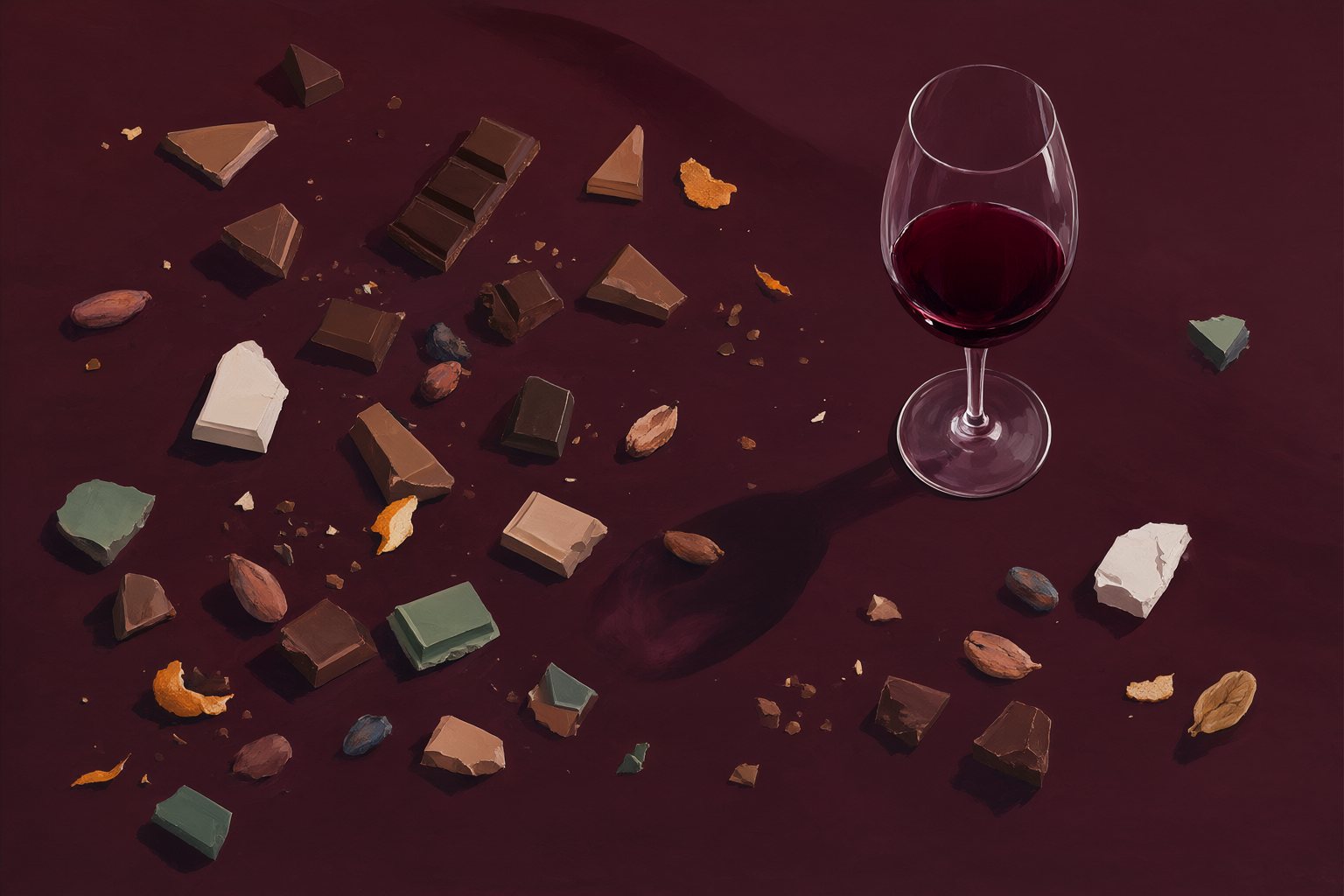
Chocolate is the dinner guest no sommelier wants at their table. It arrives at the end, when everyone is relaxed, sits down beside the glass and in two seconds makes it seem sour, thin, bitter. The important red that starred at dinner turns into a glass of squeezed timber. The dry sparkling wine poured for a toast over the cake becomes something vaguely metallic. This is not bad luck, nor a matter of taste: it is the chemistry of the palate, and it pays to understand it before opening the wrong bottle.
Why chocolate ruins almost everything
The problem has three sides. The first is sugar. The most solid rule of pairing wine with dessert says the wine must be at least as sweet as the dish, otherwise, by contrast, it will seem dry to the point of harshness. A dark chocolate with little sugar leaves some leeway; a milk chocolate bar, much less.
The second is bitterness. Cocoa is rich in polyphenols and brings with it a bitter, astringent note that adds to the wine’s tannins instead of offsetting them. Tannin plus tannin makes for roughness, not complexity. Anyone who pairs a young, dry red with 75% dark chocolate is effectively asking the palate to chew the same bark twice.
The third is fat. Cocoa butter melts in the mouth at around body temperature and coats the tongue with a soft, lingering film. A light wine slides over it without leaving a trace. You need body, you need a certain alcoholic structure capable of cleansing, and you need enough aromatic intensity not to disappear.
Taken together, these three factors explain why the solutions that really work almost all belong to one precise family: sweet wines, often fortified, often oxidative, with above-average alcohol and aromas that are already dark on their own account. Dried fruit, coffee, spice, prune. Wines that already resemble chocolate a little.
Dark chocolate: the school of sweet red
With dark chocolate the direction is clear: red, sweet, structured. Port is the classic answer, and for good reason. It is born in the Douro valley, in northern Portugal, with fermentation stopped by the addition of grape spirit: the yeasts halt, the grape sugar remains, the alcohol rises. A Ruby or a Late Bottled Vintage, young and laden with black fruit, has the sweetness and flesh to stand beside a dark chocolate of around 60–70%. A younger Vintage adds tannin, and with very bitter cocoa you risk the overlapping effect described above.
Banyuls is the lesser-known French cousin and, in this writer’s opinion, often the more interesting one. We are in Roussillon, close to the Spanish border, on schist terraces plunging into the Mediterranean. It is a vin doux naturel: here too alcohol is added to stop fermentation, but the base is Grenache Noir, at least half of the blend, rising to at least three quarters for the Grand Cru designation. The AOC dates back to 1936. Many Banyuls are deliberately aged oxidatively, sometimes in containers left out in the sun, and develop notes of cocoa, roasted coffee and cherries in spirit. With dark chocolate it is not a pairing, it is a conversation between relatives.
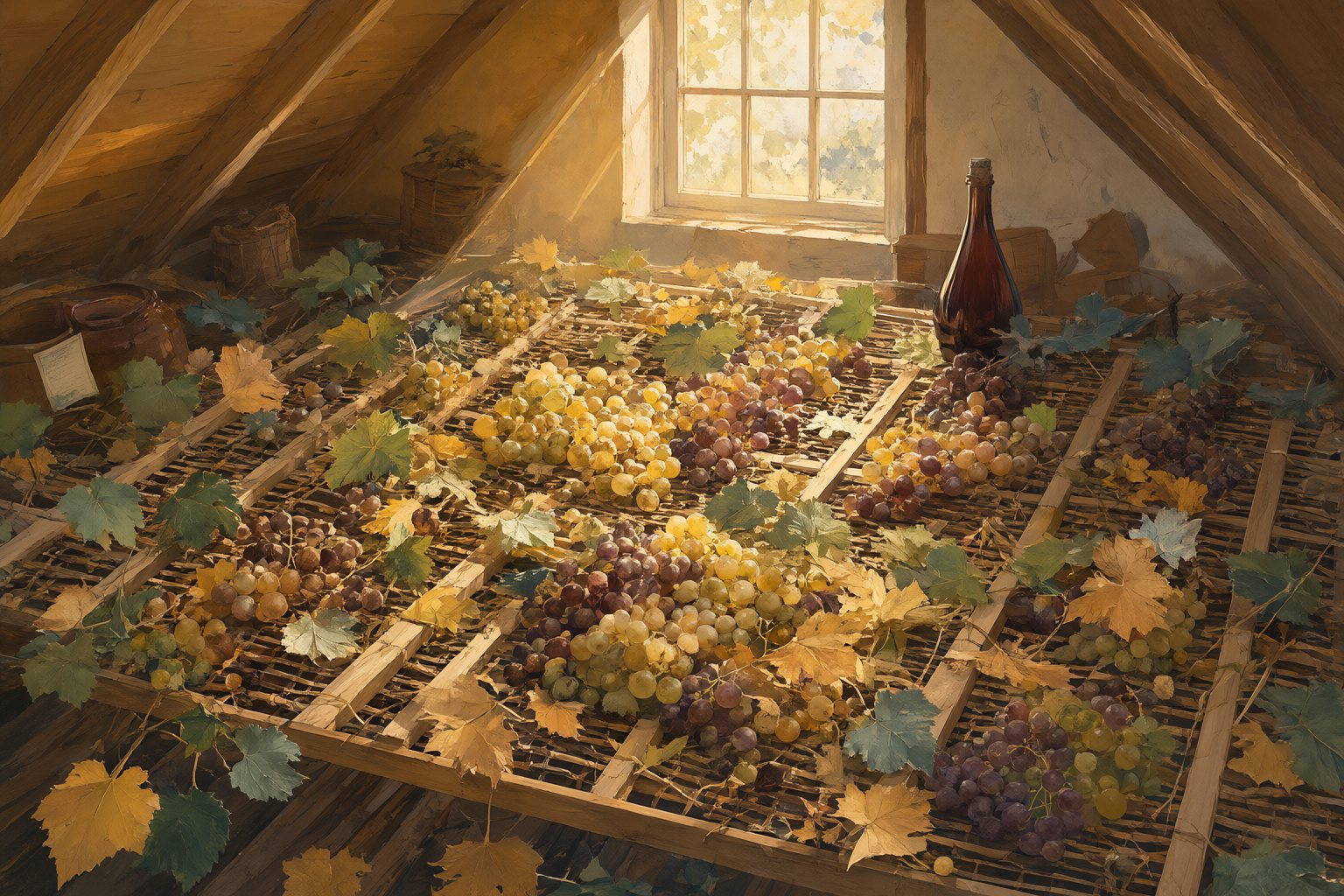
In Italy the answer is called Recioto della Valpolicella, a DOCG since 2010, the sweet and older sibling of Amarone. Corvina, Corvinone and Rondinella are left to dry for months, then vinified leaving a substantial amount of residual sugar. The result has ripe cherry, marasca sour cherry and a backbone of acidity that holds everything else up. It is probably the most elegant pairing for a dark chocolate that is not too extreme, or for a chocolate cake that is light on sugar.
Barolo Chinato, the Piedmontese exception
Then there is the case that breaks all categories. Barolo Chinato was born in Piedmont between the late nineteenth and early twentieth century as an aromatised wine: Barolo in which an infusion of cinchona bark (china) and other spices is left to macerate, then sweetened and brought to a higher strength. The sources disagree about who invented it, and several families and pharmacists in the Langhe and around Asti lay claim to it; best to leave the question open.
What is certain is that Chinato works with dark chocolate better than almost anything else, for an almost paradoxical reason: instead of fighting the bitterness, it doubles and organises it. Cinchona has a clean, balsamic bitterness that leans on that of the cocoa; the wine’s sweetness acts as a bridge; the spices add depth. With dark chocolate above 80%, where Port and Recioto begin to struggle, Chinato is often the only one to emerge with its head held high. Serve it just cool, not cold.
Milk and white: change families
Milk chocolate is sweeter, fattier, less bitter. Here young red shows its limits: too much fresh fruit, too much tannin for something so soft. Better to move towards the oxidative and the caramelised. A Tawny, the Port aged for a long time in cask, loses its purple colour and gains walnut, dried fig, toffee: with milk chocolate they understand each other instantly. The same goes for a Banyuls with many years on its shoulders.
Marsala deserves rehabilitation. For too long it has been relegated to the kitchen, but the Sicilian designation, whose roots lie in English trade at the end of the eighteenth century, includes sweet wines of remarkable complexity. An ambra or rubino Marsala in its sweet versions, with several years of ageing, brings toasted almond, date and candied orange peel. With milk chocolate, especially with hazelnuts, it is a surprisingly natural pairing.
White chocolate, strictly speaking, contains only the butter of the cocoa: no cocoa mass, and therefore no bitterness. It is sugar, milk and fat. This changes everything and, curiously, simplifies matters. Here reds vanish from the table and white passiti, or dried-grape sweet wines, come back into play: a Passito di Pantelleria from Zibibbo, with dried apricot and orange blossom, or a Moscato passito, has the acidity and perfume needed to cut through the flat sweetness of white chocolate. What matters is that the wine has nerve; a tired passito on white chocolate produces nothing but an impression of syrup.
A few rules worth breaking
Two practical warnings. First: the higher the cocoa percentage, the more character of its own the wine needs, and the less its absolute sweetness matters. Second: chocolate on its own and a chocolate dessert are two different problems. A mousse with cream, a cake with flour and butter, a tart with fruit change the weight of the dish, and often open the door to lighter wines than those that would stand up to the bar alone.
Vinofilo’s position is this: if we had to keep a single bottle at home for chocolate, we would choose Barolo Chinato for dark and a Banyuls for everything else. But the most useful truth is another one. Chocolate should not be paired with the wine you were already drinking. It should be served with a wine chosen specifically for it, or left on its own, with a glass of water. Wasting a great dry red on a bitter chocolate bar is not daring: it is an expensive way of tasting neither.
❦