What wine with bollito and brasato? The right red for winter meat
Piedmontese and Lombard bollito with its sauces, brasato al Barolo, cotechino and lentils: which wine to put in the pot and which to pour in the glass.
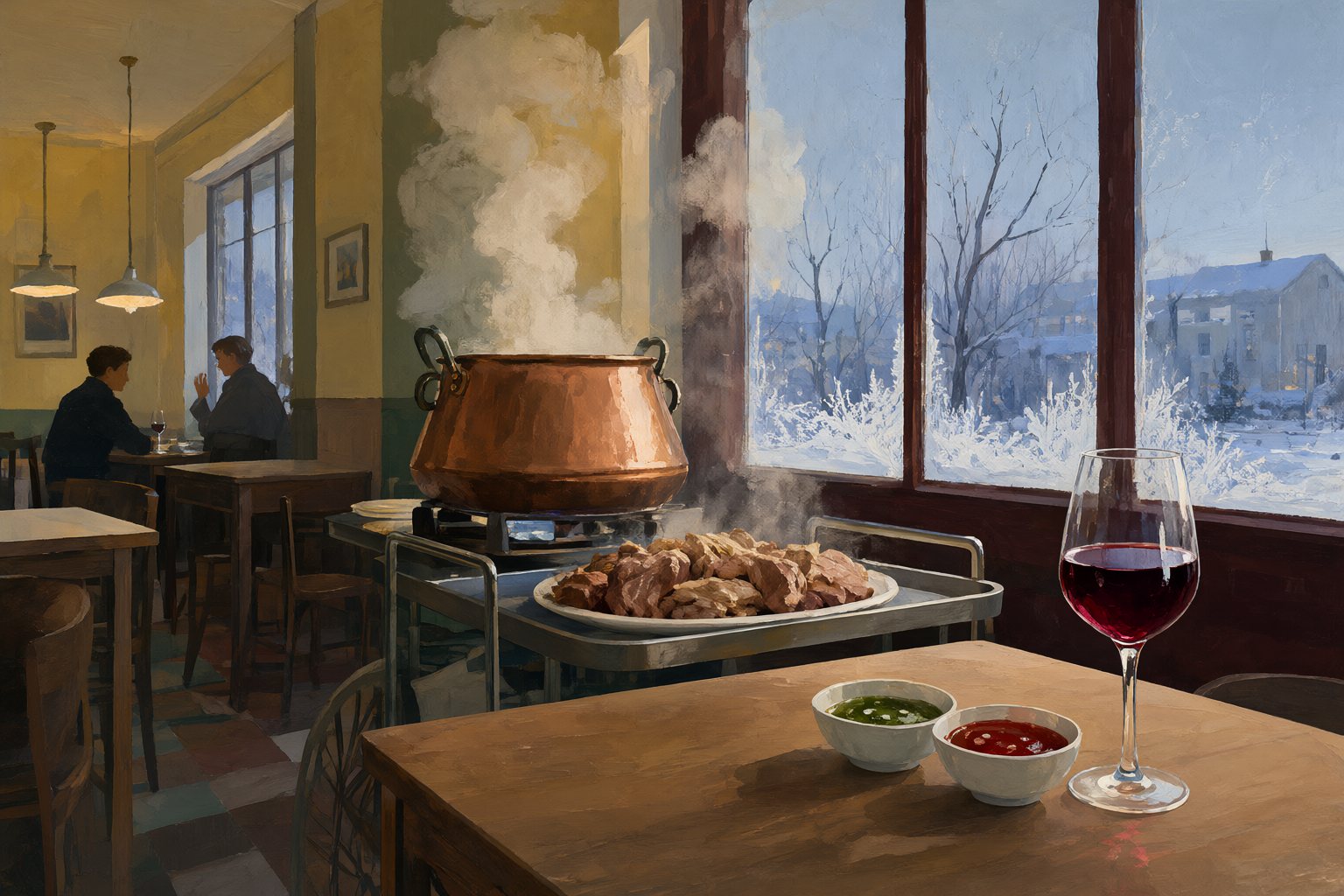
Bollito, Italy’s mixed boiled meats, is the most honest dish in Italian cooking: meat, water, salt, time. There is no crust to cover a mediocre cut, no sauce to hide a botched cooking. And that is exactly why the wine beside it so often ends up badly chosen. People think “red meat, so a serious red”, open the most solemn bottle in the cellar and find themselves with a tannin that mangles a piece of the most delicate tongue. Brasato, the braise, is its opposite sibling: concentrated, dark, glossy with reduction. Same season, same tables, almost contrary demands.
Bollito is not a meat, it’s an orchestra
The Piedmontese tradition loves round numbers and speaks of seven cuts, seven trimmings and seven sauces, even if the count varies from one trattoria to the next. What matters is the variety: there’s lean, fibrous shin, gelatinous calf’s head, tongue, oxtail, hen, and the cotechino arriving with its spiced unctuousness. Every mouthful asks something different of the glass, and no wine can satisfy them all perfectly.
That is why the most sensible route is a medium-bodied red, with lively acidity and a tannin that isn’t too angular. In Piedmont the answers are close to home: a Barbera, whose freshness mops up the fatty parts like a sponge; a Dolcetto, soft and fruity, which doesn’t trouble the lean meat; a young Langhe Nebbiolo, which brings some perfume without the weight of long ageing. Lovers of oddities can try Grignolino, pale, almost rosé in colour and surprisingly tannic, or a Freisa, which in some versions even has a hint of fizz. These are wines once considered fit only for the osteria, and they give bollito back exactly the everyday dignity it deserves.
Should Barolo be ruled out, then? Not entirely. A mature bottle, its tannin already softened by the years, can go well with the richer cuts such as oxtail or cappello del prete, the shoulder cut. But on a slice of tongue or hen it will always be too noisy a guest.
The sauces change everything
Bollito’s real problem is not the meat, it’s the sauces. Bagnet verd, with parsley, anchovies, garlic and vinegar, brings acidity and savouriness: it calls for a fresh wine, and here Barbera wins hands down. Bagnet ross, based on tomato and peppers, is sweeter and rounder, and gets on well with a Dolcetto. Then there is cognà, the Piedmontese sauce made from cooked grape must with autumn fruit: it is sweet, dense, almost a jam, and against it any dry red tends to seem more bitter and harder than it is.
In Lombardy the star is mostarda, candied fruit flavoured with mustard essence, the Cremona version first among them. It is the trickiest point of the whole meal: sweetness and heat together, a slap and a caress. Tannic still wines come off badly. A red with a bit of fruit works better and, if possible, a streak of fizz: Bonarda dell’Oltrepò Pavese, in its vivace, lightly sparkling, versions, has exactly this profile. Those who prefer a still wine can look to Valtellina, where Nebbiolo is called Chiavennasca and grows on terraces: a Rosso di Valtellina has the mountain freshness needed not to succumb to the mustard.
A simple rule: the sweeter the sauce, the more fruit and the less tannin the wine should have. The more acidic the sauce, the fresher the wine must be itself, or it will seem flat.
Brasato al Barolo: the wine works twice
With brasato the question changes nature, because the wine goes into the pot first. In the classic Piedmontese recipe the beef marinates at length in wine with vegetables and spices, then cooks slowly for hours until tender. The name says Barolo, and Barolo is a wine that by law must age for at least 38 months, 18 of them in wood: using a whole bottle for the marinade is a gesture many cooks consider a pointless luxury. In many kitchens a simpler Nebbiolo goes in the pot and the Barolo is kept for the glass. It is a reasonable compromise, provided the cooking wine is still good: cooking concentrates everything, flaws included. A tired, oxidised or vinegary wine in the pot becomes a tired, oxidised or vinegary sauce on the plate.
In the glass, here at least, Barolo is at home. Brasato has fat, gelatine, a deep, reduced sauce: everything needed to tame Nebbiolo’s tannin and let its aromas of rose, tar and spice emerge. The same goes for Barbaresco, perhaps a touch subtler, or for a Roero rosso. Those who want to leave Piedmont might think of a structured Sangiovese or an Aglianico, but the principle stays the same: brasato tolerates, indeed demands, a wine with structure and serious tannin.
A practical tip, more than a pairing one: serve the red at the right temperature, not that of the heated dining room. A Nebbiolo that is too warm turns alcoholic and loses precisely the finesse that justifies choosing it.
Cotechino and lentils, in passing
Since we are at the end of the year, a word on cotechino with lentils is obligatory. Here the logic is that of the production areas: cotechino, a rich boiled pork sausage, is fatty, spiced and enveloping, and calls for a wine that cuts through it. Lambrusco, dry and fizzy, has always been the Emilian answer, and it is hard to find a better one: bubbles and acidity rinse the palate with every mouthful, and the dark fruit converses with the spices. Alternatively, the usual lively Bonarda or a young Barbera do the same job with less froth.
Best avoided, on the other hand, are very tannic, very alcoholic reds: with cotechino they turn heavy and transform the New Year’s Eve dinner into a marathon. And if the spumante arrives at midnight, nobody will be offended if it also accompanies a few leftover slices of cotechino: a dry, fresh sparkler, after all, does the same job as Lambrusco, just with a different accent.
Our view
Bollito and brasato teach the same lesson from opposite sides. The first says that the right wine is not the most important but the most suitable: a simple Barbera, beside a bagnet verd, will give more joy than a great Barolo sacrificed on a slice of hen. The second reminds us that the wine in the pot is not a cast-off: it should be chosen with respect, even if it isn’t the noblest. If you must spend, better to do so on the glass for the brasato. For the bollito, a fresh red, a full carafe and the patience to wait for the trolley are all you need.
❦