What wine goes with lasagne, from Bolognese to Neapolitan Carnival lasagna
Bolognese, pesto, mushroom, vegetarian or the Neapolitan Carnival version: which wine to choose for every lasagna, from Sangiovese to Lambrusco and Barbera.
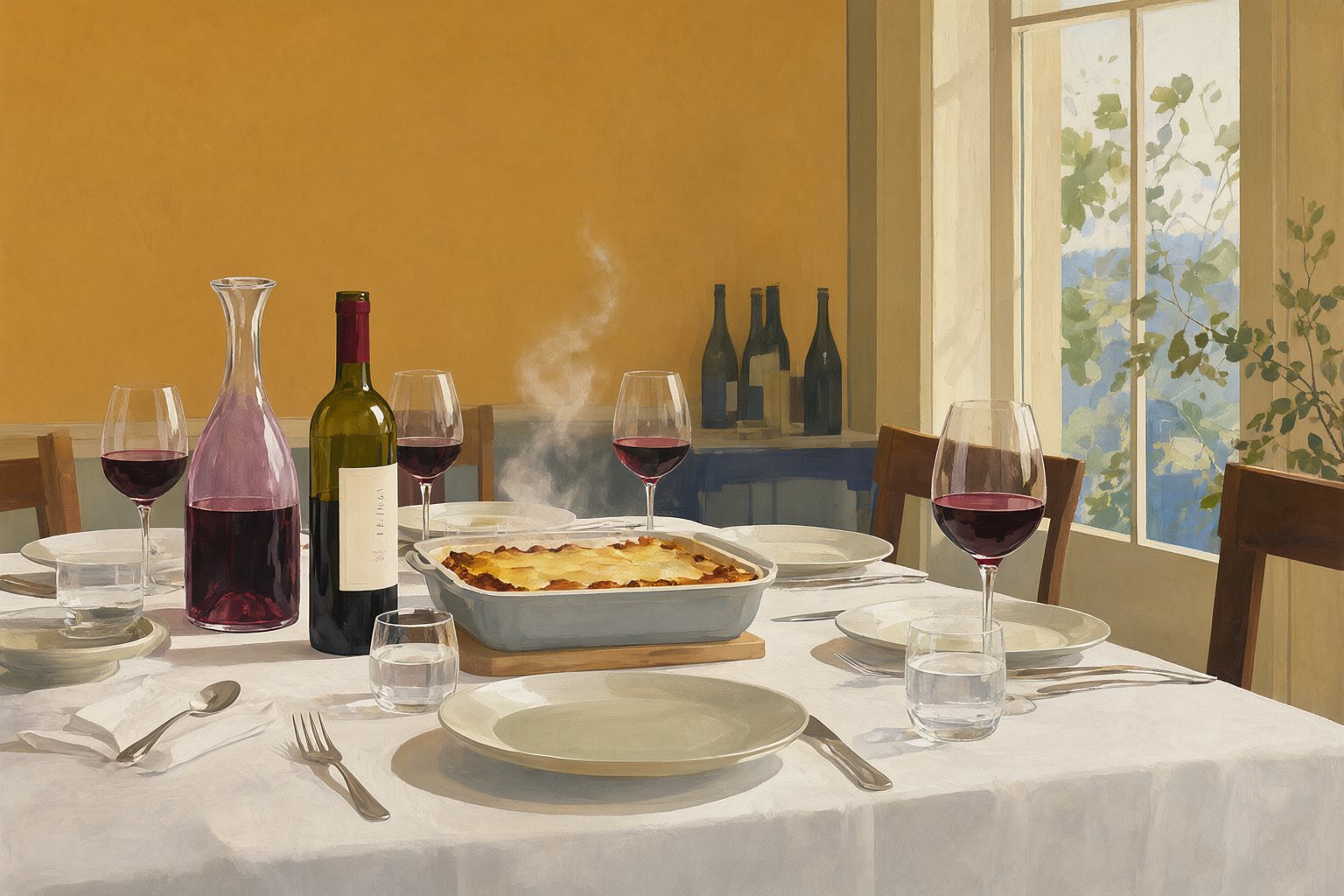
Lasagna is the dish that reaches the table when the argument has already started. It is Sunday, the baking dish sits in the middle, someone has brought the wrong bottle and nobody has the heart to say so. The trouble is that “lasagne” means nothing on its own: between the Bolognese version, with its green pasta sheets and béchamel, and the Neapolitan Carnival one, crammed with meatballs and ricotta, lies the same distance that separates a string quartet from a village brass band. The wine needs to know which concert it has been invited to.
Bolognese, or fat that calls for acidity
Let us start with the canonical version. The Bologna delegation of the Accademia Italiana della Cucina lodged its recipe with the Bologna Chamber of Commerce in July 2003: egg pasta with spinach, ragù, béchamel, Parmigiano Reggiano and butter. A rich, round dish, with an underlying sweetness that comes from the milk, the slow-cooked soffritto and the meat. Pair it with a massive, heavily oaked red and you get two heavyweights leaning on each other until neither can move.
What is needed here is a wine that cuts, not one that adds. The home answer is Sangiovese di Romagna, today Romagna Sangiovese: the single Romagna designation came into force with the 2011 vintage, absorbing the old regional DOCs, and requires at least 85% Sangiovese. It is a red of crunchy red fruit, with lively acidity and a tannin that, in the young versions, cuts through the fat without aggression. The Superiore and the versions bearing a subzone name offer more structure, useful if the ragù is especially dense, but the basic version has the merit of not taking itself too seriously, much like the dish itself after the second helping.
And then there is Lambrusco, which has an almost conjugal relationship with Bolognese lasagna. We told its story and described its different grapes in our article on Lambrusco, the “lesser” wine that never was; here it is enough to say that the bubbles and acidity do exactly the job required, cleansing the palate of béchamel with every sip. A Grasparossa, darker and more tannic, holds up better to the ragù; a Sorbara, almost rosé and razor-sharp, is the wittier choice, for those who want to lighten the meal rather than indulge it. Dry, never amabile, the off-dry style: sweetness in the glass on top of the sweetness on the plate quickly becomes tiring.
Pesto and mushrooms, two lasagne that change colour
Pesto lasagna, Ligurian by adoption and often enriched with potatoes and green beans, is another story. Basil, garlic, pine nuts, grated cheese: herbaceous and savoury notes dominate, and a tannic red turns bitter and metallic here. Better to stay in Liguria and pour a white, Vermentino or Pigato, which share the same Mediterranean note, an almost marine saltiness and a slight almondy streak that marries well with the pine nuts. If you want to leave the region, a young Verdicchio dei Castelli di Jesi does the same job with a little more body.
With mushrooms, on the other hand, the register turns autumnal and earthy. Porcini or button mushrooms with béchamel call for a medium-bodied red, more fragrant than powerful. Barbera is a natural candidate: little tannin, high acidity, dark fruit and, in Piedmont, a long habit of living alongside butter and cheese. If the lasagna also carries a grating of truffle, or the mushrooms are especially intense, you can step up to a young Nebbiolo, a Langhe Nebbiolo for instance, whose scents of forest floor and rose speak the same language. An Alto Adige Pinot Nero is the alternative for those who prefer a lighter touch and a finer texture.
Vegetarian lasagne, where the vegetables rule
Just about anything hides behind the label “vegetarian lasagne”: courgettes and aubergines, radicchio and scamorza, pumpkin and sage, artichokes. The rule is to look at the starring vegetable, not at the béchamel binding it all together.
With courgettes, aubergines and tomato, think as you would for a summer dish from the South: a structured rosé, a Cerasuolo d’Abruzzo or a Salento rosé from Negroamaro, has enough fruit and freshness to hold together the sweetness of the cooked vegetables and the acidity of the tomato. With bitter Treviso radicchio, a soft, low-tannin red is the wiser choice, because bitter on bitter becomes an exercise in endurance: a young Valpolicella or a Bardolino works well. With pumpkin and sage, sweet and buttery, whites with a little flesh come back into their own: a Soave, a Fiano, a dry Romagna Albana, which also has a faint tannic grip rare in a white and stands up to the texture of the dish.
Artichokes deserve a separate warning: they are wine’s historic enemy, because they tend to make whatever you are drinking seem sweet and flat. Here a fresh, savoury white with no oak limits the damage better than any red.
The Neapolitan Carnival lasagna, a banquet in a baking dish
Neapolitan lasagna is the dish of giovedì grasso and martedì grasso, the last feast days of Carnival, and it apologises to no one. Long-simmered Neapolitan ragù, ricotta, fried meatballs, sausage, hard-boiled eggs, fior di latte or provola: every layer is a course in itself. With all that fat and substance, a fresh white would be swept away at the first mouthful.
Campania has the answer at home; two answers, in fact. The first is Gragnano, the sparkling red of the Sorrento Peninsula, which plays the same role at the Neapolitan table that Lambrusco plays in Emilia: bubbles, fruit, acidity, and the ability to make a dish seem light when it is anything but. The second is a still red, and here the choice depends on your mood. Piedirosso, soft and spicy, accompanies without competing; Aglianico, with its serious tannin, stands up to the ragù and the sausage, but is best in its younger or less extracted versions, because a very structured, oak-aged Aglianico risks turning the Carnival lunch into an endurance test.
One baking dish, one bottle (or two)
If you really must choose a single wine for the table, it pays to aim for freshness rather than power. Lasagna, whatever kind it is, is already a complete and saturated dish: it needs a wine that cuts the fat and invites the next mouthful, not one that demands attention. That is why our conviction, a little against the grain, is that a dry sparkling red, Lambrusco in the North and Gragnano in the South, is more often the right choice than a great age-worthy red. Save the great red for the roast that comes afterwards, if anyone is still hungry. Usually nobody is.
❦