Ruchè, the red a village priest rescued from oblivion
Ruchè di Castagnole Monferrato, a DOCG since 2010: the story of don Giacomo Cauda, the seven communes of the zone and a profile of rose, violet and spice.
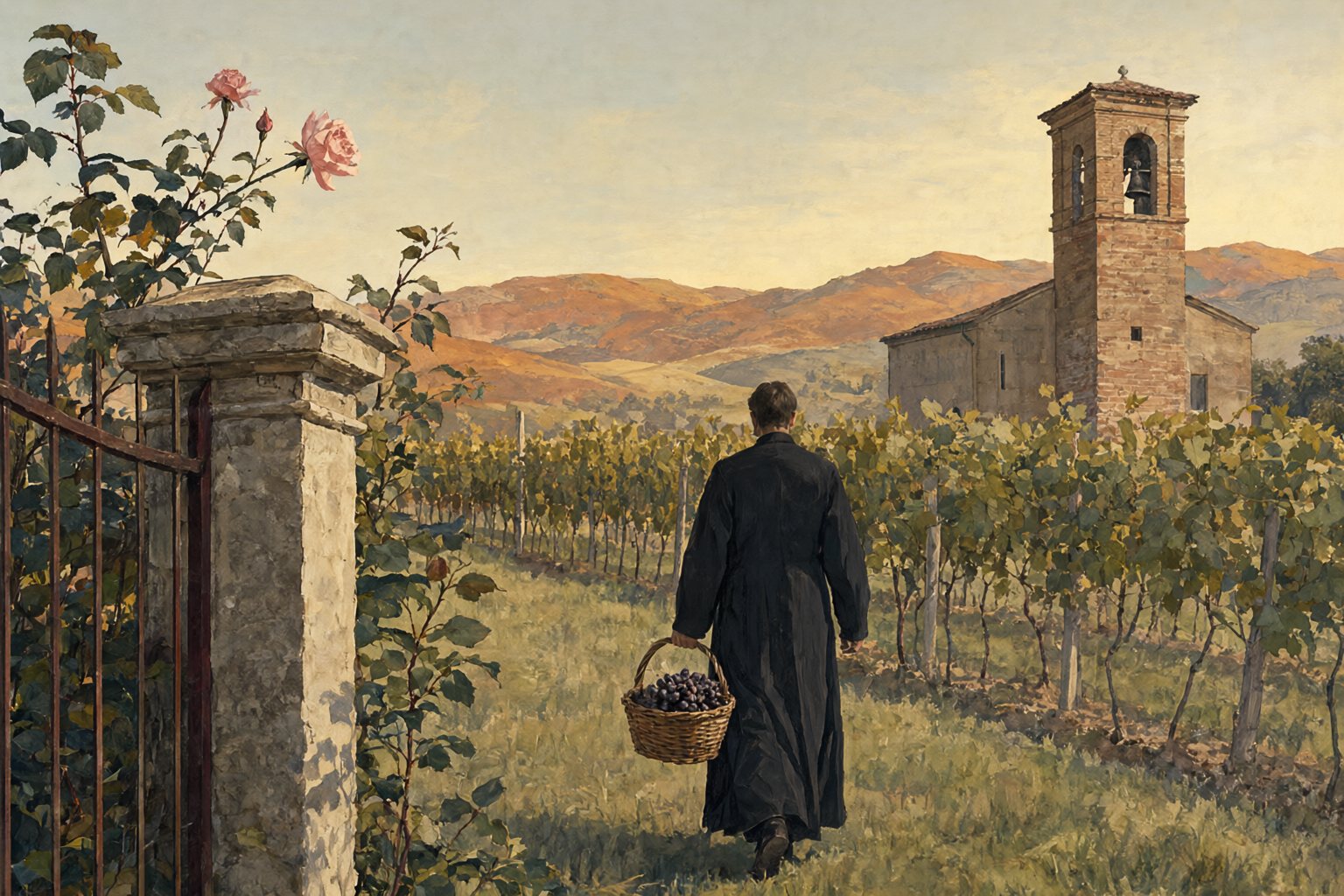
Some grape varieties are saved by a university, a consortium, a European grant. Ruchè was saved by a priest who had a vineyard to look after and, it seems, a soft spot for what grew in it. This is no tourist-board legend: the priest existed, his name was don Giacomo Cauda, and without him this Piedmontese red would in all likelihood be a footnote in the ampelography manuals today.
A priest and an abandoned vineyard
The most widely told version goes like this: in the 1960s don Cauda is parish priest at Castagnole Monferrato, in the Asti hills, and finds the parish vines neglected, planted with a local variety that the farmers were by then growing half-heartedly, if at all. Rather than rip it out, he tends it and vinifies it. The wine that results, called with disarming candour “the priest’s wine”, ends up helping to pay for work on the parish and its buildings.
A note of caution is in order here, because the sources do not agree on everything. One gives 1964 as the year of his arrival at Castagnole, others speak only of the 1960s, and still others place his efforts in the following decade. The official rulebook remembers him as the parish priest who, in the 1960s, helped define Ruchè as a quality dry wine made as a single variety. The broad picture holds: a priest, a parish vineyard, a nearly vanished grape. The exact dates are best left to local historians.
The beauty of the story lies in how ordinary it is. No winemaking revolution, no consultants: someone simply decided that this grape deserved to be treated as a proper wine rather than as filler.
From DOC to DOCG
After the priest comes the bureaucracy, which here does its job with dignity. Ruchè di Castagnole Monferrato obtained its DOC in 1987 and was promoted to DOCG in 2010. For an appellation that a few decades earlier risked having no vines at all, it is far from a given.
It is a tiny DOCG, and that is part of its charm. The production zone covers seven communes in the province of Asti: Castagnole Monferrato, Grana, Montemagno, Portacomaro, Refrancore, Scurzolengo and Viarigi. None of the seven has the media weight of Barolo or Montalcino. The production estimates in circulation put output at around one million bottles a year, a figure to be taken as an order of magnitude rather than an accounting entry. For an appellation built on a single grape, these are workshop numbers, not industrial ones.
What the rulebook says
Ruchè is the undisputed lead: the sources I consulted agree that this is a strongly single-variety wine, but they differ on the margin. Some speak of vinification as a pure varietal, others of a Ruchè share between 90 and 100%, with a maximum of 10% Barbera and/or Brachetto. On the exact threshold, I would check the text of the current rulebook before quoting it at a dinner party.
The other figures are firmer: a minimum alcohol of 12.5% and a maximum yield of 63 hectolitres per hectare. The prescribed colour is a ruby red with violet reflections, at times drifting towards orange; the nose is intense, persistent, lightly aromatic and fruity. A Riserva category exists too, but the sources I found are not consistent on its ageing requirements, so I do not report them.
Rose, violet and a little pepper
Ruchè is a red that defies categories. It has neither the severe geometry of Nebbiolo nor the round flesh of Barbera. What it has is an aromatic profile unusual for an Italian red: rose petals, violet, sweet spice, a hint of ripe red fruit. Terpenic compounds explain it, the same ones that lend character to aromatic varieties such as Moscato and Gewürztraminer, except that here they end up in a dry, structured red. One producer has compared its aromatic elegance to that of a white from Alto Adige: an effective image.
The paradox is on the palate. After so perfumed a nose, you expect something soft and faintly sweet; instead Ruchè has present tannin, body and a dryness that surprises anyone who let the perfume seduce them. It is a red for the real table: cured meats, agnolotti, aged cheeses, spiced dishes where a Barbera would be all too obvious.
It should be said that Ruchè does not forgive approximation in the cellar. A grape so rich in perfume tends to lose it if handled in a hurry or with too much oak, and those who know how to read it aim for freshness of fruit rather than power. Hence also its aptitude for being drunk relatively young, without ruling out that some more structured versions can hold up for a few years in bottle.
My verdict
Ruchè risks two opposite fates. The first is to remain a niche wine for enthusiasts, mentioned on wine lists with a touch of condescension. The second, more insidious, is to become a fashion: the aromatic red for aperitivo, served too warm and too quickly. Either would be a pity.
Its strength is precisely its contradiction: the perfume of a white, the structure of a red, the origin of a country parish. An appellation of seven communes that exists because a priest had the patience to look after a vineyard nobody wanted is, in my view, more interesting than a hundred appellations born at a drawing board. It deserves to be drunk with curiosity, and written about with honesty, even when the sources disagree.
❦