Pinot Nero in Italy, the challenge to Burgundy
From Alto Adige to the Oltrepò, Trentino and Friuli, why Pinot Nero is the hardest grape to tame and where Italy manages to pull it off.
Every Italian winery that plants Pinot Nero eventually gets the same question: “Yes, but how does it compare with Burgundy?” It is an unfair and unavoidable question, like asking a violinist whether they play like Paganini. Yet it explains why this grape has become a small national obsession in Italy: growers plant it knowing they start at a disadvantage, and plant it anyway.
Why it is so difficult
Pinot Nero is a thin-skinned grape, and that is no metaphor. The berries have a delicate skin, poor in pigment and tannin compared with a Cabernet, which explains the transparent colour and slender structure of the wines. It buds early, so it risks spring frosts; its bunches are tight, so it suffers from damp and rot; in the cellar it forgives neither brutal extraction nor intrusive oak. The upshot is that a mediocre vineyard makes a mediocre wine, with no alibi. Other grapes can hide behind power; Pinot Nero cannot.
Then there is the question of place. In Burgundy the Côte d’Or has had centuries to work out which parcels perform best, so much so that the region’s climats have been a UNESCO World Heritage site since 2015. Pinot Nero is a recording device: it reproduces precisely the soil and climate it grows in, and if the site is wrong you notice on the first sniff. That is why Italy, which has plenty of sites, has had to proceed by trial and error, and often by disappointment. Pinot Nero planted where it is too warm becomes cherry jam without a backbone; planted where it is too cold it stays green and sullen. The right window is narrow, and finding it takes patience, which means years, which means money. No surprise that many estates gave up.
Alto Adige: the mountain school
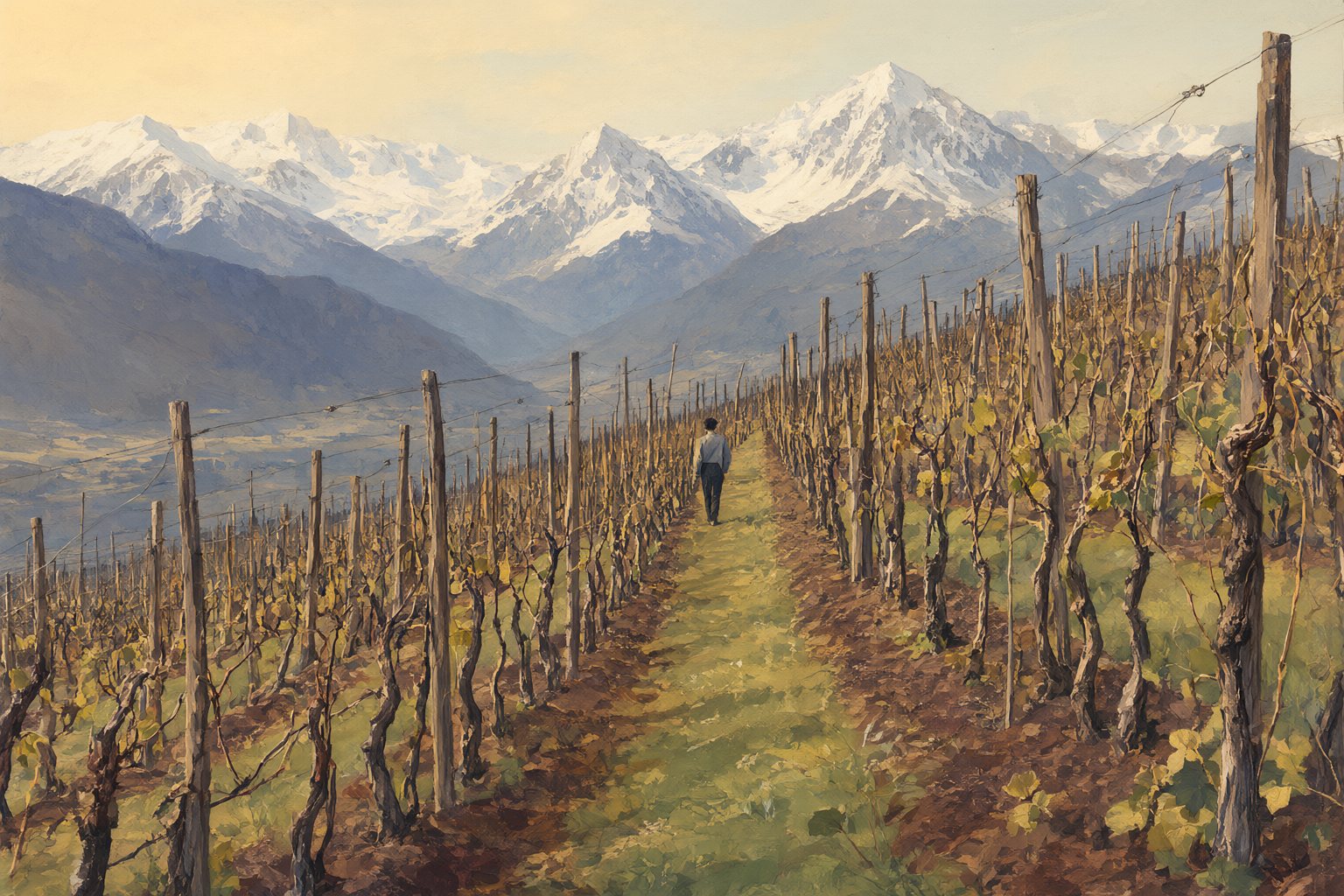
If there is an Italy of Pinot Nero that can look Burgundy in the eye, it begins here, where the grape is called Blauburgunder and, according to local tradition, has been present since the nineteenth century. The reference point is Mazzon, a slope above Egna and Montagna in the south of the province: hilly, breezy country with big temperature swings between day and night, producing pale, fruity reds that are more nervy than full-bodied. Mazzon proves that in Italy the talk of Pinot Nero crus is not a rhetorical fiction: producers speak of it as a precise place with a recognisable character, not as a label.
We have already written about Alto Adige as a whole, its altitudes and its whites, so one fact will do here. The grape has found a climate where acidity holds even at full ripeness, a condition that Burgundy takes for granted and that everywhere else has to be chased.
Oltrepò Pavese: the Lombard paradox
The second great hub is surprising, because there is nothing alpine about it: the hills of the Oltrepò Pavese, in Lombardy. Pinot Nero has long been grown here and is used above all for traditional-method sparkling wine; according to the local consortium’s most recent mapping, it has overtaken the area’s traditional red varieties in planted surface. Still Pinot Nero has its own denomination, the Pinot Nero dell’Oltrepò Pavese DOC, created in 2010: it requires at least 95% Pinot Nero and provides for a Riserva with at least two years of ageing, six months of them in wood. It is a small denomination, about 130 hectares according to 2021 data, a reminder that here still red is the exception and bubbles are the rule.
Trentino, Friuli and the Tuscan Apennines
The rest of Italy plays from the wings. In Trentino, Pinot Nero has a natural ally in the traditional method, because sparkling base wines want acidity and finesse before power, and the cooler zones deliver both. In Friuli, where the whites hold the field, there are Pinot Nero vineyards and niche red wines, often made in tiny quantities. In Tuscany the challenge is almost heretical: planting a Burgundian grape in the land of Sangiovese. It is attempted only in a few high, cool corners of the Apennines, where altitude makes up for latitude. These are experiments, sometimes successful, that tell you more about the stubbornness of the growers than about an established tradition, and should be taken as such: with curiosity, without swearing by the vintage.
An opinion on Burgundy
Comparing an Italian Pinot Nero with a Burgundy is wrong twice over. First, because “Burgundy” is a single word for thousands of very different wines, from the village red to the unattainable grand cru: which of the two is ours supposed to measure up to? Second, because Italy has an advantage France does not, the freedom to try the grape in new places, among the Alps, the Lombard hills and the Apennines.
The result, in the best cases, is not a copy but another reading of the same grape: more acidity, more light, less butter. And that is why it is worth drinking. Not to measure how closely it resembles the original, but to understand what happens when a difficult grape changes country and stops imitating.
❦