Cooking with wine: which one to use and how much alcohol really remains
White or red, deglazing, braises, risotto and desserts: which wine to use in the kitchen, and how much alcohol really remains in the dish after cooking.
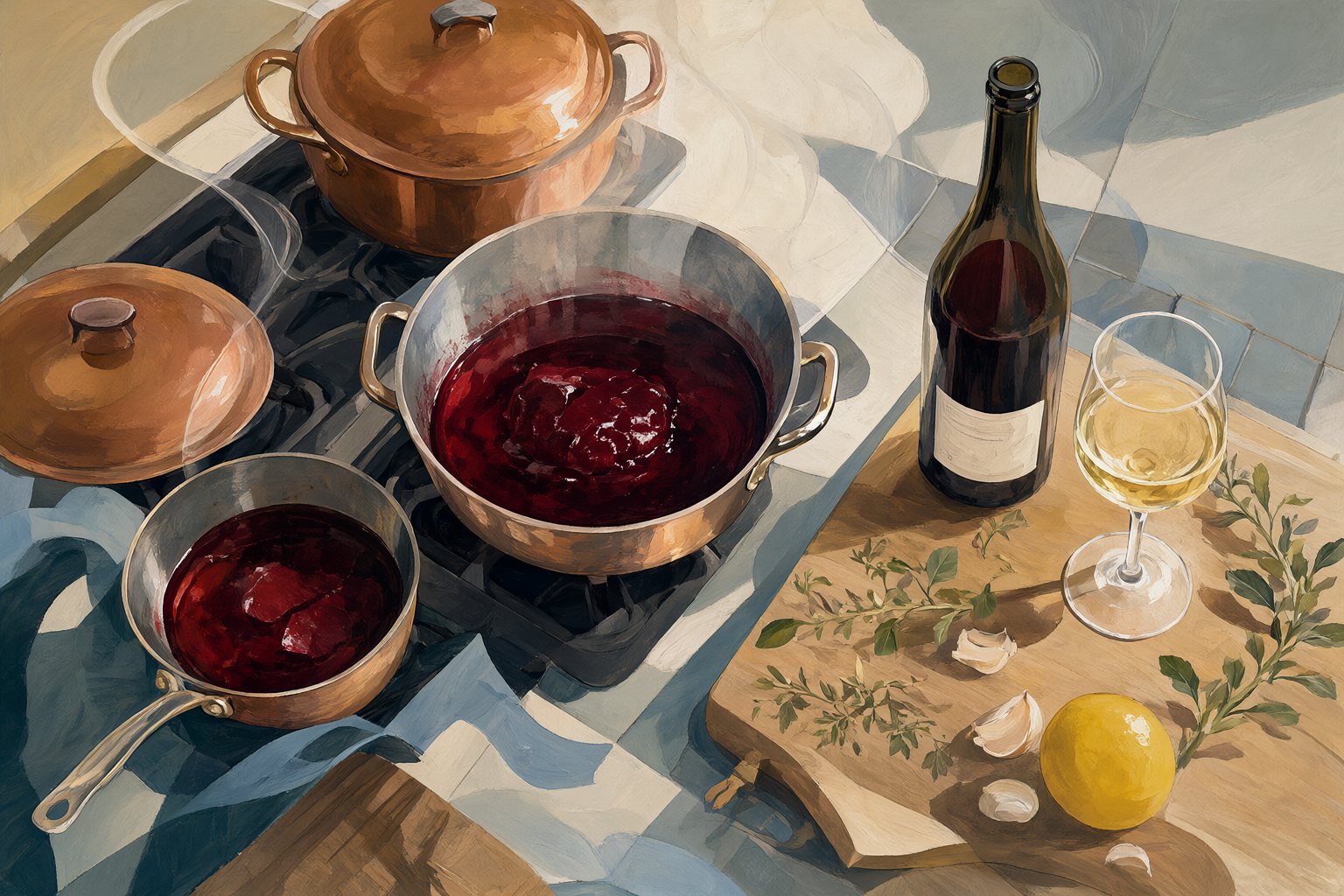
In many homes there is a bottle that never makes it to the table. It sits beside the hob, open for weeks, its cork pushed back in askew, and it has a single task: to end up in the soffritto. This is so-called cooking wine, and almost everyone treats it the way they treat tap water, that is, without a second thought. The trouble is that wine, unlike water, does not disappear in the pan. It concentrates.
The rule everyone quotes
“Never cook with a wine you wouldn’t drink.” The phrase has been doing the rounds of cookbooks and television programmes for decades and, like many popular rules, it is half right. The right half is this: a faulty wine stays faulty even after an hour on the heat. If it smells corked, vinegary, of wet cardboard or of tired oxidation, reduction will not save it. On the contrary, as the water and alcohol evaporate, what remains is the very substance of the wine, acidity, sugars, tannins and the less volatile aromas, in a denser form. A fault diluted in a glass becomes a fault concentrated in a sauce.
The wrong half is the implied corollary, that you need a great wine. You do not. The nuances that make an important bottle special, the tertiary bouquet, the finesse of its aromas, its evolution in the glass, are exactly the things heat erases first. Pouring an age-worthy red into a three-hour braise is a generous gesture and a rather pointless one. The right rule, if we really want one, is more modest: what goes into the pan should be a sound, clean wine you would happily drink at dinner on any old Tuesday. Not the Saturday bottle, and not the one forgotten behind the olive oil.
Then there is a less romantic question. The bottle that has been open for three weeks beside the hob, exposed to heat and air, is in most cases no longer a sound wine. If sniffing it leaves you in doubt, the doubt is already an answer.
What happens to the alcohol
Here one of the most deep-rooted beliefs of home cooking comes into play: that the alcohol “all evaporates”. It does not, or at least not that quickly. Ethanol boils at around 78°C, lower than water, but in a mixture with water and other ingredients it does not vanish all at once as soon as the liquid simmers. It leaves a little at a time, and the rate depends on time, temperature, the width of the pan and how much you stir.
The most widely cited reference is a table from the United States Department of Agriculture, the one on nutrient retention factors, which draws on laboratory measurements made on real dishes. The figures should be taken as orders of magnitude, since they come from specific recipes and not from every pan in the world, but the picture is eloquent. If alcohol is added to a boiling liquid and the heat is turned off immediately, about 85 per cent remains. Flambéing, a gesture that looks drastic, leaves around 75 per cent. Baking for about twenty minutes without stirring stops at around 45 per cent. For dishes that are simmered and stirred, the decline is slow: about 40 per cent after a quarter of an hour, 35 after half an hour, 25 after an hour, 10 after two hours, 5 after two and a half hours.
In other words: a splash of wine deglazed for a minute leaves a good part of its alcohol in the dish. A braise left to cook all afternoon retains very little, but rarely none. Anyone who, for whatever reason, must avoid alcohol entirely would do well to know this, instead of relying on the reassuring formula “it all evaporates anyway”.
Deglazing, braising, finishing
Sfumare, deglazing with wine and letting it bubble off, is the most Italian gesture of all, and also the most misunderstood. You pour the wine onto a hot base, let it sizzle and wait for the pungent smell of alcohol to fade before adding anything else. The aim is not to eliminate the alcohol, which, as we have seen, only partly leaves in a few minutes, but to remove the raw edge and leave the dish with the wine’s acidity and flavour. Your nose is the best instrument: as long as the steam stings, it is not time to move on.
In risotto, the wine goes in straight after the rice has been toasted, when the grains are hot and glossy. The classic choice is a dry, fresh white, without pronounced oak and without exuberant aromatics: a wine that brings acidity and leaves room for everything else. A very aromatic white tends to impose its profile on the whole dish, and a heavily oaked white can leave a bitter note that the butter of the mantecatura, the final enrichment with butter and cheese, cannot cover.
With braises the story changes, because the wine is not a seasoning but the cooking medium. Here you use a red with good structure, and the Piedmontese tradition of brasato al Barolo, beef braised in Barolo, says a great deal about how far wine can define a dish’s identity. But character matters more than the label: you need a red with enough acidity to sustain hours of cooking and tannins that are not too aggressive, because they concentrate too. A very tannic red that is already hard in the glass can leave an astringent background. Marinating the meat in wine the night before, then using the same liquid for cooking, remains the simplest way to make the wine work thoroughly.
Desserts, where the wine shows
In desserts, wine stops hiding. Pears poached in red wine with spices and sugar take on colour and an acidity that balances the sweetness; here a fruity, not too tannic red is the best choice, because concentrated tannins and sugar make for a rough contrast. Zabaione, in its best-known version, is made with Marsala, and it is one of the few cases in which a recipe names a specific designation and has good reason to do so: a fortified wine brings structure, sugar and oxidative aromas that a dry wine would not. Remember that in a zabaione whisked over a bain-marie the cooking is brief and gentle, so much of the alcohol remains.
For biscuits, ring cakes and fried doughs, Italian tradition often uses dry white wine as the liquid in the mix. In these cases the quantity is small and the wine works more on crumbliness and aroma than on the final flavour.
White or red
The basic rule is almost banal, and it works: white for fish, vegetables, white meats, pale risottos and delicate sauces; red for red meats, game, long-cooked ragù and braises. But the exceptions are many and enjoyable. A light red goes beautifully with a robust fish stew, and a structured white can stand up to rabbit or chicken cooked for a long time. The colour of the wine, let us remember, also ends up on the plate: a risotto deglazed with red turns purplish, and that is not always the desired effect.
The most useful criterion, more than colour, is acidity. It is acidity that gives wine its function in the kitchen: cutting through fat, brightening, binding. A flat, flabby wine gives little to any dish, white or red.
And here we come to our opinion. The “cooking” bottle as a category of its own, the wine you use but do not drink, should simply be abolished. Not out of snobbery, but because it is an idea that wastes twice over, first the wine and then the dish. Cook with what you are drinking, or with what you will drink tomorrow. If you do not fancy drinking it, you will not fancy eating it either.
❦