Teroldego Rotaliano, the red born on the valley floor
A Trentino red that grows on the plain, not the slope: history, DOC rules, famous relatives (Syrah included) and the style of Teroldego Rotaliano.
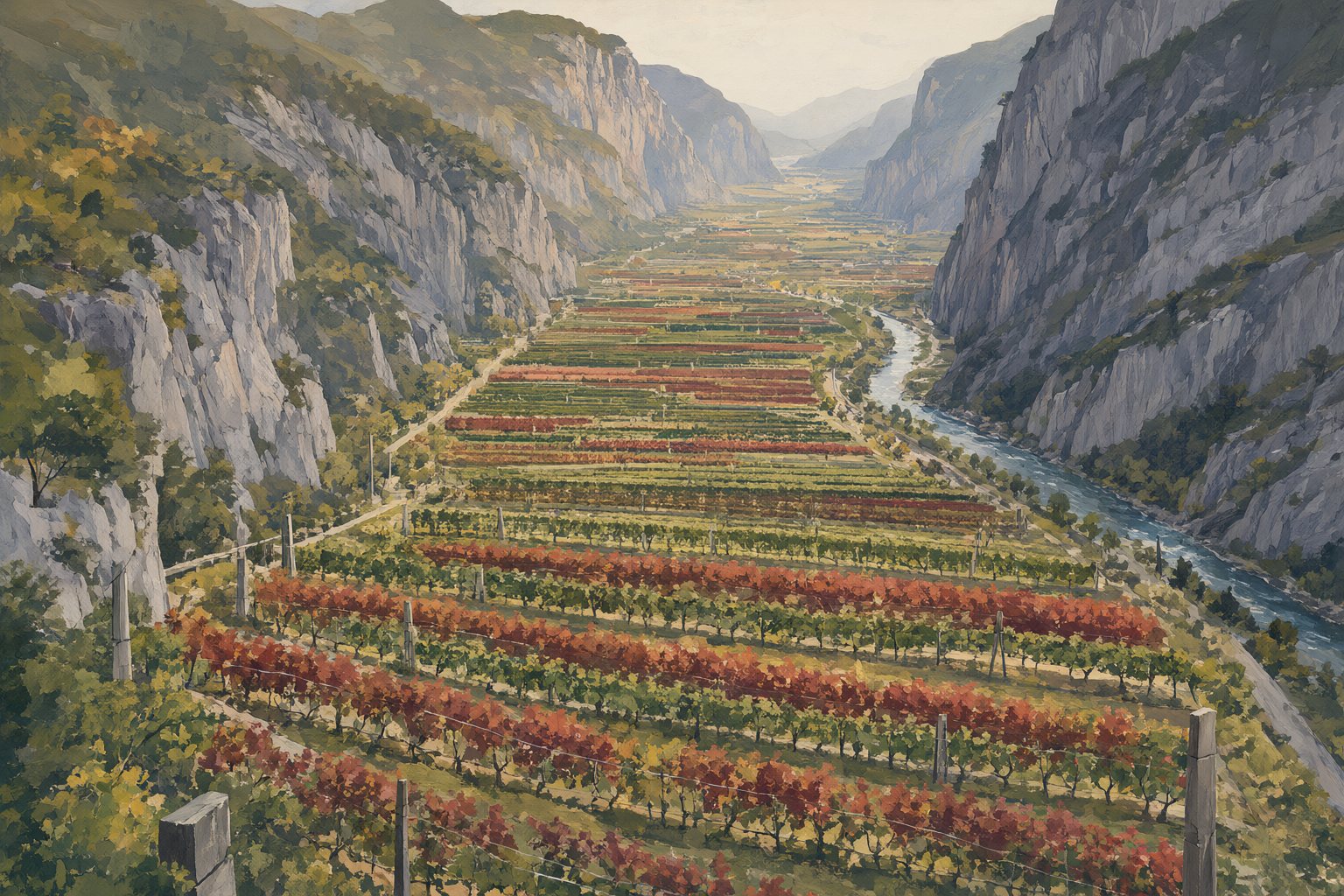
In Trentino, everything climbs. Vineyards scale terraces, and the white wines chase altitude and freshness. Then there is a red that does the opposite and comes down to the valley floor. Teroldego lives on a plain, squeezed between walls of rock that seem placed there to contain it, and it may be the only great Italian red whose identity depends on a gravel bed.
One valley floor, three communes
The DOC zone is called Campo Rotaliano, and its borders are almost cadastral. The production rules confine it to the territories of Mezzolombardo and Mezzocorona and the hamlet of Grumo, in the commune of San Michele all’Adige. That is all. No satellite hills, no subzones, no extensions “for historical reasons” of the kind found elsewhere.
The soil is alluvial, of glacial and river origin, in a landscape where water has done more work than man. Here the pergola trentina dominates, the training system that makes many people think of a roof of leaves above the rows. Anyone who believes a great red can only be born on a steep slope will have to accept that this is a plain with character.
A name nobody can explain
The earliest documented mention of Teroldego goes back, according to the sources consulted, to 1480. On the origin of the name the versions differ, and it is best to say so honestly. Some scholars link it to tirella, an ancient training form that predates the pergola; others to Teroldeghe, a locality in Mezzolombardo. Neither theory has ever prevailed, and perhaps that is as it should be: a grape with too many certainties would be less interesting.
Then there is the very Trentino matter of how much Teroldego has stayed at home. For centuries, attempts to plant it elsewhere have given unconvincing results, and even today it is a wine identified with a place before it is identified with a fashion.
A DOC with four versions
The Teroldego Rotaliano denomination was recognised by decree in 1971. The rules provide for four types: the rosso (also called Rubino), the rosato (or Kretzer), the Superiore and the Superiore Riserva. The minimum alcohol on release rises from 11.5% by volume for rosso and rosato to 12% for Superiore and Riserva; the latter requires ageing of no less than two years.
The rosato, incidentally, is the type that makes the least news and deserves the most attention: the intense colour of Teroldego yields rosés of rare vividness, able to hold their own at the table far better than certain timid whites.
The relatives: a family that crosses the Alps
The most interesting part, though, is in the DNA. In 2006 José Vouillamoz and Maria Stella Grando published a study in Heredity on the genealogy of grape varieties, and in the middle of that work Teroldego turned out to be a central node of the family. According to the analysis, it is a full sibling of Dureza, and the parent of both Lagrein and Marzemino, in each case with an unknown other parent. Lagrein and Marzemino, that is, are children of our red from the plain.
The twist lies in the rest of the tree. The study points to a second-degree relationship between Teroldego and Syrah, something like uncle and nephew, and a relationship of the same degree with Pinot. It was the first evidence of a genetic link between grapes on either side of the Alps.
A word of caution, as a careful reader of genetics: these are the results of a single study, solid but dated, and “kinship” should be read as a statistical probability between profiles, not as a documented family tree.
How it drinks
In the glass, Teroldego is colour before anything else: an intense ruby red, with garnet reflections as it ages. The classic profile is made of small red and black fruits, flowers, a note of liquorice and coffee in the more mature versions, and tannins that are present but pleasantly tamed. The minimum acidity laid down is 4.5 g/l, a figure that explains the freshness many expect less from a valley-floor red.
Styles vary. There is the Teroldego to drink young, juicy and direct, often aged in steel, and there is the one for special occasions, more structured, with oak and time. Prices vary greatly with type and producer, and I prefer not to feign precision: better to look at the shelf than at a figure.
The red that doesn’t play hard to get
Teroldego does not have the severe reputation of Nebbiolo or the pedigree of Barolo. It has something rarer, the ability to be good without demanding an entrance exam. That is why it is so often underrated, in a country that confuses seriousness with effort.
My view is that it is one of the best proofs that terroir need not always play the tough guy: all it takes is a plain of stones, a pergola, an unsuspected genetic family. And a red that fathered Lagrein and Marzemino, and is apparently a second-degree relative of Syrah, deserves more respect than it is usually granted.
❦