Pecorino and Passerina, the white grapes that came back from nowhere
Two near-extinct grapes, now the stars of Offida DOCG. The rediscovery across Marche and Abruzzo, and the legends behind their names, to be taken with caution.
At the end of the 1970s, Pecorino was a grape almost nobody missed. It yielded little, its berries were tiny, and it did nothing for the people who had to make a living from the vineyard: across southern Marche it was being left to fade, one uprooted row after another. Today the same grape gives its name to a white that sommeliers and restaurateurs seek out with a certain devotion. It is one of the least likely comebacks in Italian wine, and it deserves to be told with some caution, because more legends than documents have gathered around this story.
A grape on the way out
The most often repeated account of the rediscovery has a precise protagonist: Guido Cocci Grifoni, a producer in Ripatransone. According to the usual reconstructions, in 1982 he located surviving vines around Arquata del Tronto, at the foot of the Sibillini mountains, and in February 1983 he propagated them by grafting. The first varietal wine reached the market in 1990, in fewer than two thousand bottles. A tiny affair, but enough to show that a grape so stingy and stubborn in the vineyard could give a white of real character in the cellar.
One detail makes the story less romantic and more interesting: Pecorino did not return because it was fashionable, but because someone had the patience to work with an ungenerous plant. Low yields and minuscule berries, which a post-war farmer would have counted as faults, became forty years later the very source of its personality.
On the other side of the Apennines the story takes a different turn. In Abruzzo, Pecorino found extremely fertile ground, and according to some accounts it was there that, in the late 1990s, it was first put on a label under its own name. The details of who did what, and when, vary from one telling to the next; for that very reason I prefer not to hand out firsts. What is certain is that the grape now lives two lives, one in Marche and one in Abruzzo, and the glasses do not always resemble each other.
Passerina, the discreet cousin
If Pecorino got its epic, Passerina got the lot of the supporting actor. For a long time it was a blending grape, generous and fresh, useful for lightening and adding backbone to the whites of the area. Even its name has more synonyms than one grape should need: in various territories it goes by Campolese or Uva Passera, among other local names.
In the glass, the difference from Pecorino is easy to sense. Broadly speaking, Passerina is read as more linear and immediate, Pecorino as broader in the shoulder: these are common impressions, not rules, and every vintage and every vineyard shuffles them. They are not rungs on a ladder of quality, they are two temperaments.
Offida DOCG, three wines in one rulebook
Recognition came in 2011: the decree that promoted Offida to DOCG is dated 15 June 2011, with publication in the Gazzetta Ufficiale on 29 June. The denomination has three types, two white and one red: Pecorino and Passerina, each with at least 85% of the grape of the same name, and an Offida Rosso that rests instead on Montepulciano, again for at least 85%. The remaining 15% may come from other non-aromatic grapes suitable for cultivation in Marche.
The production zone lies in the provinces of Ascoli Piceno and Fermo and includes communes such as Offida, Ripatransone, Acquaviva Picena, Castorano and Castignano. For Pecorino and Passerina the rules set a maximum yield of 63 quintals of grapes per hectare and a minimum alcohol of 11.5% vol. For the Rosso, by comparison, the minimum is 13% and the ageing totals 24 months, 12 of them in wood, plus 3 more in bottle.
Here is the paradox: a DOCG devoted to two whites that forty years ago risked disappearing, with a red as its third wine that, on reputation alone, might have claimed the lead. Instead it is the whites that hold the stage, and the credit goes above all to those who stubbornly defended them.
Legends about the names, to be handled with care
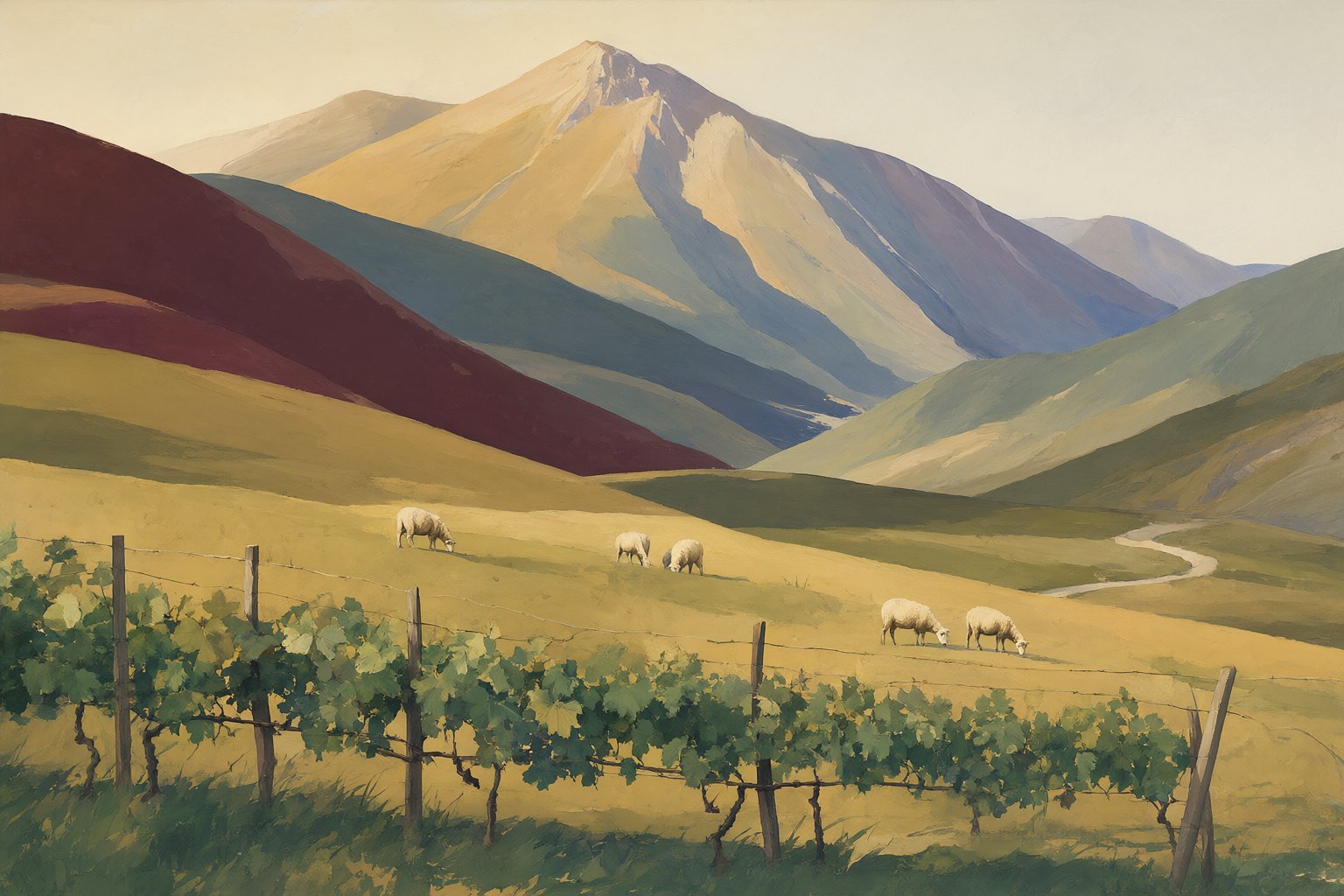
Now to the names, where imagination has done more work than philology. Two stories circulate for Pecorino. The first holds that flocks ate the grape during the transhumance, when sheep came down from the Sibillini pastures and found themselves among the vine rows. A more prosaic hypothesis simply links it to the cheese of the same name, and on that point the sources do not agree. They are lovely stories, perfect for a label, and as far as I know neither is backed by documents: treat them as oral tradition at best.
For Passerina, the tale goes that the name comes from the sparrows, greedy for its berries. Here too I found no solid evidence, and I would rather say so. The charm of grape names, after all, is that the legend often survives precisely because nobody can disprove it.
What is documented is something more sober: as early as 1526, according to the sources consulted, the statutes of Arquata del Tronto imposed fines on anyone who damaged Pecorino vineyards. A rule like that says more than a hundred legends: if you fine people for ruining a vineyard, that vineyard was worth something.
Why they win me over
The reason these two wines deserve attention is not their story of redemption, fascinating as it is. It is that they are Italian whites with a voice of their own, in a market where too many whites speak the same neutral, evergreen language. Together they tell of a central Italy that for decades suffered from a complex about its illustrious neighbours, and that now, with the calm of those who have nothing to prove, has stopped chasing.
My view is clear-cut: the next time you are offered the usual fashionable white, ask whether there is a Pecorino. If the answer is no, you have already learned something about the restaurant.
❦