Valpolicella, the valley of four wines (plus one)
Classico, Superiore, Ripasso, Amarone and Recioto: how the Valpolicella family works, between dry-stone marogne, Corvina and an everyday red worth rediscovering.
Anyone who has ordered “a Valpolicella” in a trattoria knows the small disappointment that follows: the waiter comes back with the list and asks which one. Classico? Superiore? Ripasso? And the Amarone, which costs three times as much, is that a Valpolicella too? The answer is yes, more or less, and that is precisely the beauty of it. On these hills north-west of Verona they don’t make a wine, they make a family: same grapes, same vineyards, four or five different characters. As in every family, the famous child has ended up overshadowing the others. Here we try to give a voice back to the ones who usually stay in the kitchen.
One valley, or rather eleven
The first misunderstanding is geographical. Valpolicella is not a single valley but a fan of valleys running down from the Monti Lessini towards the Adige: the Consorzio counts eleven, spread across nineteen communes in the province of Verona and a little over 8,600 hectares of vineyard. The most frequently cited etymology would have it as the “valley of many cellars”, from a mix of Latin and Greek, but the explanation is more charming than proven: take it as a good omen, not as a fact.
The historic heart is the Classico zone, the only one allowed to put the word on the label, together with Valpantena: five communes, namely Sant’Ambrogio, San Pietro in Cariano, Fumane, Marano and Negrar, with parallel valleys, limestone and marl soils, and altitudes that climb quickly. This is generally where the most fragrant and taut reds come from, with acidity to the fore. Valpantena is a single valley north of the city, more open, with its own identity and its own mention. Then there is the east, “greater” Valpolicella: the valleys of Mezzane, Illasi, Tramigna and thereabouts, where soils of volcanic origin and warmer exposures appear. It has no label mention of its own, but a growing share of the wine comes from here, often darker and fuller. For years there has been talk of a finer division into subzones, one per valley: it would be a step towards a Burgundian-style reading of the territory, but the work is still in progress and far from finished.
The marogne, or toil you can see
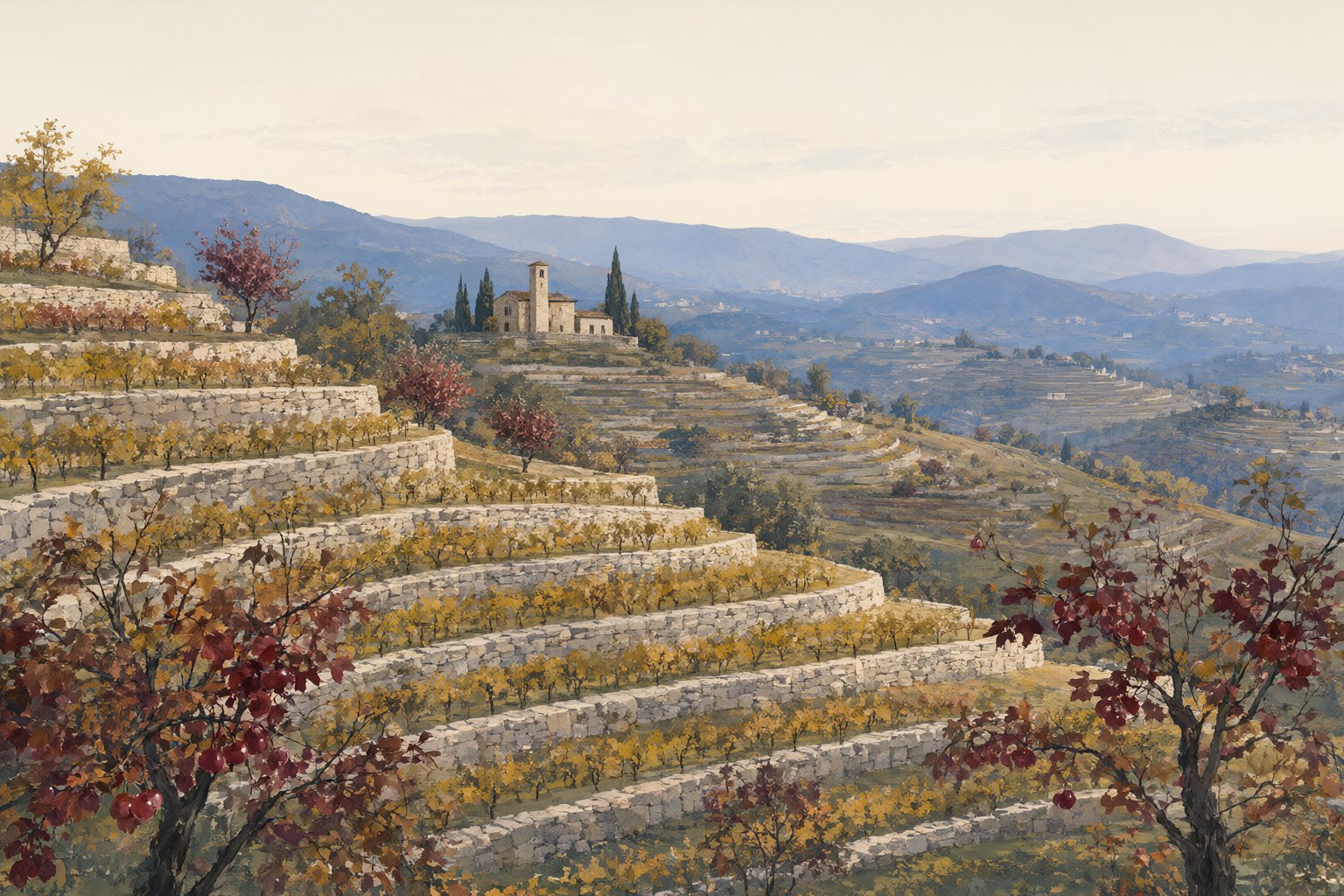
If one image sums up Valpolicella, it is not a bottle but a wall. The marogne are the dry-stone walls holding up the terraces on the steepest slopes: local limestone fitted together without mortar, the same pink and white stone used to build the area’s Romanesque parish churches, such as San Floriano. In 2018 UNESCO inscribed the art of dry-stone walling on the list of the Intangible Cultural Heritage of Humanity, and the marogne are one of the most frequently cited Italian examples.
The point is not merely aesthetic. A terrace means vines worked by hand, natural drainage, exposures chosen inch by inch. It also means maintenance costs unknown on the plain, and indeed the real risk to this landscape is abandonment, or vineyards shifting to easier, less expressive land. Cherry trees often appear among the rows: Valpolicella is cherry country too, and in spring the hills turn first white and then red. A detail, but it says a lot about a farming tradition that has never been an absolute monoculture.
Corvina and company
The production rules are simple to state and less simple to apply. Corvina, which can be partly replaced by Corvinone up to a maximum of 50%, accounts for 45 to 95% of the total; Rondinella for 5 to 30%; the rest, up to 25%, may come from other permitted red grapes. Corvina is the lead: thick skin, a perfume of sour cherry and violet, a bitterish streak on the finish reminiscent of almond. It is not a grape of great colour or robust tannin, and that is exactly why it gives free-flowing wines when left in peace. Corvinone, long believed to be a large-berried version of it, was recognised as a distinct variety by DNA analysis in the 1990s and brings structure and darker fruit. Rondinella adds colour and resilience, and stands up well to drying.
And Molinara? For decades it was a compulsory part of the recipe, and many textbooks still describe it as essential. Today it no longer is: pale, light in colour, prone to oxidation, it has been demoted to an optional supporting role, and according to the Consorzio’s figures it now covers about 2% of the vineyard. Some defend it for its savouriness and acidity; the market, so far, has decided otherwise.
The family, from lightest to richest
Basic Valpolicella, which became a DOC in 1968, is the young wine, made from fresh grapes, easy-drinking, with red fruit to the fore: it is what the people of Verona drink at table, and it can be served lightly chilled without scandal. Superiore requires at least 12 degrees and a year of ageing before sale: more body, sometimes a spell in wood, same DNA.
Ripasso is the valley’s cleverest invention. Valpolicella that has already fermented is “re-passed” over the grape skins left from making Amarone or Recioto, still rich in sugars and aromas: a brief fermentation starts again, and alcohol, structure and ripe-fruit notes all increase. Recognised as a DOC in its own right in 2010, it has become the area’s great commercial success, to the point that far more of it is now bottled than plain Valpolicella: according to the Consorzio’s figures for 2025 production, around 27 million bottles against 16 and a half.
Then come the two wines from dried grapes, both DOCGs since 2010. Amarone, dry, powerful and now famous the world over, to which we have already devoted an entire article and which we leave here to rest in its fruttai, the drying lofts. And Recioto, sweet, the true ancestor: wine from dried grapes in this area has ancient roots, and it is often linked to the Veronese “acinatico” praised in late Roman times. For a long time Amarone was little more than a Recioto that got away, fermented until it lost all its sugar.
The everyday red deserves more respect
Here is the opinion. Over the past twenty years Valpolicella has raced upmarket: more drying, more alcohol, more oak, more concentration, with Ripasso serving as a convenient bridge between the everyday and the prestigious. Commercially, it worked. But it risked making people forget that Corvina, on these marls and behind these walls, can give one of the freshest, most food-friendly reds in Italy, able to sit alongside a risotto, a bollito or a pizza without crushing them.
The figures of recent years, with Ripasso slowing after its peak and basic Valpolicella holding up better, suggest that someone is beginning to notice. If you do too, the next time the waiter asks “which one?”, try answering with the shortest name on the list. It is the one that tells the valley’s story best.
❦