Fiano and Greco, the whites that defy time
Fiano di Avellino and Greco di Tufo, Irpinia's whites that improve with age: soils, altitude, sulphur and an unlikely revival in inland Campania.
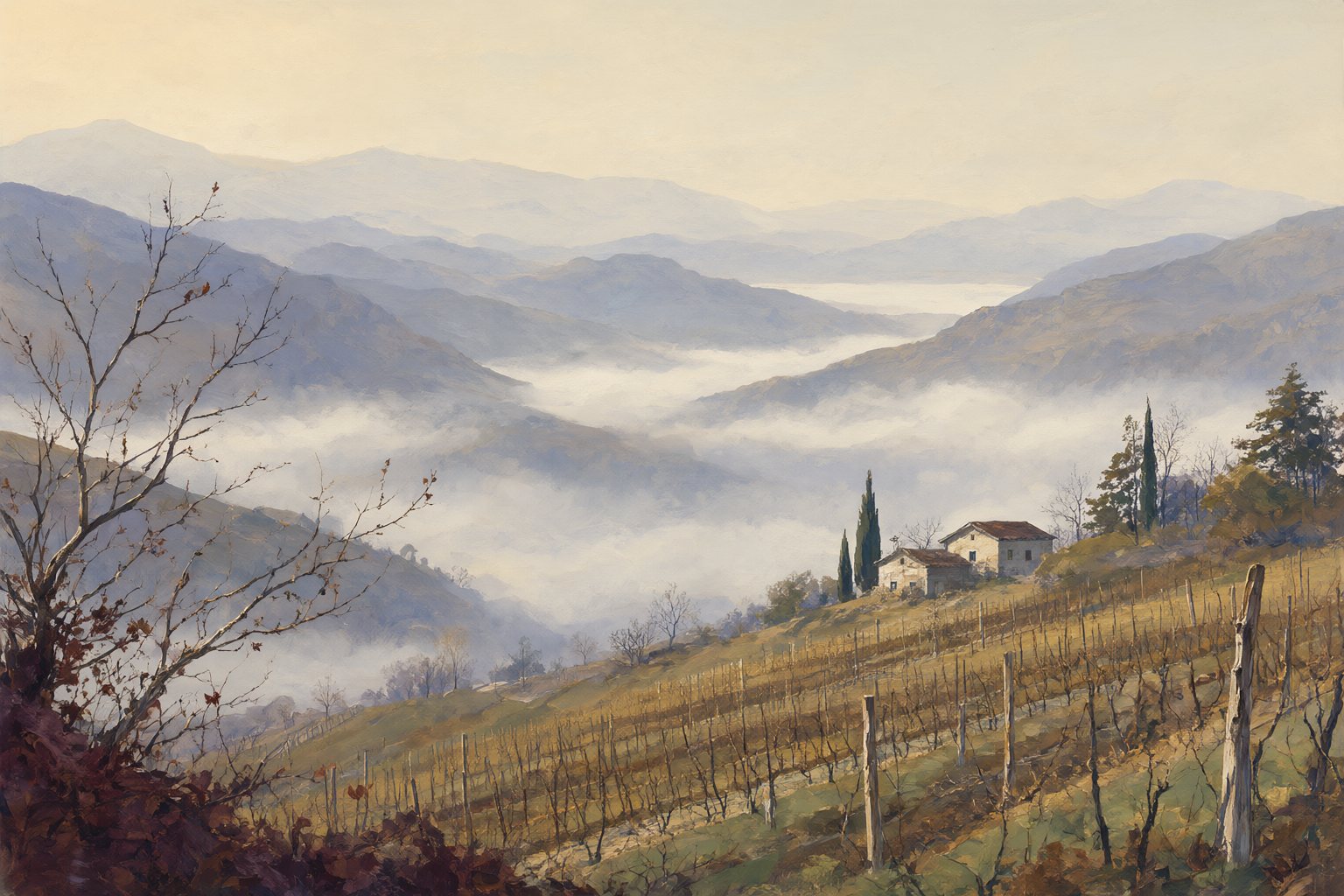
Think of a great age-worthy white and your mind goes to Burgundy, the Loire, the Rhine. Hardly anyone looks south of Rome, and fewer still to inland Campania, where winter brings fog, snow and roads that climb between ridges. Yet it is there, in Irpinia, that two white grapes do something the South is not famous for: they become more interesting with the passing years.
A mountain white, latitude notwithstanding
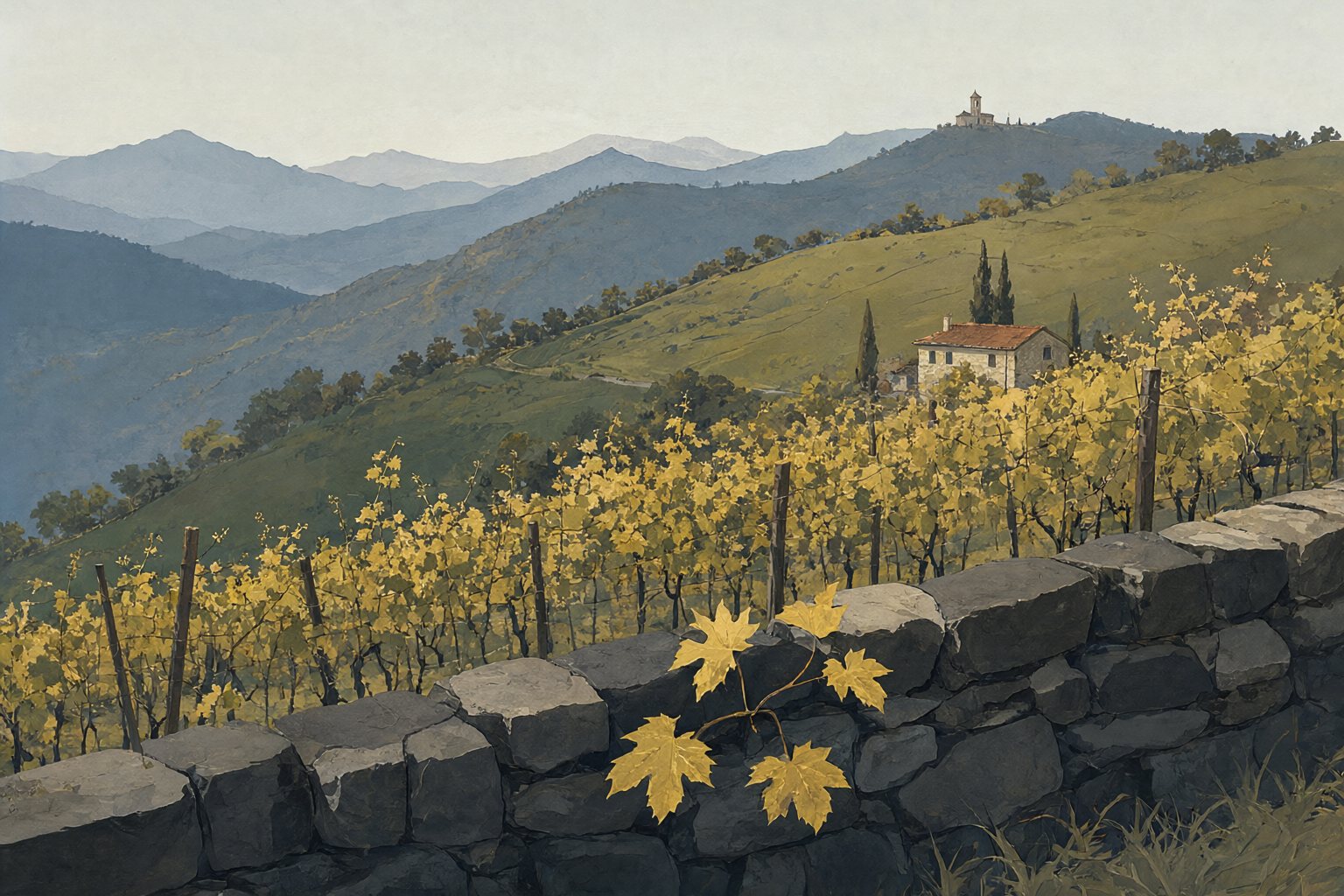
The first correction is geographical. Irpinia is not Campania’s smiling coast: it is a plateau of high hills and narrow valleys, where the vines sit roughly between 300 and 600 metres (sources differ on the exact limits, and altitude varies from one commune to the next). At these heights summer days are warm, but the nights cool decisively, and the grapes ripen slowly, holding on to their acidity. It is the same logic that gives a mountain white more nerve than a lowland one, and that makes harvest here so often fall well into October.
Fiano di Avellino and Greco di Tufo are two separate denominations with different production zones. Both require at least 85% of the grape that gives the wine its name, with the remainder left to complementary local varieties. The DOC came first for Greco, in 1970, then for Fiano, in 1978. Promotion to DOCG followed, but the sources I consulted disagree on the date, so I leave it out.
Soils: clay, tuff and a shadow of sulphur
Soil is the second reason these wines do not resemble other southern whites. Fiano grows on fairly heavy ground, with a strong clay component and volcanic and marly substrates: earth that holds water and produces wines of structure rather than immediate perfume.
At Tufo, by contrast, the village name says almost everything. Tuff is a soft volcanic rock, and in this area, known over the centuries for its sulphur deposits, the subsoil has a sulphurous component that local winemakers invoke whenever they speak of the savoury, flinty note of a mature Greco. A caution: attributing a precise flavour to a soil is an exercise in charm more than in science, and the research linking soil minerals directly to taste in the glass is far less clear-cut than the brochures suggest. But that Greco di Tufo has a smoky, saline, almost cutting character, nobody disputes.
Why they age (and why it surprises)
Here is the point. A white wine lasts if it has real acidity, extract and a structure that does not melt at the first contact with oxygen. Young Fiano is restrained: hazelnut, herbs, camomile flowers, white fruit barely sketched. With time it develops a darker, broader register of honey, wax and dried fruit. Greco has more shoulder, and according to many producers it can close up and reopen, almost capriciously, over the course of a decade.
The comparison with certain northern European whites is no cover-line bravado: it describes similar mechanisms, high acidity and slow maturation. That does not mean every bottle deserves the cellar; many wines from both denominations are made to be drunk young, and that is fine. It means the two DOCGs have a quality ceiling that the best bottles reach only with the patience of whoever puts them aside.
The revival
Fiano and Greco are very old: Fiano is said to descend from the vitis apiana the Romans wrote about, and the name of Greco is thought to recall Hellenic origins more than two thousand years ago. Suggestive theories, not entirely proven, as is often the case with ancient grapes. The recent story is firmer: for a long time these grapes were grown by few, and a family from Atripalda, the Mastroberardino, is recognised as a custodian of these varieties across several generations, at a time when the market was looking elsewhere.
Then, in recent decades, another generation of Irpinian growers began to take seriously the idea that inland whites deserved more patient work in the vineyard and the cellar. Today the two denominations are among the most admired white wines in Italy, even if the plantings remain small: on the order of a few hundred hectares each, according to the available data. The flip side is that demand is growing faster than supply.
Taurasi can wait
Irpinia already has a king, and his name is Taurasi: an Aglianico red that deserves a story of its own. But to keep describing this land as “the home of Taurasi” is a lazy way of reading the map. Fiano and Greco are its younger siblings only to those who look at colour.
My view: if I had to say where some of Italy’s most underrated whites are made today, I would go neither to Friuli nor to Alto Adige. I would climb toward the fog-wrapped hills in January, where the wine tastes of stone and smoke, and I would learn to wait.
❦