Grillo, Catarratto, Inzolia, Carricante: Sicily's white grapes
Four white grapes that show Sicily beyond Marsala and Etna, shaped by salt flats, wind and an acidity few expect from such a hot island.
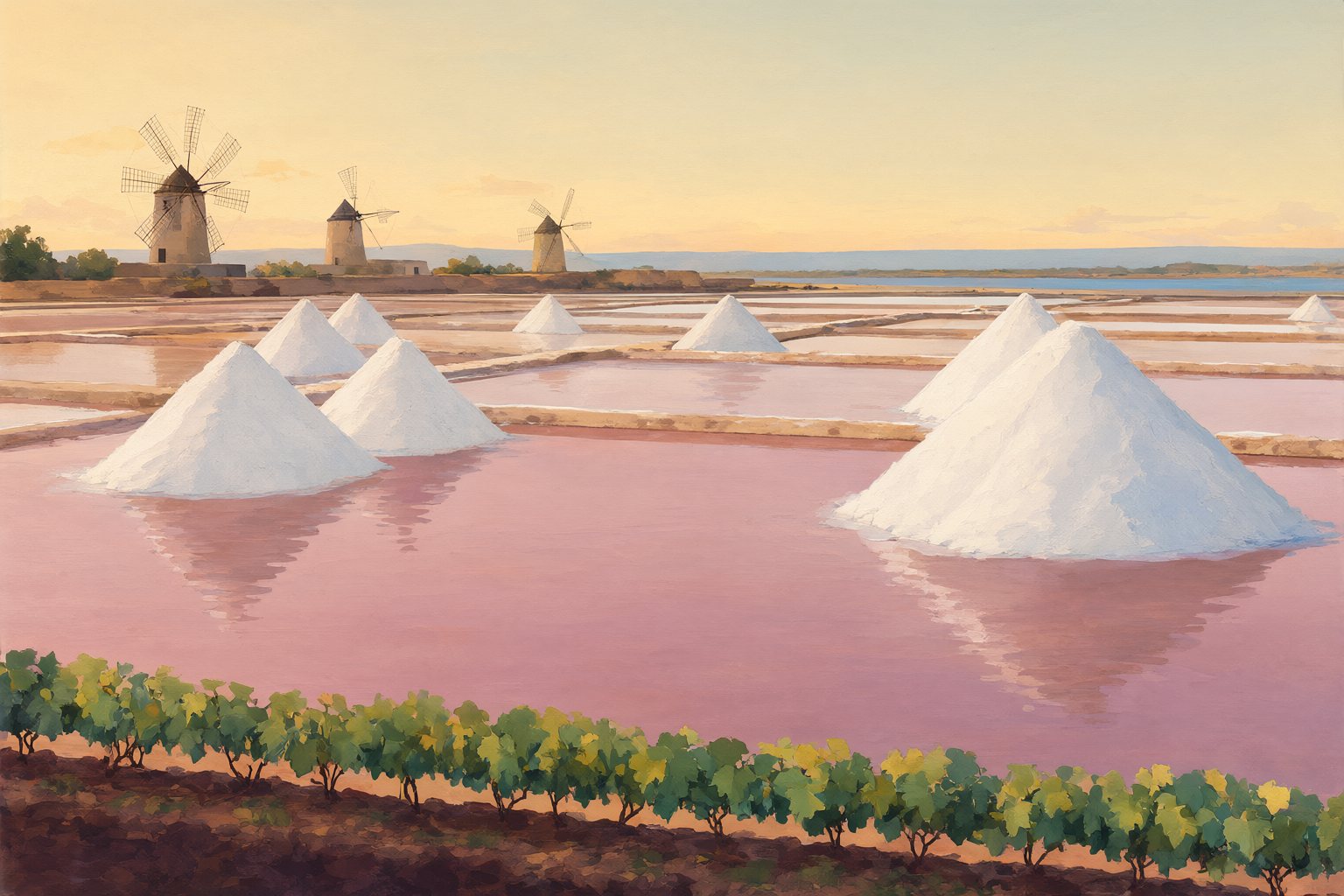
For decades, white Sicily was a reservoir. Generous grapes, endless sun, tanks that filled without effort, and wine that left in bulk for the north to give body to someone else’s blend. Then something changed, and anyone who still pictures Sicilian white as a heavy, alcoholic liquid is describing an island that no longer exists, or at least not only that one.
Marsala and Etna have already had their space here. This is the story of what lies in between: four grapes, four characters, and a less obvious idea of Sicily.
Catarratto, the modest giant
Let us begin with the grape nobody puts on the cover. Catarratto is by a wide margin the most planted white variety on the island: the estimates in circulation speak of around 38,000 hectares, roughly a third of all Sicilian vineyards, although the figure is not recent and should be taken as an order of magnitude. That alone explains why its reputation was long that of a grape for quantity.
The reputation is unfair, or at least incomplete. Catarratto comes in several variants, and those called Lucido and Extra Lucido, less productive, give wines with livelier acidity and a sharper structure. Its natural home is the west of the island, between Trapani and Palermo, with the Alcamo area as its historic seat. Grown with low yields and picked at the right moment, it offers a white of citrus, white flowers and a saline note that seems carried in on the wind. It is not showy. It is dependable, and in wine dependability is underrated.
Grillo, the child with more character
Grillo is the grape that understood before the others how to change its life. According to DNA analysis dating from 2007, it comes from a probably spontaneous cross between Catarratto Bianco Lucido and Zibibbo, that is, Muscat of Alexandria: one sober parent and one aromatic, and the offspring took a little from each. The variety was first documented in 1873. It was widespread before phylloxera and was used in Marsala, then gave way to more productive varieties.
Its revival is recent and shows in the numbers. In 2010 Grillo covered about 6,300 hectares in Italy, against about 1,800 ten years earlier. It grows above all around Trapani, loves heat and wind, ripens late and gives wines of good alcohol but with a profile of aromatic herbs and citrus that keeps it clear of heaviness. It is the Sicilian white that best carries ambition, from the fresh, immediate style to the more structured one, aged with greater patience.
A warning at this point. Talking about Sicilian grapes as a block is convenient but misleading: the same Grillo, planted near the sea or on an inland height, produces wines with very different balances. So it is better to read the place and the moment of harvest rather than the name of the grape, because on an island this large, picking a few weeks earlier can change a wine’s acidity more than any decision in the cellar.
Inzolia, the grape that wants time
Inzolia is the most neglected of the four, and the most curious. On the Tuscan coast they call it Ansonica, and the fact that the same grape lives so far from home says something about the history of Mediterranean trade routes. In Sicily it has a softer character: acidity that is not especially high, a tendency to oxidise easily, and an unusual tannic presence for a white.
These limits are also its personality. Inside Marsala it was long a precious supporting player, and on its own it asks for a light hand in the cellar and a little waiting in bottle. It does not seduce with the first glass, which is why it never became a fashion. Those who love it love it because it demands attention, which is a form of loyalty.
Carricante, the mountain white
Carricante is the exception that proves the rule: a Sicilian white that lives on freshness rather than heat. It stands on Etna, often at altitudes between 800 and over 900 metres, and the rules for Etna Bianco DOC require at least 60% of this grape, with a higher threshold for the Superiore. A mention is enough here, because Etna has its own article. But it is worth noting a paradox: the most acidic and mineral grape on the island grows on a volcano, while the rest of Sicilian white shelters from the sun in the coastal areas.
Why they matter together
Lined up, these four grapes describe an island that refuses to be reduced to a formula. There is the windswept coast around Trapani, the hills of Alcamo, the altitude of Etna, and for each landscape a grape that has learned to live there. The Sicilia DOC has given many of these grapes a common frame, useful for being recognised, less so for telling differences apart, which remain the real interest.
My opinion is simple. Sicilian white does not need to become something else, to imitate Burgundy or dress up as a northern wine. It only has to stop apologising for the sun and learn to talk about its acidity, which is there, and is more interesting than its reputation suggests. The next Sicilian white you open, forget the label and ask yourself which grape you are drinking. It is the quickest way to understand that the island has at least four, and that none truly resembles another.
❦