Nero d’Avola, from blending wine to symbol of Sicily
For decades Sicily shipped it north to give other wines colour. Today Nero d’Avola has its own denominations, its own zones and, at last, a face of its own.
For a long time, Nero d’Avola was a wine nobody drank under its own name. It left in a tanker, travelled up the peninsula and ended up in some northern cellar, where it had one job: to lend body, colour and strength to wines that were thinner and paler. The Sicilian grower knew it, the buyer knew it, and the drinker had no idea it existed. That the same grape is now the red that best represents Sicily, with recognised zones and arguments over where its true home lies, is one of the stranger reversals in recent Italian wine.
A name that sends you the wrong way
The name points to Avola, a town in the province of Syracuse, and it is there that growers are said to have selected the grape a very long time ago. The synonym “Calabrese” misleads plenty of people, who assume the variety comes from Calabria. The more widely accepted explanation is different: it derives from calavrisi, a dialect form meant to say simply “grape of Avola”. A story of linguistic misunderstanding, in other words, rather than of migration.
What is certain is the character. Dark skins, deep colour, fruit of plum and spice, and tannins that, in well-made versions, come across as sweet rather than rough. It is a grape that loves heat and drought, and in Sicily it finds near-ideal conditions. That very generosity, though, was its undoing: a wine so loaded with colour and sugar was perfect for strengthening others, and for years Sicily played supplier to the big blenders of the North. Nobody had any interest in making it a wine with an identity.
The turn, without the postcard myths
The change of course came when some Sicilian producers began bottling their own wine and betting on local grapes instead of chasing Cabernet and Merlot like everyone else. One red blending Perricone and Nero d’Avola is often cited as the first sign of the island’s rebirth. Then the wider movement picked up speed, and the grape went from anonymous ingredient to name on the label.
In fairness, not everything that followed was brilliant. Nero d’Avola has also produced enormous, heavy wines, weighed down by oak and concentration, that mistook power for quality. The cliché of the hot, muscular “Sicilian red” was born here, and it is not entirely unjust. But it is a cliché about a style, not about the grape.
The south-east, where it all began
If you want to understand what this grape can really do, you have to head down to the island’s south-eastern corner, between Pachino, Noto and the Eloro valley. These are among Italy’s southernmost vineyards, at roughly 36° 41’ north, and the Noto and Pachino areas are recognised as quality zones for the variety.
Eloro, a DOC since 1994 and named after an ancient Greek city, provides for reds and rosés with at least 90% Nero d’Avola, Frappato and Pignatello. Within it sits the Pachino subzone, reserved for reds and more demanding: at least 80% Nero d’Avola, the rest Frappato and/or Pignatello. The Noto DOC, known for years only for Moscato (it was in fact called Moscato di Noto), now also has a red with at least 65% Nero d’Avola and a varietal Nero d’Avola with an 85% threshold.
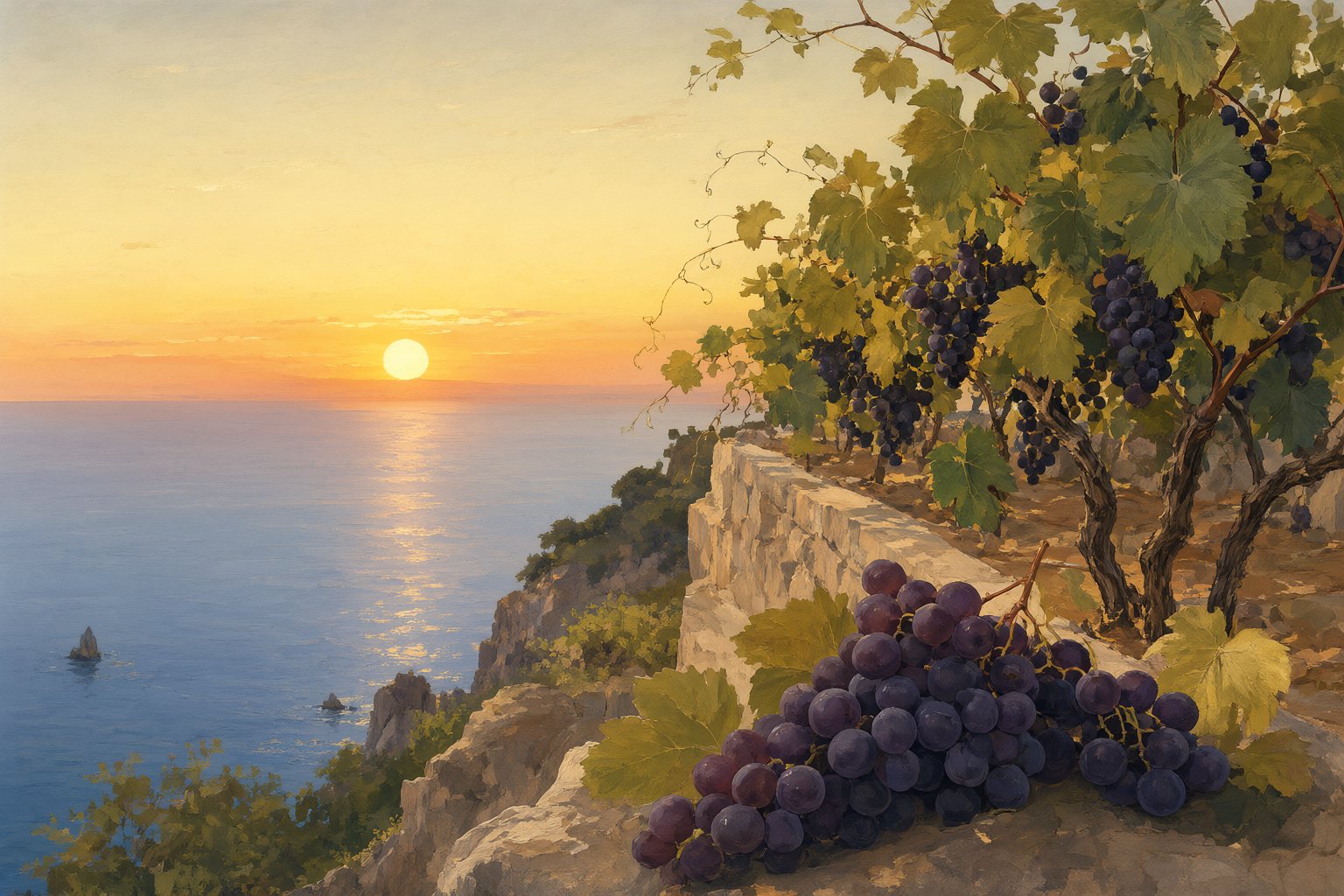
Here the grape reads in a different key: the heat, the proximity of the sea, the strong light, and vines often pictured as alberello, the low, compact bush form typical of the South. The best wines have less jam than you would expect and more salt, more spice, more tension.
Vittoria and the DOCG that stands alone
Further west, around Vittoria, Nero d’Avola meets Frappato, a light, perfumed grape that acts almost as a counterweight. Cerasuolo di Vittoria is a blend in which Nero d’Avola makes up 50 to 70%, with Frappato the remainder. It has been a DOC since 1973 and a DOCG since 2005, and as far as I can tell it remains Sicily’s only DOCG. Future reclassifications might change that, but it says a lot: on an island with a great many denominations, only one has reached the top rung.
It is an interesting wine precisely because it does not try to shout. Frappato lightens, lifts the aromatic profile and makes the blend fresher than Nero d’Avola alone would tend to be. Anyone who thinks of the grape as simply a dark red should stop by here.
The Sicilia DOC and the problem of home
Alongside the zonal denominations there is the Sicilia DOC, which covers the whole island and allows the grape variety to appear on the label. It is a useful tool, giving a frame to a wine that for decades had none, but it carries an awkward question: can a Nero d’Avola from all of Sicily say anything precise about where it comes from? The risk is that the name of the region ends up covering the difference between a vineyard by the sea and one deep inland, which are different worlds.
On prices, to stay cautious, I would give no figures: the range is too wide, from everyday red to zone wine, to promise a band that holds.
What I would ask of it
Nero d’Avola no longer needs to prove it is a wine. The problem now is a different one: deciding whether it wants to be Sicily’s comfortable, recognisable red or the one that can speak of places, as it has begun to do in the Syracuse area and at Vittoria. I am rooting for the second, and not out of snobbery. A grape that for decades played second fiddle to someone else deserves, at last, to tell its own story.
❦