What wine to drink with carbonara, amatriciana and cacio e pepe
Guanciale, pecorino and pepper lay down the law. Which wine to choose with Rome’s three great pasta dishes, from Cesanese to Frascati, and why it works.
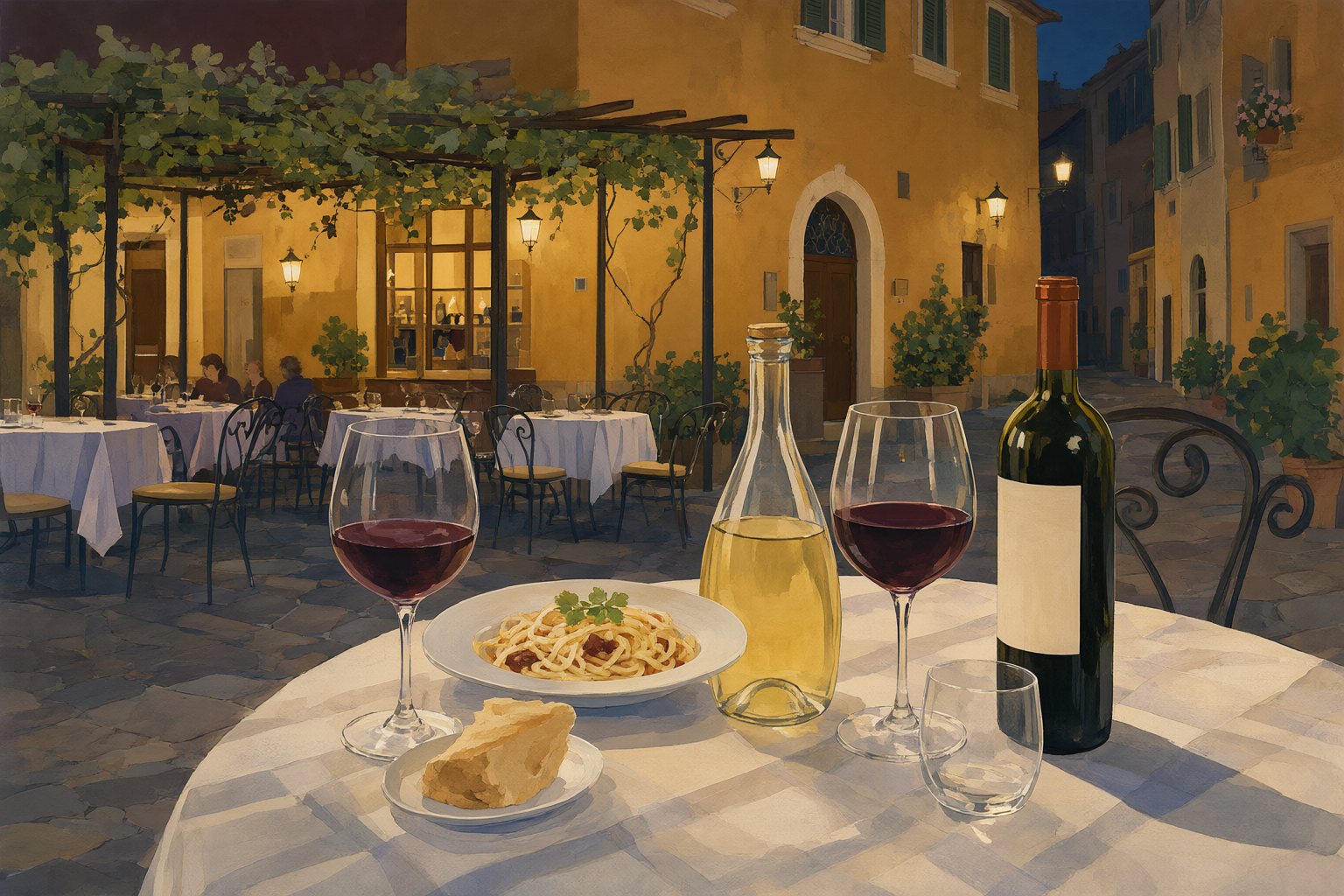
In Rome pasta is argued over like football: with passion, with little patience for other people’s opinions and with the certainty of being right. Over wine, curiously, there is far less fighting. At the table of any trattoria the choice often comes down to “house white or house red”, and nobody bats an eyelid. A pity, because carbonara, amatriciana and cacio e pepe are three of the hardest dishes in Italian cooking to pair, and they would deserve the same fervour reserved for cream (banned) or onion (disputed).
The reason is simple. These dishes share a three-word grammar: fat, salt, pecorino. Guanciale, cured pork cheek, brings sweet, savoury fat, pecorino romano brings salt and a rather assertive animal note, and black pepper adds heat. A wine that can’t handle these three elements ends up crushed, or worse, amplifies the salt until every mouthful becomes tiring.
The pecorino rule
Pecorino romano is the real referee at the table. It is an aged, salty cheese, with a savouriness that clings to the palate. Faced with it, two things work: acidity, which cleans and refreshes, and fruit, which balances the salt with a sensation of softness. What must be handled with care, on the other hand, is tannin. A very tannic red, in contact with salt and fat, can turn rough, almost metallic, especially if the dish lacks the sweetness of tomato to act as a cushion.
Hence the first conclusion, which many will find counter-intuitive: with two of the three Roman pastas, the safest route is a white. Not just any white, though. It needs body, a certain structure, a finish that doesn’t vanish at the first forkful of guanciale.
Carbonara, the white that stands up to egg
Carbonara is the youngest of the trio, and also the most talked about. The first documented recipe is surprisingly American, published in Chicago in 1952; in Italy it reached the food press in 1954, and those early versions featured pancetta, not guanciale. Pecorino and guanciale only took over later, between the late 1950s and the 1960s. Anyone swearing by carbonara’s age-old tradition, in short, is defending a recipe younger than many grandparents.
Carbonara’s oenological problem is the egg. The yolk coats the palate with a creamy film that dulls the acidity of slighter wines and makes tannic reds bitter. Here Lazio has the answer at home: Frascati, one of Italy’s first DOCs, recognised in 1966, and above all Frascati Superiore, which became a DOCG in 2011. The rules require it to be based on Malvasia, at least 70 per cent between Malvasia di Candia and Malvasia del Lazio, with Trebbiano, Greco and other white grapes making up the rest. Malvasia del Lazio, also known as Puntinata, contributes aromas and a certain richness; the Superiore version adds backbone. The result is a white with enough weight to sit alongside the yolk and enough freshness to cut through the guanciale.
For those who want to look beyond Lazio, the logic is the same: medium-bodied whites, with little or no oak, with lively acidity. A Verdicchio dei Castelli di Jesi or a Fiano di Avellino play in the same register, with a bitterish or smoky note that converses nicely with the pepper.
Amatriciana, red at last
Amatriciana is the oldest and most territorial of the three, so much so that since 2020 the European Union has protected it as a Traditional Speciality Guaranteed under the name Amatriciana tradizionale. Here tomato changes everything. Its acidity and sweetness soften the effect of the salt and open the door to reds, as long as they are young, juicy and gently tannic.
The natural candidate is Cesanese, Lazio’s most distinctive red. Cesanese del Piglio, from the hills of the province of Frosinone some forty kilometres from Rome, became a DOCG in 2008 and is the region’s only red DOCG: the rules require at least 90 per cent Cesanese, in its Affile and Comune variants. In its basic versions it is a wine of red fruit and spice, with a finer weave than its colour suggests, and it is precisely this restraint that makes it suitable. The Superiore and Riserva versions, higher in alcohol and longer aged, are fine if the amatriciana is generous with guanciale, but risk being too much for a dish that remains, at heart, a humble one.
An interesting alternative is Roma DOC, the youngest appellation of the group, created in 2011. The Rosso is based on at least half Montepulciano, with a share of Cesanese, Sangiovese or international varieties: the result is soft, fruity reds, designed more for the table than for the cellar. Many traditional versions of amatriciana also call for a splash of white wine on the guanciale, and those who want to stay consistent can serve the same white in the glass; with tomato, though, a nimble red has the edge. Outside the region, a young Montepulciano d’Abruzzo or a Rosso Piceno follow the same logic.
Cacio e pepe, the most merciless
It is the simplest dish and therefore the cruellest: no tomato, no egg, no guanciale. Just pecorino, pepper, pasta water and the skill of whoever does the mantecatura, the final emulsifying toss. All the cheese’s savouriness reaches the palate unfiltered, and the black pepper, used generously, warms and stings.
With cacio e pepe a tannic red is almost always a mistake. Whites with good acidity and some substance work better: once again Frascati Superiore, or a Roma DOC Bianco, which the rules require to be at least half Malvasia del Lazio or Malvasia Puntinata, with Bellone, Bombino, Greco or Trebbiano following. Bellone, which Roma DOC also allows as a varietal white, is another card to play for those who love drier, more savoury whites. And if you really want red, make it light, served cool, almost an afternoon-snack wine: a young Cesanese at cellar temperature holds up better than many more illustrious reds.
There is also a side road that works for all three dishes: dry sparkling wine. Carbon dioxide and acidity do a formidable cleaning job on fat and salt, and a zero-dosage traditional-method wine alongside a carbonara converts even the sceptics. It isn’t Roman, granted. But then neither, entirely, was the carbonara of 1952.
White, without shame
The real point is another. For decades Lazio’s wine was associated with an osteria white, plentiful and anonymous, served by the carafe, locally sourced and with no questions asked. That image did the most damage to Frascati, which today, in its best versions, is a serious white, with its own personality and production rules that have raised the bar. In the same way Cesanese long ago stopped being a local curiosity.
Our opinion is clear-cut: with the Roman pastas the right wine, in most cases, is a Lazio white with body and freshness, and red should be reserved for amatriciana, chosen young and not too structured. The reflex of “red with meat-sauce pasta” doesn’t help here: guanciale is not a stew, and pecorino does not forgive. Drinking local, in this case, is not folklore. It is simply the choice that works best.
❦