Lugana, the Lake Garda white that won over the world
Turbiana, clay soils and a denomination straddling Lombardy and Veneto: why Lugana travels so well abroad, and how to read its styles.
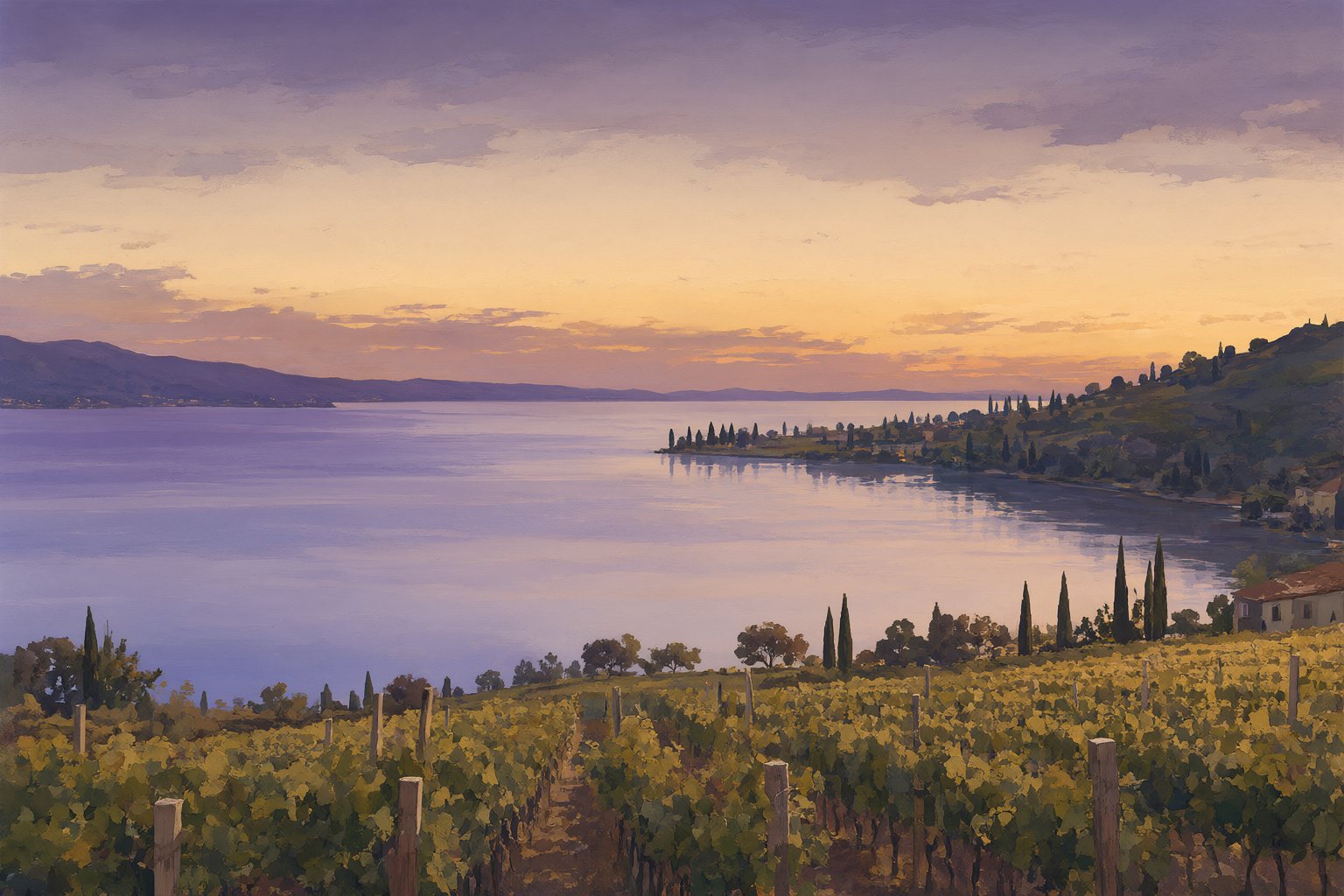
They say Lake Garda looks like the sea, and Lugana is the wine that has best absorbed the lesson: light, apparent calm, and a savoury note that arrives at the very end like a splash of spray. For a long time it was little more than a lakeside trattoria white, drunk quickly with lake fish and forgotten just as fast. Today it is one of the most recognisable Italian white denominations abroad, and it is worth asking why.
A strip of land between two regions
The production zone is tiny. It takes in the whole commune of Sirmione and parts of Desenzano del Garda, Lonato del Garda and Pozzolengo, in the province of Brescia, so in Lombardy, plus a portion of Peschiera del Garda, in Veneto. That makes Lugana a denomination straddling two regions, with all the gentle parochial rivalry that implies. Vineyard area is a little over two thousand hectares, almost all on the Lombard side.
The DOC dates from 1967, which places it among Italy’s very first denominations, and the rulebook has been revised several times, the last in 2014 according to the sources I consulted. It is a longer story than its recent fame suggests: Lugana is not a fashion born yesterday, but a wine that waited for its moment.
Turbiana, a grape with too many names
At the heart of the wine is Turbiana, also listed as Trebbiano di Lugana or Trebbiano di Soave. The rulebook requires at least 90% of this grape, with the remainder reserved for other permitted white varieties; in practice most producers vinify it on its own.
Turbiana’s problem is its surname. The word Trebbiano conjures, in the popular imagination, neutral whites of great volume and little personality. That has nothing to do with it here: Turbiana has lively acidity, good structure, a profile of white flowers, citrus and almond that with age turns towards spicier, more balsamic tones. It is a grape that ages better than prejudice suggests, which is why some bottles of Lugana have the surprising habit of improving after a few years.
The clay, or how to explain the savoury edge
The soil is the second protagonist. The flat part, close to the lake, rests on compact, at times stubborn clay; climbing towards the morainic hills the clay turns sandier. Clay holds water and releases freshness even in hot summers, while the lake softens temperature extremes. The result is a white that combines body and tension, two qualities that rarely get along.
That said, it pays to distrust explanations that are too convenient. Savouriness and minerality are words Italian white wine uses rather freely, and nobody has demonstrated a direct link between clay and salt on the palate. It is more honest to say that soil, lake climate and grape together produce a recognisable character, without pretending to break it down into its components.
Four ways of being Lugana
The rulebook recognises several styles, and understanding them avoids misunderstandings at the restaurant.
- Lugana, the base version, released from 15 January after the harvest: fresh, immediate, the most widespread.
- Superiore, with at least twelve months of ageing from 1 October of the harvest year: more structured and built to last a little longer.
- Riserva, with at least twenty-four months, six of them in bottle: the style designed for those who want to see what happens to the wine over time.
- Vendemmia Tardiva, from grapes picked later, with a higher minimum strength (13% according to the sources consulted): a broader, softer Lugana, not to be confused with a sweet wine.
There is also a sparkling version, confirming that Turbiana is more versatile than its aperitif-white profile suggests. As for prices, I found no evidence solid enough to give reliable ranges, and I prefer not to invent them.
Why it travels so well
According to the figures I found, more than half of production leaves Italy. For a small denomination that is a remarkable share, and the reasons are not hard to guess. Lugana is a white that is easy to understand without being banal: it lacks the overbearing aromatics of certain international varieties, it lacks the austerity of certain alpine whites, and it has a drinkability that meets the taste of markets used to fresh, clean wines. Garda, moreover, is a global tourist destination: many foreigners discover the wine on holiday and look for it back home.
My verdict
I believe Lugana’s future will be decided in its long-aged styles. The base wine will always follow the market, and rightly so. But it is the Riserva and the more mature versions that will tell us whether Turbiana is truly a great Italian white grape or merely an excellent aperitif machine. I would bet on the former, provided producers have the patience to leave the wines in the cellar a few years longer than the market would ask. It is the same patience the denomination once had to find within itself.
❦