What wine goes with risotto? What goes in the pan decides the glass
Milanese, al Barolo, all’Amarone, seafood or radicchio: how to choose the wine for risotto, starting with the one you pour into the pan.
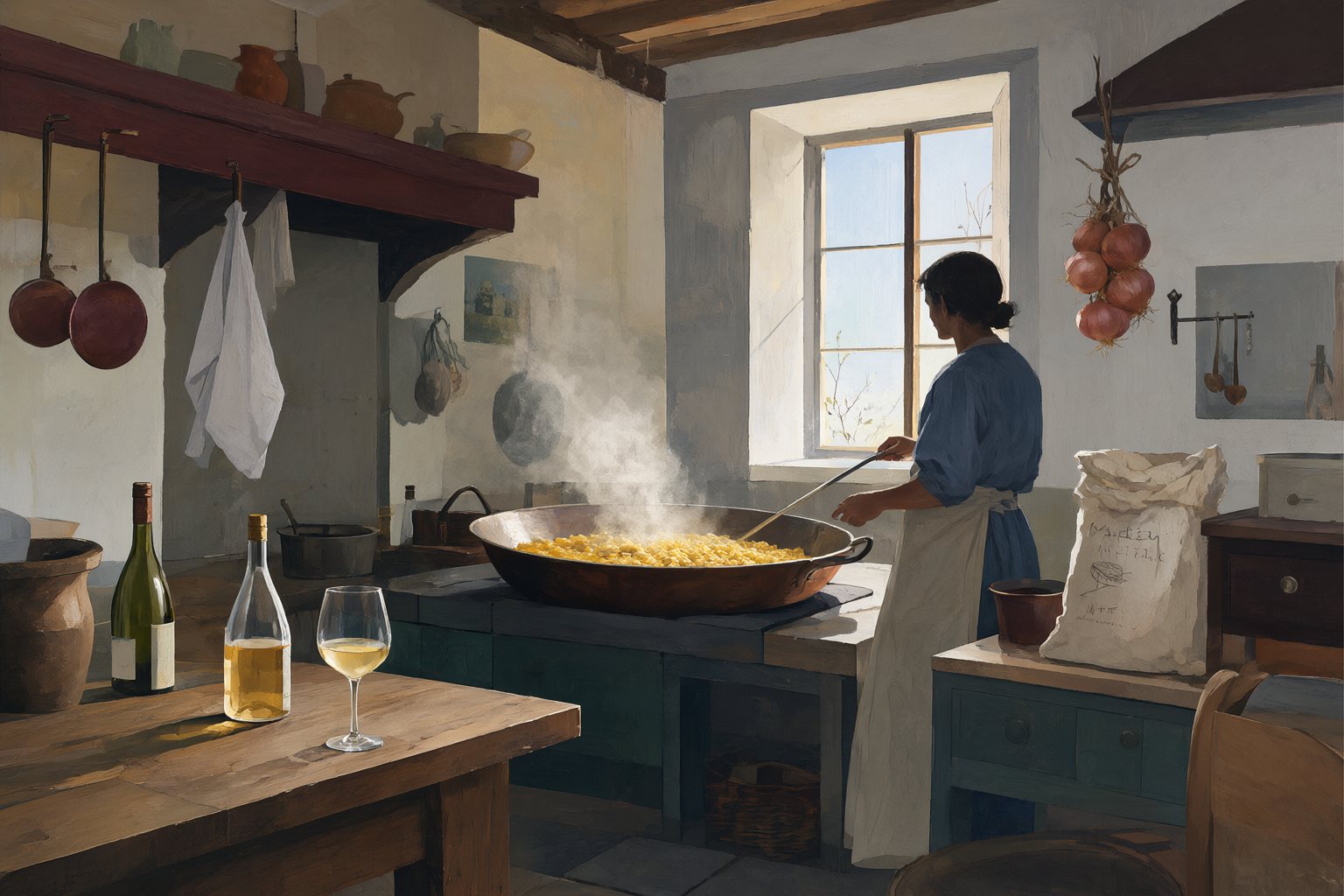
Risotto is the only Italian dish that drinks its wine twice. The first time in the pan, when the toasted rice gets its splash of wine and sizzles like a steam iron; the second in the glass, beside the plate. Whoever gets the first wine wrong usually gets the second wrong too, because they are the same decision taken at two different moments.
Risotto, moreover, has a problem pasta does not: the mantecatura, the final beating-in of butter and cheese off the heat. It turns the rice into something enveloping, almost fatty, that coats the mouth. The wine has to act as a counterweight, with acidity or with bubbles, or, in red risottos, with a tannin that knows its place. Everything else comes after.
The wine in the pan, first of all
The splash of wine is there to add acidity and to rid the rice of that flat note of toasted starch. That is why the right wine to pour is dry, fresh and unoaked: a simple, easy-drinking white that does not cost much. A barrique-aged white in the pan turns bitter and slightly resinous; a sweet or aromatic wine leaves a mark no stock can cover.
There is just one rule, as old as the osterie: do not put into a risotto a wine you would not drink. Not because you need a great bottle (wasting one would be a minor crime), but because a tired, oxidised or corked wine concentrates as it cooks and carries its faults straight onto the plate. And, if you can, use in the pan the same wine, or a close relative, that you will then serve at the table. It is the simplest way to build a pairing without thinking about it too much.
Alla milanese, or gold and fat
The yellow risotto is the most buttery of them all. Butter, sometimes beef marrow, aged cheese and saffron, which brings an almost mineral, slightly bitter note. Its birth is wrapped in a sixteenth-century legend linked to the building site of Milan’s Duomo and to a young glazier who supposedly used the saffron from his pigments to colour the rice at a wedding banquet. A lovely story, scant documentation: take it for what it is.
In the glass, risotto alla milanese asks for freshness and cut. The most Lombard answer is also the most convincing: a dry traditional-method sparkling wine, from either the Oltrepò Pavese or Franciacorta. The bubbles clean the butter from the palate, the acidity keeps the saffron upright, and the bread-crust notes converse with the toasted rice. Those who do not care for bubbles can turn to a still white with good acidity and a modicum of structure, such as a Lugana, born on the southern shores of Lake Garda between Lombardy and the Veneto.
Avoid tannic reds: saffron and tannin quarrel, and in the end all that is left in the mouth is a metallic sensation. If the risotto accompanies ossobuco, the story changes, but then you are pairing the meat, not the rice.
Al Barolo and all’Amarone, when the wine is the ingredient
Here the rule of the pan becomes literal. In risotto al Barolo, a dish of the Langhe, the red does not simply deglaze: it is added several times during cooking and dyes the rice a deep purple. In risotto all’Amarone, typical of the Verona area, Vialone Nano is often used, the rice of the lowlands south of Verona that since 1996 has been protected as an IGP under the name Riso Nano Vialone Veronese. In both cases the aged cheese in the mantecatura cushions the acidity and the tannins.
The pairing almost writes itself: the same wine in the glass. The problem is that pouring a Barolo or an Amarone, wines that are long and costly to make, into a pan is a gesture generous to the point of recklessness. Many cooks fall back, without shame, on a younger and more affordable relative: a Langhe Nebbiolo for the first, a Valpolicella or a Ripasso for the second, keeping the serious bottle for the glass. It is an honest compromise, and the dish is almost always grateful, because a wine that is too concentrated and alcoholic in the pan risks making the risotto bitter.
A note on service: these are red risottos, warming dishes of the season, and they go with wines served at the right temperature, not left tepid in the kitchen. An Amarone at twenty-two degrees over steaming rice is an embrace that is far too tight.
Seafood, where butter steps aside
Seafood risotto is another creature. The stock is made from fish or shellfish, the mantecatura is often lighter, sometimes just oil or a knob of butter, almost never cheese. Savouriness goes up, richness comes down, and the wine can afford to be more slender.
Here savoury, taut whites work, with that saline streak that seems made for molluscs. A Soave to stay in the Veneto, alongside risotto alla veneziana; a Verdicchio dei Castelli di Jesi if the dish has crustaceans and a few herbs; a Vermentino if you want more Mediterranean perfume. If the risotto is made with cuttlefish ink, a dry, fresh rosé is a less obvious choice and often a happier one than you might think.
In the pan, the same white used to deglaze. Never a red: with shellfish, the meeting of tannin and iodine is one you remember for all the wrong reasons.
Radicchio, and a word on mushrooms
Risotto al radicchio, which in Treviso is made with Radicchio Rosso di Treviso IGP, brings to the plate the hardest thing of all to pair: bitterness. Tannins exalt it to excess, overly soft whites make it seem harsher still. The most local solution is also the smartest: a dry, fragrant Venetian sparkling wine, perhaps a rifermentato in bottiglia, refermented in the bottle, cloudy and a little rustic, whose acidity and fruit smooth the leaf’s rough edges. Those who prefer red can try a young, light, low-tannin red served cool.
As for mushrooms, the subject deserves an article of its own, and it will get one. Suffice it to say here that the earthiness and umami of porcini open the door to medium-bodied reds, and that Nebbiolo, once again, is rarely out of place.
The rule that remains
Pared to the bone, the question of wine with risotto is simpler than it seems: look at the mantecatura, not the colour of the rice. The more butter and cheese, the more you need acidity or bubbles. The more red wine in the cooking, the more sense it makes to stay in the family. The more sea and the less fat, the more you can dare with savouriness.
And then there is the pan, which is the real test. Whoever treats the wine for deglazing as leftovers to be got rid of ends up with a risotto that tastes of leftovers. Whoever chooses it as though they had to drink it, and then really does drink it, has done half the pairing before even laying the table. One glass for the pan, one for the table: it is the only pairing that never lets you down.
❦