Marsala, the great Italian wine we locked in the kitchen
From John Woodhouse to Florio, from egg Marsala to its revival: the history, categories and redemption of Italy’s most underrated fortified wine.
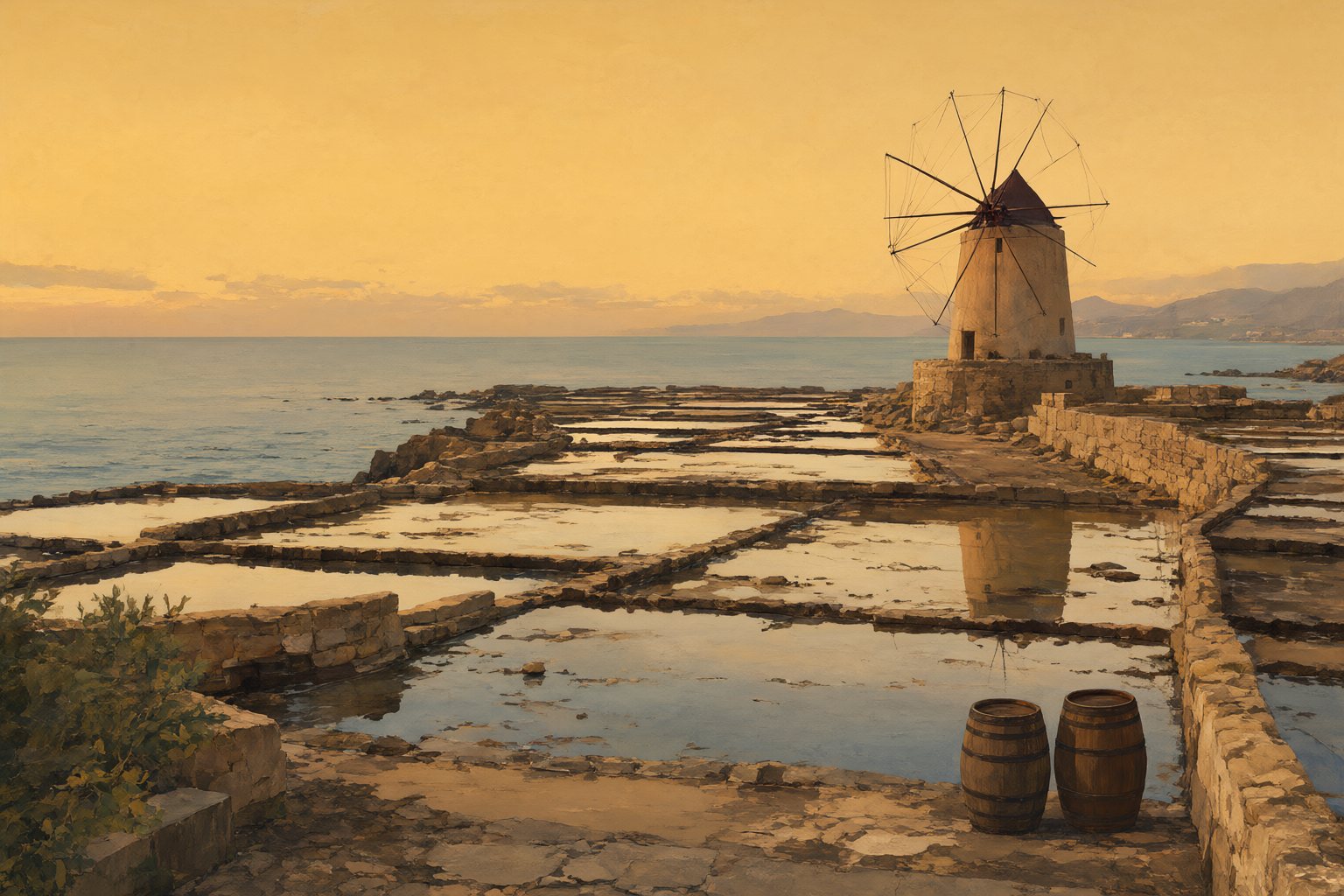
Ask ten Italians where they keep their bottle of Marsala. Seven will point to the cupboard next to the sugar, two to the spice shelf, and one will look at you as if you had asked about castor oil. No one, or almost no one, will mention the cellar. And yet this is the Italian wine that first conquered the markets of the world, the one that sat in the holds of the British fleet and in Victorian drawing rooms long before anyone abroad could pronounce “Barolo”. We turned it into an ingredient for escalopes. It is a sin that deserves a few paragraphs of penance.
An Englishman, a storm, a barrel
The canonical story begins in 1773, when the Liverpool merchant John Woodhouse landed at Marsala, driven there, according to tradition, by bad weather. The dates vary a little depending on the source (some place his arrival a few years earlier), but the point does not change: Woodhouse tasted the local wine, already aged even then using a topping-up system the peasants called perpetuo, and saw in it a natural rival to Port, Sherry and Madeira, which the English drank by the barrel. To help it survive the voyage he added grape spirit to the casks. Thus, for logistical reasons before aesthetic ones, fortified Marsala was born.
The stroke of luck came with the Royal Navy. Around 1800 Admiral Nelson ordered an annual supply of several hundred casks for his fleet (the chronicles speak of 500), and a provincial Sicilian wine suddenly became an affair of state. Woodhouse, meanwhile, had opened his baglio at Marsala, the first establishment devoted to the wine.
Ingham, Whitaker, Florio: the wine dynasty
Where there is business, a competitor follows. Benjamin Ingham, who landed in Sicily from Leeds in 1806, founded his own establishment a few years later and took Marsala far beyond England, as far as the Americas. Ingham was an entrepreneur of a different stature from Woodhouse: trade, banking, ships. His empire later passed to his Whitaker nephews, a family that would leave more traces in Palermo and on Mozia than you will find in an encyclopaedia.
The first Italian to really enter the game was Vincenzo Florio, who in the early 1830s built his cellars on the Marsala seafront. With Florio, Marsala stopped being a business of foreign merchants and became a source of Sicilian pride, complete with family legend, wealth worthy of a novel and a permanent place in the island’s economic history. For much of the nineteenth century, if an Italian wine travelled the world with a recognisable name, that name was Marsala.
How to read a label (and why it’s worth doing)
Marsala had its production zone delimited by law as early as 1931, ahead of most Italian wine, and became a DOC in 1969, among the country’s first appellations (not the very first, as is sometimes claimed: that honour belongs to others). The current rules derive largely from the law of 1984, which brought order back to a system that had become anarchic.
The first criterion is colour. Oro (gold) and ambra (amber) are made from white grapes, mainly Grillo, Catarratto, Inzolia (Ansonica) and Damaschino; the difference is that ambra requires the addition of mosto cotto, cooked grape must, which gives colour and notes of caramel, while oro forbids it. Rubino (ruby), rarer, comes from red grapes such as Perricone, Nero d’Avola and Nerello Mascalese, and it too is made without cooked must.
The second criterion is time, and it is the one that matters most:
- Fine: at least one year of ageing, minimum strength around 17 degrees.
- Superiore: at least two years, 18 degrees.
- Superiore Riserva: at least four years.
- Vergine or Soleras: at least five years, with no cooked must or added sugar; only wine and alcohol.
- Vergine Stravecchio or Riserva: at least ten years in wood.
The third criterion is sugar: secco (dry) up to 40 grams per litre, semisecco (medium-dry) between 40 and 100, dolce (sweet) over 100. The result is a grid that looks daunting at first sight but is in fact a little atlas of styles, from the sweet Fine for pastry-making to the dry Vergine, bone-dry, saline, oxidative, which need fear no comparison in the eyes of a lover of Sherry or Vin Jaune. The problem is that almost nobody gets to the bottom of the list.
The egg that ruined everything
The decline has no precise date, but it has an identifiable culprit. After the war, faced with demand for sweet, easy wine, the industry responded by stretching the Marsala name over a series of flavoured products: egg, almond, coffee, cream. Cremovo, zabaglione in a bottle, ended up on the shelves next to the Vergine wines with the same name on the label. For the average consumer, that is what Marsala became: something sweet and thick, good for tiramisu or for deglazing veal. The real wine disappeared behind its caricature.
The 1984 law tried to plug the leak: flavoured products could no longer be called Marsala, after a three-year transition period, and were renamed “flavoured wine” or confined to the list of ingredients. But habits outlive regulations. Even today, in many cookbooks and many minds, “Marsala” means a seasoning.
The redemption, slow and stubborn
The revival began on the margins, as is often the case. The most cited example is Marco De Bartoli, who from 1978 took over the family estate at Samperi and returned to the old perpetuo method, eventually producing an unfortified wine, pure Grillo, topped up each year with a small share of new wine. Paradoxically, precisely because it is not fortified, that wine cannot bear the name Marsala on its label: and it became the manifesto of what Marsala was before we standardised it. For years De Bartoli was regarded with suspicion; today he is considered a benchmark.
Around that example a small front of producers, large and small, has formed, staking everything on the Vergine wines, on long spells in wood, on Grillo as the grape of identity. Grillo, meanwhile, has built itself a second life as a dry, fresh, sea-scented white, and this has helped remind everyone that those grapes were not born for the saucepan.
The cultural knot remains, though. Good Marsala exists, it is long-lived, versatile at table well beyond dessert, and often costs less than a fashionable white with a picture-postcard name. What is missing is the courage to serve it in a proper glass, lightly chilled, with a plate of aged cheeses or raw fish, instead of keeping it in the larder with the nutmeg. We spent two centuries getting the English to drink Marsala and half a century forgetting it ourselves. It is time to reverse the proportion.
❦