Montepulciano: the Abruzzo grape or the Tuscan town?
Montepulciano d’Abruzzo and Vino Nobile di Montepulciano share only a name: grapes, regions, rules and how to tell them apart on the label.
Order “a Montepulciano” in a Milan restaurant and you will almost certainly be brought a red from Abruzzo. Do the same in Siena and the waiter may look at you with a raised eyebrow, asking whether you mean the Nobile or the Rosso. Same word, two regions, two different grapes, two stories that never meet. It is probably the most deep-rooted misunderstanding in Italian wine, and it is not the drinker’s fault: it is the fault of a name that, for once, denotes both a grape and a town.
A grape called Montepulciano
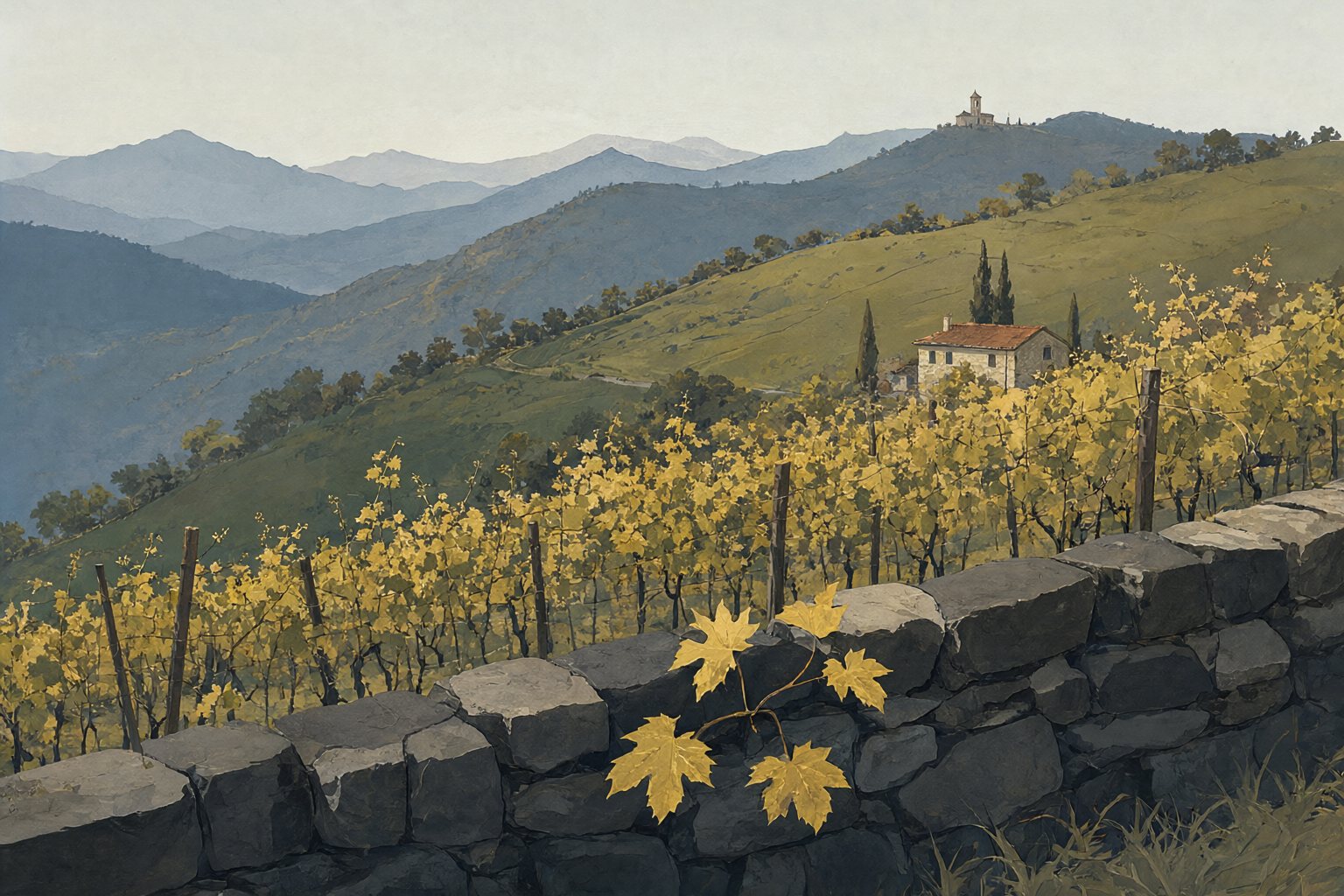
Montepulciano is a black-skinned grape, and its home is Abruzzo. It is also grown in the Marche, where it is the backbone of Rosso Conero, and in other regions of central and southern Italy, but it is on the hills between the Apennines and the Adriatic that it has become an identity. It gives wines of very deep colour, rich in dark fruit, with soft tannins and a certain generosity: a grape that ripens well, crops abundantly and carries off both everyday versions and ambitious ones built for long ageing.
The Montepulciano d’Abruzzo appellation has been a DOC since 1968 and requires at least 85% Montepulciano, with the remainder allowed to be Sangiovese. The basic version is released early, while the Riserva must age for at least two years, part of it in wood. The production rules also provide for subzones with stricter regulations and are undergoing a revision whose details, at the time of writing, are not all final: anyone wanting the up-to-date map would do well to check the consortium’s sources.
Then there is Cerasuolo d’Abruzzo, which is the same grape vinified as a rosé, so deep in colour that it looks like a light red. Since 2010 it has had a DOC of its own, which adds a third name to the general chaos.
Colline Teramane, the top step
In the north of the region, in the province of Teramo, Montepulciano gained its DOCG: Colline Teramane Montepulciano d’Abruzzo, born as a DOC subzone in the 1990s and promoted in 2003. Here the rules tighten: at least 90% Montepulciano, at most 10% Sangiovese, lower yields, a minimum of one year’s ageing for the basic version and three years for the Riserva, at least one of them in cask.
It is a small appellation, producing a tiny fraction of the ocean of Montepulciano d’Abruzzo. And that is precisely why it deserves attention: it is where the grape stops being a synonym for affordable red and tries to tell the story of a place, among clay hills, the nearness of the sea and the shadow of the Gran Sasso behind.
A town called Montepulciano
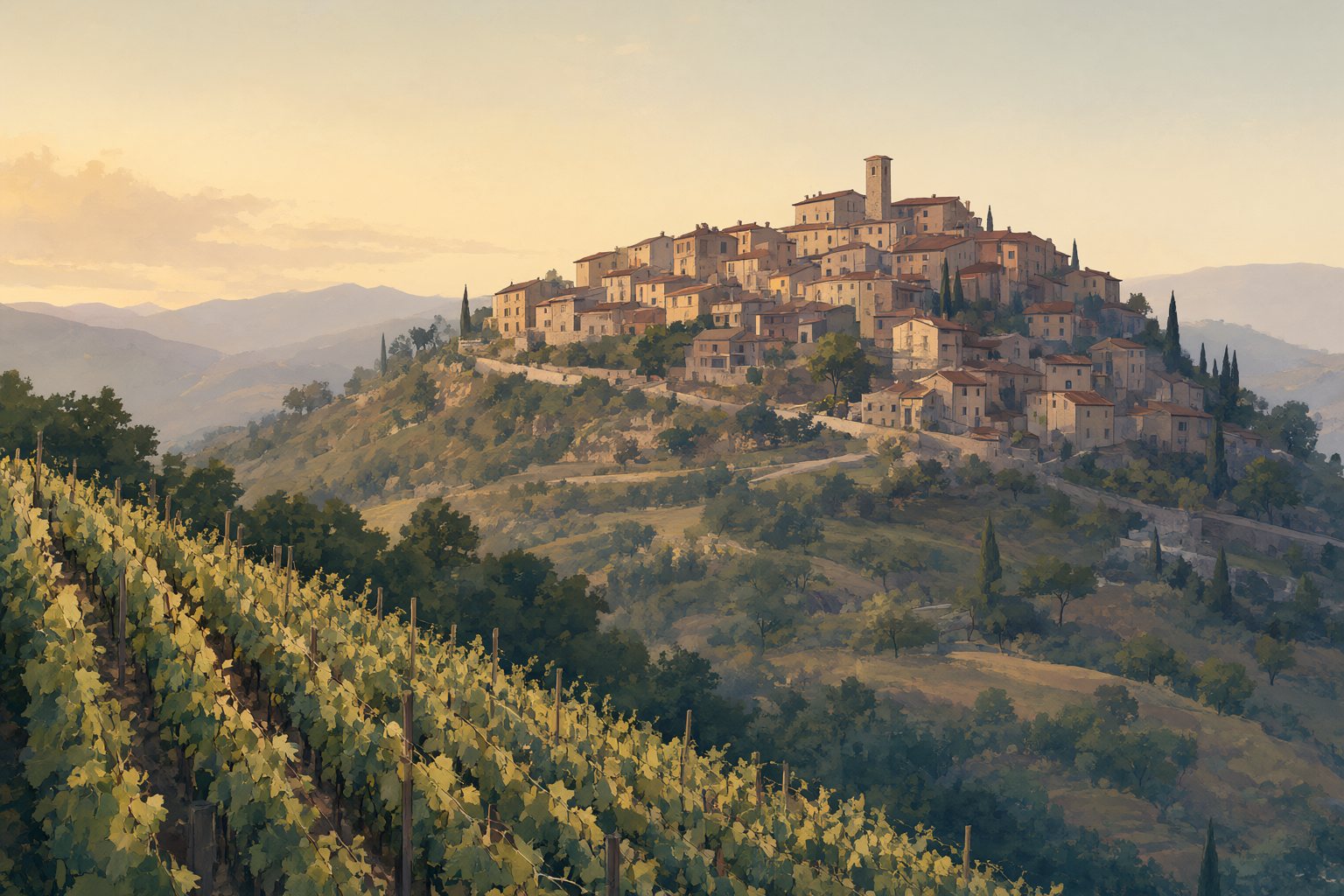
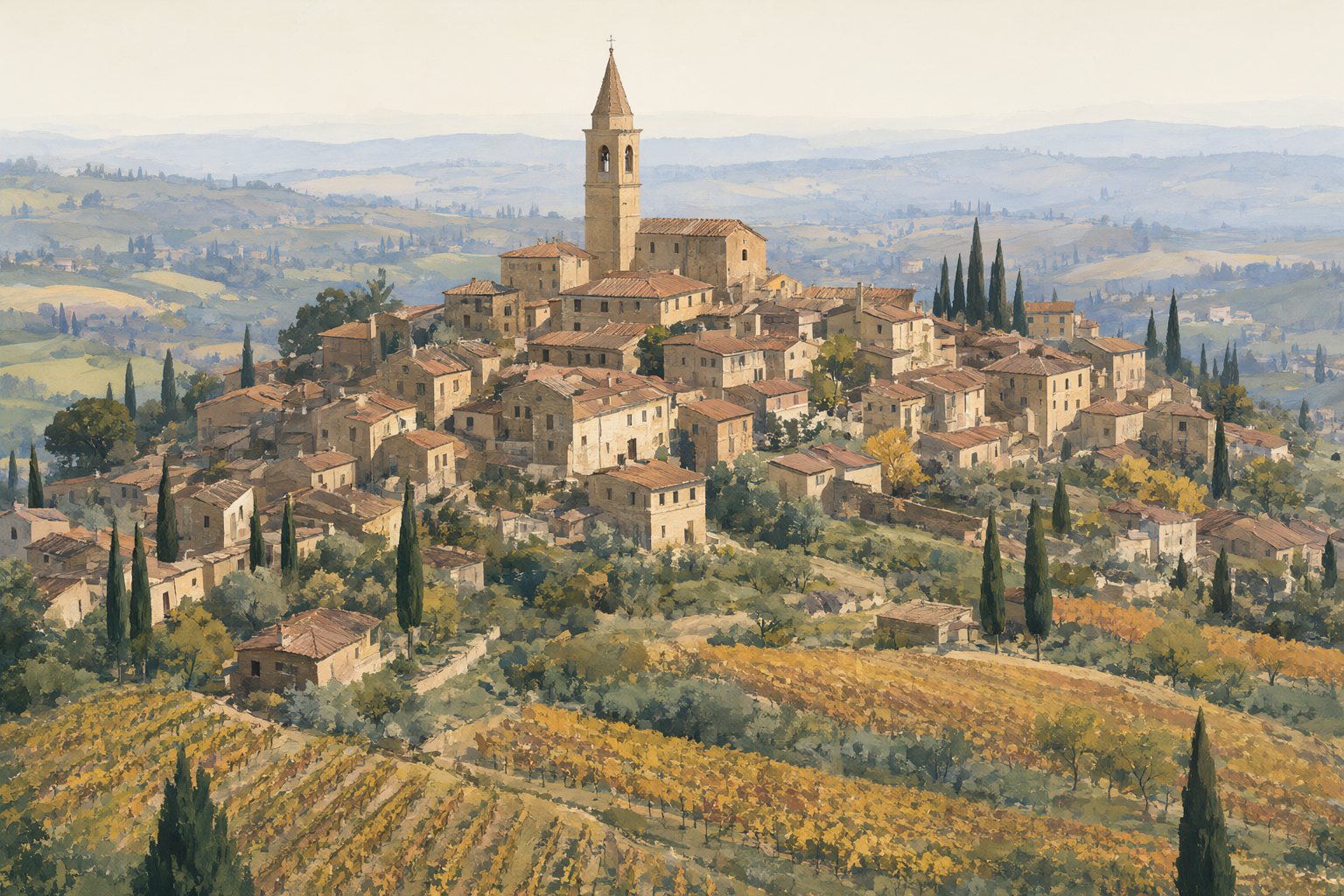
Let us move a few hundred kilometres west. Montepulciano is a Renaissance hill town in the province of Siena, perched on a ridge between the Val di Chiana and the Val d’Orcia. Its most celebrated wine is Vino Nobile di Montepulciano, and here the Montepulciano grape has nothing to do with it: the base is Sangiovese, which locally bears the historic name of Prugnolo Gentile.
The Nobile has a pedigree few Italian wines can boast. In 1685 Francesco Redi, in his dithyramb Bacco in Toscana, crowned it king of all wines, and its fame has never faded since. In 1980 it was among the first Italian wines to gain DOCG status; the consortium in fact claims it was the very first. The production rules require at least 70% Sangiovese, with the rest entrusted to other grapes authorised in Tuscany, and a minimum of two years’ ageing, rising to three for the Riserva. Alongside it stands Rosso di Montepulciano DOC, the younger, more immediate sibling, which can be released as early as the spring after the harvest.
The Pievi, or Tuscany getting serious
The latest Tuscan development is also the most interesting. Vino Nobile has introduced the Pieve designation, which divides the territory into twelve additional geographical units traced over the boundaries of the ancient pievi, the ecclesiastical districts of late antique and Lombard times. The names already sound like a wine list: Argiano, Ascianello, Badia, Caggiole, Cervognano, Cierliana, Gracciano, Le Grazie, Sant’Albino, San Biagio, Valardegna, Valiano.
The rules are strict. At least 85% Sangiovese, with the rest only from complementary native varieties; grapes exclusively from the estate that bottles the wine, from vines at least fifteen years old; lower yields; three years of ageing, at least twelve months of them in wood and twelve in bottle. The national wine committee gave the green light in 2023, the production rules were published in 2024 and the first bottles, from the 2021 vintage, reached the market at the start of 2025. We are talking about roughly a tenth of total Nobile production: a niche, at least for now.
The point of the exercise is clear. After years spent explaining to the world that the Nobile is not Montepulciano d’Abruzzo, Montepulciano has decided to stop defending itself and at last talk about itself, that is, about soils, exposures and hamlets, as they do in Burgundy or the Langhe.
How not to get the label wrong
The golden rule is simple: look at where the word Montepulciano sits and what accompanies it.
- “Montepulciano d’Abruzzo”: Montepulciano is the name of the grape, Abruzzo the region. A red from Abruzzo, Montepulciano grape.
- “Colline Teramane Montepulciano d’Abruzzo” with DOCG: still the Abruzzo grape, in its most rigorous version, from the province of Teramo.
- “Cerasuolo d’Abruzzo”: a rosé from Montepulciano grapes.
- “Vino Nobile di Montepulciano”: here Montepulciano is the town. Inside is Sangiovese. If the word Pieve appears followed by a name, you are in the appellation’s highest and most precise tier.
- “Rosso di Montepulciano”: still the Tuscan town, still Sangiovese, in a younger version.
The preposition trick helps: “di Montepulciano” (“of Montepulciano”) almost always indicates the place, while “Montepulciano d’” indicates the grape followed by its region. It is not a grammatical law, but in a wine shop it works.
The glass gives clues too, with due caution. Abruzzo’s Montepulciano tends towards a darker, more impenetrable colour, dark fruit and softer tannins; the Nobile, like many Sangiovese wines, usually has a more translucent red, tauter acidity and drier tannin. Generalisations, of course, but useful for not confusing the two blind.
One name, two prides
Every so often someone proposes settling the question by renaming something. That would be a mistake. The misunderstanding is irritating, but it is also proof of how layered Italian wine is: a grape that perhaps took its name from a distant place, a town that built its reputation on another grape. The real solution is not to simplify, but to study the label for ten seconds longer. And if we must give some advice, here it is: next time you get the chance, put a Colline Teramane and a Nobile Pieve on the same table. You will understand in one sip why they are two worlds, and why both deserve to hold on tight to their name.
❦