Cinque Terre wine, the vineyard that climbs in steps
Dry-stone walls, monorails, Bosco, Albarola and Vermentino. The wines of the Cinque Terre and Sciacchetrà, a passito that survives only while the terraces are farmed.
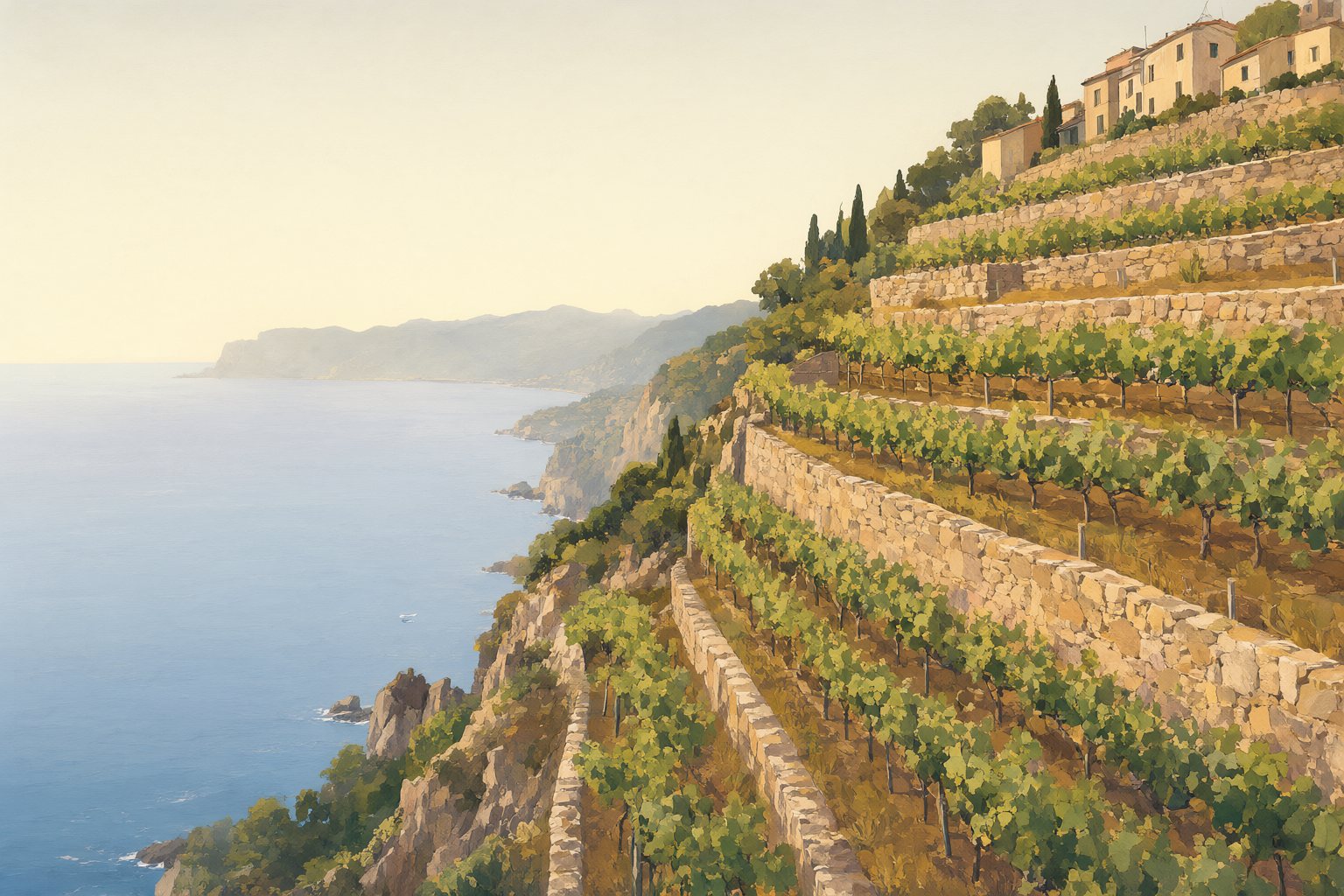
Before it is a wine, the Cinque Terre is a work of masonry. Look at those slopes from the sea and you see vineyards; look from close up and you see stones, millions of them, laid one on another without mortar, building steps as narrow as a shelf above the water. The vine, there, is almost a pretext. The real product is the terrace, and the wine is what keeps it from collapsing.
A landscape made by hand
The dry-stone walls (muretti a secco) are the load-bearing structure of everything. They hold back the little soil there is, drain the rain, and store the sun’s heat to give it back to the vines at night. Some sources trace their origins back to around the eleventh century; the exact date is hard to pin down, but the idea of a landscape built over centuries, one stone at a time, is very well documented. It is no accident that in 1997 UNESCO inscribed the Cinque Terre on the World Heritage list as a cultural landscape, and that in 1999 the national park was born.
On the steepest slopes no machine can pass. The work is done by hand, bent double, with vines kept low to shelter them from the salt-laden wind. To bring the grapes down, monorails were built, little rack-and-pinion trains that climb between the rows and replace, at least in part, the toil of shoulders and baskets along the footpaths. It is an almost comic image, a tiny train on a terrace that looks like a staircase, but it is the reason someone still harvests. How many tracks and how many kilometres of walls there are, I will not say: I found no figure I trusted, and I prefer silence to an invented number.
Three white grapes and one rule
The wine of the Cinque Terre denomination, recognised in 1973, is a white made from three local varieties. According to the production rules, Bosco must make up at least 40%; Albarola and Vermentino may each reach up to 40%, and a further share of up to 20% may come from other permitted white grapes. Real proportions vary from cellar to cellar, and they should not be taken as fixed truths: the sources consulted give different figures.
Bosco is the character. It gives structure and a savouriness that seems borrowed from the cliff. Albarola brings freshness and aromatic finesse, Vermentino roundness and a more recognisable profile. The result, in the dry versions, is a dry, mineral white, often more serious than its postcard reputation would suggest. Its virtue is precisely this: it does nothing to please at once, and so it holds up well over the years. It is not a wine for distracted aperitifs: it needs fish, focaccia, Ligurian olive oil, a cuisine with the same frankness.
Sciacchetrà, the passito in no hurry
Sciacchetrà is the other face of the denomination, and probably the more interesting one. It is a passito, a wine from dried grapes: the best bunches, above all Bosco and Albarola, are selected and left to dry in ventilated rooms for weeks (one source speaks of about fifty days), so that the sugars concentrate. Then comes a slow vinification, and ageing before release. It is often found in small 37.5 cl bottles, because production is minimal and every bunch costs effort.
In the glass we are not looking for the sugary sweetness of other passiti. Amber, honey, candied orange peel, hay, an acidity that keeps the sip taut, and a salty note that leads back to the land of origin. It suits aged or blue cheeses, dry pastries, or can be sipped alone at the end of dinner, when conversation slows. As with almost any handmade sweet wine, the shelf price is high compared with an ordinary wine, but an exact figure depends too much on producer and vintage to be given seriously.
The risk of abandonment
Here the story stops being picturesque. According to one source consulted, a century ago the vineyards covered around 1,400 hectares; today there are around 150. These are indicative figures, not confirmed by a second source, but the order of magnitude of the loss is clear to anyone who walks those paths. An uncultivated terrace does not stay as it is. Bramble roots push, water seeps in, a wall gives way and drags down the one beneath it. A single season of heavy rain is enough to see collapse in a few days what took centuries to build.
The problem is not nostalgia, it is economics and demography. What is an hour of work on a step one metre wide worth? What is the wine that comes out of it worth? Very few small estates hold up the hardest part, and the tourism that fills the villages does not automatically translate into people climbing up to prune.
Drinking to keep the walls standing
I do not believe in the rhetoric of wine that saves the world. But I do believe that in few places does the choice of a bottle have such visible consequences. Buying a white or a Sciacchetrà from the Cinque Terre, from a small producer who truly works those slopes rather than from a commercial postcard, means paying for the upkeep of a landscape that would otherwise slide into the sea. So yes, let us accept that it costs more: it is not only grapes and fermentation, it is also masonry.
❦