Valtellina, the Nebbiolo that climbs the dry-stone walls
Terraces, dry-stone walls and Chiavennasca, or how mountain Nebbiolo is made in Valtellina, from the five subzones to Sforzato from dried grapes.
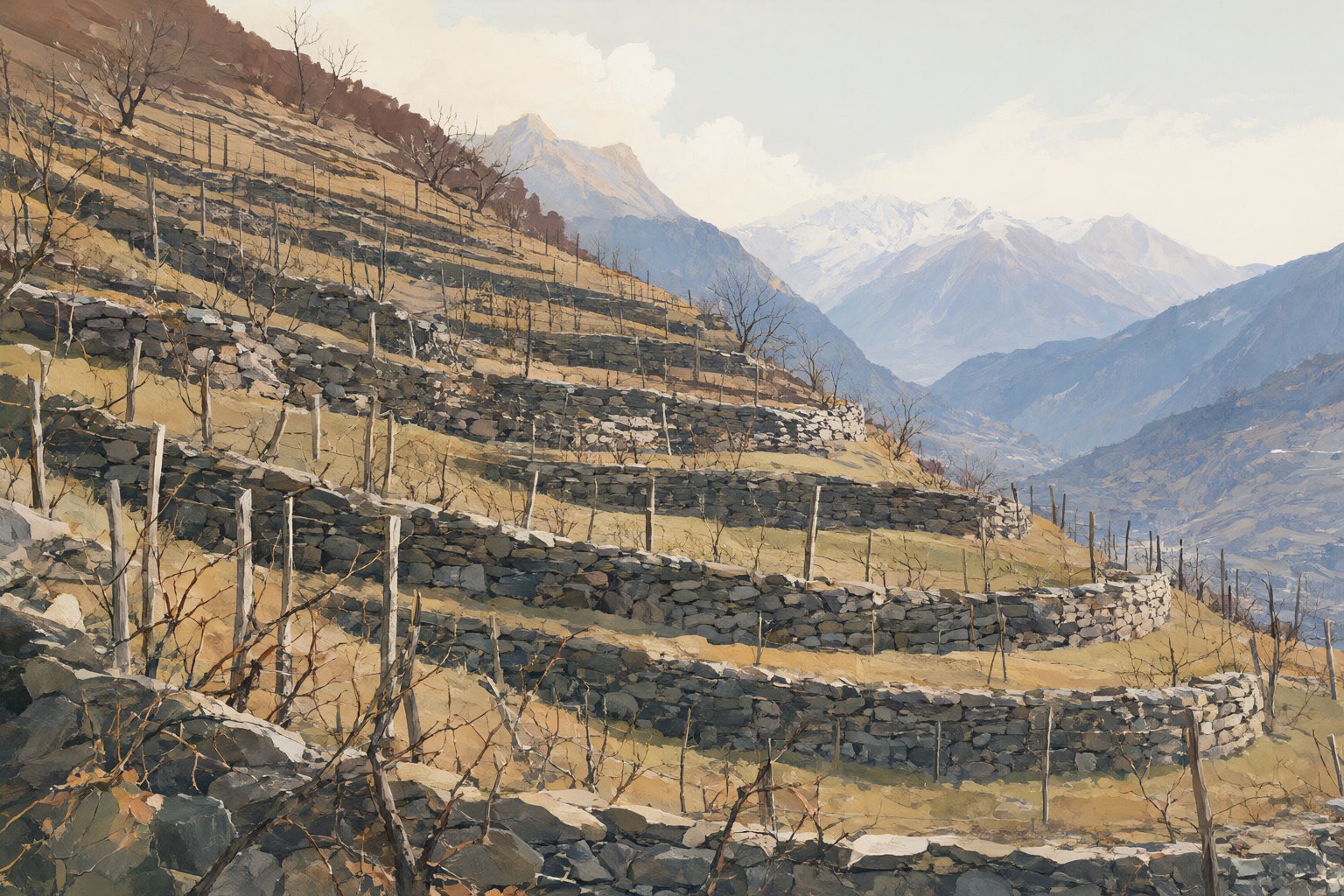
Imagine having to plant a vineyard on a wall. Not a gentle hillside but a wall, with slopes that in places reach 70 degrees, where every row exists only because someone, centuries ago, stacked dry stones to hold back a little soil. Valtellina has been doing this for a thousand years, with a grape that elsewhere enjoys the luxury of softer hills. The result is a Nebbiolo with the character of someone who has had to fight for every centimetre of room.
One slope, built entirely of stone
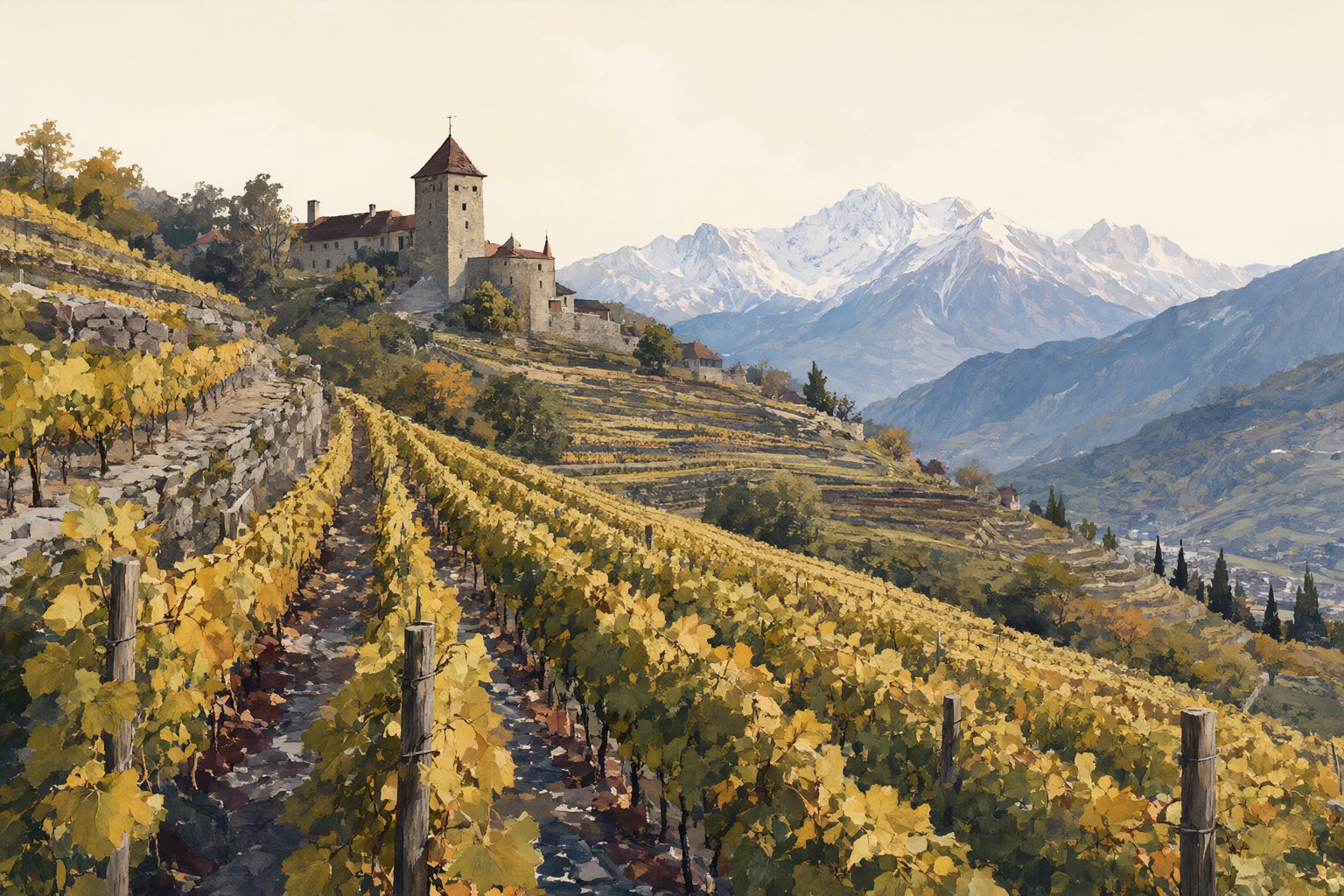
Valtellina’s vineyards sit almost entirely on the Rhaetian slope, which faces south and catches the sun all day. According to a University of Milan study of the area, the wine belt covers roughly 1,200 hectares, tops out around 700 metres above sea level and runs over slopes inclined between 27 and 70 degrees. Those figures alone explain why mechanisation here is more of a joke than a plan.
What makes it all possible are the muretti a secco, the dry-stone walls: the same research puts their combined length at around 2,500 kilometres. Stone on stone, without mortar, drawing terraces sometimes barely wider than a single row of vines. They act as buttresses against landslides, as heat stores that give back at night what they took in by day, and as a bulwark against exhaustion, because much of the work is still done by hand. Those who built them were not thinking of the landscape; they were thinking of survival. That they now look like a work of art is a side effect, and probably the best one.
As for the grape, tradition traces it to Benedictine monks, who are said to have brought Nebbiolo into the Alpine valleys between the tenth and eleventh centuries. Here it is called Chiavennasca, and for its wider story I refer you to the article Vinofilo has already devoted to Nebbiolo. What matters in Valtellina is that it is the same grape as in the Langhe, but with a different voice.
Valtellina Superiore and its five subzones
The flagship designation is Valtellina Superiore DOCG, recognised in 1998 (it had been a DOC since 1968). The rules require at least 90% Nebbiolo and two years of ageing in total, at least twelve months of it in wood, rising to three years for the Riserva. There are five subzones, and the list sounds like a small Alpine litany: Maroggia, Sassella, Grumello, Inferno and Valgella.
The differences between them matter to those who have drunk them for a long time, and prudence advises against brochure-style schematics in which each subzone gets a fixed adjective. What can be said with confidence is that they are distinct portions of the slope, each with its own exposure, altitude and history, and that the name on the label is an indication of place before it is one of style. Anyone who wants to understand them properly must do what one does in Burgundy: pick one, drink three vintages, and only then move on.
One thing, though, can be said without too much hedging: Valtellina Superiore is mountain Nebbiolo in the fullest sense. The freshness is high, the fruit is taut, the tannin has a nervy grain. It does not seek the solemn majesty of certain Barolos, and it is right not to. Its appeal lies in tension, in the sense that the wine has been hauled up from the rock with the same effort that went into farming the vineyard.
A figure for scale, to grasp what we are talking about. According to statistics gathered by Italian Wine Central, Valtellina Superiore covered around 300 hectares in 2021, with average five-year production of about 13,350 hectolitres. Crumbs compared with the great Piedmontese designations. But that is precisely why it should not be treated as a curiosity: when a designation is this small, every bottle carries a story of geography and obstinacy.
Sforzato: Nebbiolo turned dense
Then there is the other face. Sforzato di Valtellina, or Sfursat, has been a DOCG since 2003 (also a DOC from 1968) and is made from Nebbiolo, minimum 90%, left to dry after the harvest until it reaches a potential alcohol of at least 14%. The rules call for at least 20 months of ageing, 12 of them in wood, with release from 1 December of the year after the harvest.
The principle is appassimento, the drying of grapes, the same as for Amarone, and the comparison comes naturally, even if it does an injustice to both. Sforzato is not a mountain Amarone: it is Nebbiolo that uses drying to gain body and that, in the best versions, keeps the freshness of a grape grown at altitude.
The numbers describe a niche within a niche: about 61 hectares in 2021 and average production of 2,460 hectolitres over the last five years, again according to Italian Wine Central. These are volumes that rule out any commercial phenomenon, and perhaps that is for the best.
Why it is worth a look
Valtellina has an image problem that is the flip side of its strength: it is difficult, small, awkward to reach and awkward to work. Nobody passes through by chance. Yet it is one of the very few places in Italy where landscape and wine say the same thing at the same moment, and where the glass is, almost literally, the final bill for a collective effort lasting centuries.
My opinion is simple. If you love Nebbiolo and know only the Langhe, you are reading a single chapter of a longer book. Valtellina should not be treated as a cheaper or folkloric alternative: it is a different reading of the same grape, with less ceremony and more nerve. And it has an advantage that the more celebrated hills are losing, namely that it has not yet stopped surprising.
❦