What wine goes with sushi: bubbles, Riesling and the reds to leave at home
Soy, wasabi, salmon and tempura: why dry sparkling wine, Riesling and rosé work with sushi, and which wines to avoid. With Italian examples.
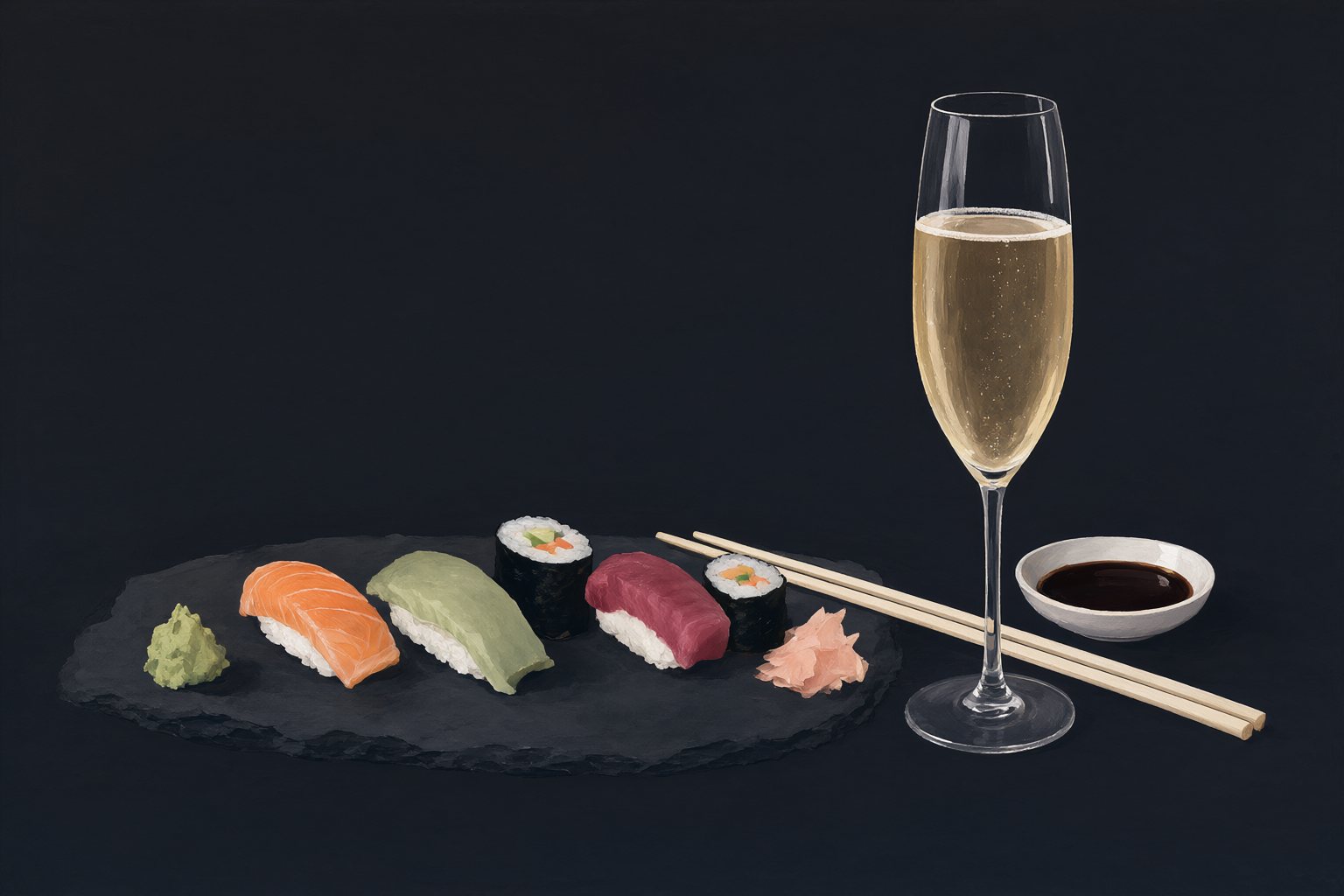
Sushi is the dish that most unsettles wine lovers, because it looks simple and is in fact a small trap. Rice that is faintly sweet and sour, raw fish, a fiercely salty sauce, a green paste that stings the nose, pickled ginger. Five different registers in the same mouthful, and not one of them asks for an important wine. It asks for an intelligent one.
The Italian reflex, at a Japanese restaurant, is to order “a white” and think no more about it. It is not wrong, but it is approximate. With a little method you can see why certain wines make sushi taste better and others ruin it, and you discover that the best answer often has bubbles.
The real enemy is soy
Before the fish, it is worth looking at the little dish. Soy sauce brings two things: plenty of salt and plenty of umami, that full, brothy flavour that comes from the glutamate produced by fermentation. Salt is generally an ally of wine: it blunts the perception of bitterness and makes wines seem softer. Umami, on the other hand, is a capricious ally. It tends to heighten bitterness and astringency, and to make a wine with prominent tannins or oak seem harder and more metallic.
From this comes a useful rule: with soy, the winners are wines in which acidity does the work and tannin is absent, or nearly so. Acidity cleans the salt from the mouth, gets the saliva flowing again and prepares you for the next bite. It is the same reason a squeeze of lemon fixes so many things.
Wasabi deserves a note too. What is served in most restaurants outside Japan, as food writers have been reporting for years, is in fact a paste made from horseradish and mustard with colouring, while the real root is rare and expensive. Real or fake, the principle is the same: a volatile heat that rises to the nose and passes quickly. High alcohol amplifies it, so moderate-strength wines are better, under thirteen degrees where possible. Ginger, incidentally, is not a condiment but a palate cleanser between one piece and the next: there is no point looking for a pairing for it.
Oily fish, lean fish, fried fish
The second axis is the raw material. A nigiri of sea bass or sea bream is delicate, almost vegetal, and wants a subtle wine. Salmon and tuna belly are another matter: fatty, buttery, enveloping. Here you need something that cuts, with taut acidity or fine bubbles, able to strip away the fat without smothering.
Then there is tempura, which on all-you-can-eat menus turns up as often as raw fish. Light Japanese frying is the easiest thing on the whole table to pair: all it asks for is freshness and, if possible, bubbles. It is the same reason that in Italy a plate of fried fish almost always ends up beside a sparkling wine.
The sweet sauces of uramaki, the dark glazes or the spicy mayonnaises, shift everything a little further. A wine with a shadow of residual sugar, or at least ripe, aromatic fruit, holds up better than a cutting, bone-lean white.
Why dry bubbles almost always win
If you have to choose a single bottle for the whole meal, the most solid answer is a dry traditional-method sparkling wine. It has high acidity for the salt and the fat, the bubbles act as a brush on the palate, the alcohol is moderate, and those bread-crust notes that come from ageing on the lees converse nicely with the rice and the tempura.
In Italy you are spoilt for choice. Franciacorta, Trento DOC and Alta Langa are all areas that work with refermentation in the bottle. For sushi it is best to lean towards the driest versions, Brut or better still Extra Brut and Pas Dosé, where added sugar is minimal or absent. A Blanc de Blancs, made from chardonnay grapes alone, is more agile; a traditional-method rosé, with a little pinot nero, stands up better to tuna and salmon. A Prosecco Brut or Extra Brut also works well, fruitier and less complex, perfect if the menu leans towards sauces and fried food.
Riesling, aromatics and rosés
The second family is that of the aromatic whites, provided the hand is light. Riesling is the natural candidate: very high acidity, precise fruit, often low alcohol, and in its slightly sweet versions it is one of the few wines able to stand beside soy and glazed sauces without losing out. In Italy it is found above all in Alto Adige and the Oltrepò Pavese, in dry, taut versions.
Among the moderate aromatics, Müller-Thurgau from Alto Adige and Trentino works, subtle and moderate in alcohol, as does a Gewürztraminer used with judgement, that is, with the spicier and sweeter dishes, not with sea bream nigiri, which would vanish. Among the non-aromatic whites, young Verdicchio dei Castelli di Jesi, Vermentino di Gallura, Lugana and steel-fermented Ribolla from Friuli all have that acid backbone and savouriness that raw fish loves.
Rosés are the choice few people make and many should. They have the freshness of a white with a discreet red fruit that gets along well with tuna and salmon. Chiaretto di Bardolino, Cerasuolo d’Abruzzo in its lighter versions, Etna Rosato, Salento rosé from negroamaro: as long as they are from the latest vintage, low in alcohol and unoaked.
What to leave in the cellar
Tannic reds are the classic mistake, and it is not just a question of taste. In 2009 a group of researchers from the Japanese company Mercian, led by Takayuki Tamura, published a study in the Journal of Agricultural and Food Chemistry identifying the iron contained in wine as an essential cause of the fishy aftertaste that appears in certain pairings with seafood. Iron content varies from wine to wine, red or white, so the rule is not absolute; but combined with the conflict between tannin and umami it goes a long way to explaining why a Barolo or an Aglianico beside raw salmon tastes metallic and tired.
If you really want a red, better a light one served cool: a Grignolino, a Schiava, a young pinot nero, perhaps with seared tuna rather than raw. Also to be avoided are whites aged at length in barrique, buttery and vanilla-laden, which weigh the fish down and quarrel with the soy, and any wine over fourteen degrees, which with wasabi turns into a blaze.
That leaves a provocation, and we are happy to sign up to it: sushi is one of the few dishes in which the simplest wine on the list often beats the most ambitious. A bottle of Pas Dosé traditional-method sparkling or a taut Riesling makes the chef look better. A great aged red makes the fish look less fresh. At a Japanese restaurant it pays to leave your ego in the cloakroom and order the bottle that knows how to step aside.
❦