Prosecco explained: DOC, DOCG, Cartizze and Rive
DOC, DOCG, Asolo, Cartizze, Rive and Col Fondo: a map of Prosecco, from the village near Trieste to the Glera grape and the UNESCO-listed hills.
Asking for “a Prosecco” at the bar is a bit like asking for “a cheese”. You will get something, of course. But behind that word lie a Karst village almost nobody has visited, a grape that changed its name in 2009 for reasons more legal than botanical, two DOCGs that eye the lowland DOC with suspicion, a patch of hillside that costs as much as a district of Milan, and a label term, “Extra Dry”, that means the exact opposite of what it seems. It is worth putting some order into it.
A village, a grape, a trick
Prosecco is first and foremost a place: a hamlet in the municipality of Trieste, on the Karst plateau overlooking the gulf. The grape that bore that name for centuries, however, had found its home mostly much further west, in the hills around Treviso. As long as “Prosecco” was the name of a grape, anyone anywhere in the world could plant it and write it on a label, from Australia to Brazil.
The solution that came with the 2009 reform was elegant and a little unscrupulous. The grape was rechristened Glera, an old local synonym, and “Prosecco” became a geographical name, protected just as Champagne or Chianti are. To make the geography credible, the new DOC was drawn so as to stretch all the way to the village of the same name: nine provinces across the Veneto (Treviso, Venezia, Vicenza, Padova, Belluno) and Friuli Venezia Giulia (Trieste, Udine, Pordenone, Gorizia). The result is an enormous appellation, held together partly by an umbilical cord running along the coast to the Karst. Those who find the move too clever by half have a point; so do those who find it a stroke of genius.
The pyramid: DOC at the bottom, hills at the top
The base is Prosecco DOC, vast and largely flat. A minimum of 85% Glera, the rest from permitted varieties; since 2020 there has also been a sparkling rosé version, with Pinot Nero providing the colour. The numbers are those of an industrial phenomenon: according to the Consortium, around 667 million bottles were produced in 2025, largely destined for export. This is the Prosecco of spritzes, office toasts and supermarkets across half the world. There is nothing wrong with that, provided you know what you are drinking.
Above sit the two DOCGs, both born with the 2009 reform. The older as a quality area is Conegliano Valdobbiadene Prosecco Superiore, a DOC since as far back as 1969: fifteen communes on the band of hills between the two towns that give it its name. The other is Asolo Prosecco, on the Colli Asolani and around the Montello, born as Colli Asolani and renamed a few years later. Asolo is smaller and less well known, and in recent years has built part of its identity on very low dosages, Extra Brut and Brut Nature.
A useful curiosity: the DOCG rules themselves also allow still and frizzante versions, but the “Superiore” qualification is reserved for the spumante alone. If you find the word on the label, you already know the bubbles are the real thing.
Cartizze and Rive: the cru and the bell tower
At the top of the pyramid is Valdobbiadene Superiore di Cartizze: around 107 hectares of vineyard on the hills between San Pietro di Barbozza, Santo Stefano and Saccol, in the commune of Valdobbiadene. Ancient soils, steep gradients, a sheltered position that lets the grapes ripen more calmly. The rules require hand harvesting and a higher minimum alcohol level. Cartizze is traditionally made in the Dry style, the softest, and those expecting the area’s driest cru are often surprised. The price of land here is legendary: the figures doing the rounds are very high but vary greatly from source to source, so let us take them for what they are, village tales more than price lists.
The Rive are the other face of the same idea. In the local dialect a riva is a steep slope, and the designation indicates a spumante from a single commune or one of its hamlets: the Consortium counts 43 of them. Here too, hand harvesting and a vintage on the label are compulsory. It is an attempt, successful more often than one might think, to make Prosecco speak the language of villages instead of that of a brand. Two Rive from different hamlets, tasted side by side, dismantle in a few sips the prejudice that it all tastes the same.
Col Fondo, or grandfather’s Prosecco
Before the autoclave, Prosecco was refermented in bottle in spring, with the yeasts then left at the bottom. No disgorging: the sediment was left where it was, and some drank it clear by pouring carefully while others shook the bottle to cloud it. This is Col Fondo, kept alive for decades in family cellars and back in fashion along with the curiosity for bottle-refermented wines.
In the Conegliano Valdobbiadene DOCG this style now has an official name, Sui Lieviti: a single-vintage spumante, refermented in bottle, undisgorged and obligatorily Brut Nature, that is, with no added sugar. It is a different Prosecco, more rustic and drier, with the bread-crust notes that come from contact with the yeasts. It is not for every occasion, but it tells you where this wine comes from better than any brochure.
Extra Dry does not mean dry
We come to the most widespread misunderstanding. Dosage terms follow the European rules for sparkling wines and, in order of residual sugar, run as follows: Brut Nature up to 3 grams per litre, Extra Brut up to 6, Brut up to 12, Extra Dry from 12 to 17, Dry from 17 to 32. Extra Dry, then, is sweeter than Brut, and Dry sweeter still. These names were born in an age when average taste was far sweeter than today’s, and nobody has had the courage to change them.
For Prosecco this scale matters more than for other sparkling wines, because Glera is an aromatic grape, with scents of apple, pear and white flowers. A little sugar supports and rounds them; too few grams on less ripe fruit can leave the wine thin. It is no accident that Extra Dry is the historic style of the hill zone: there, Prosecco has never tried to imitate anyone.
The hills UNESCO put on record
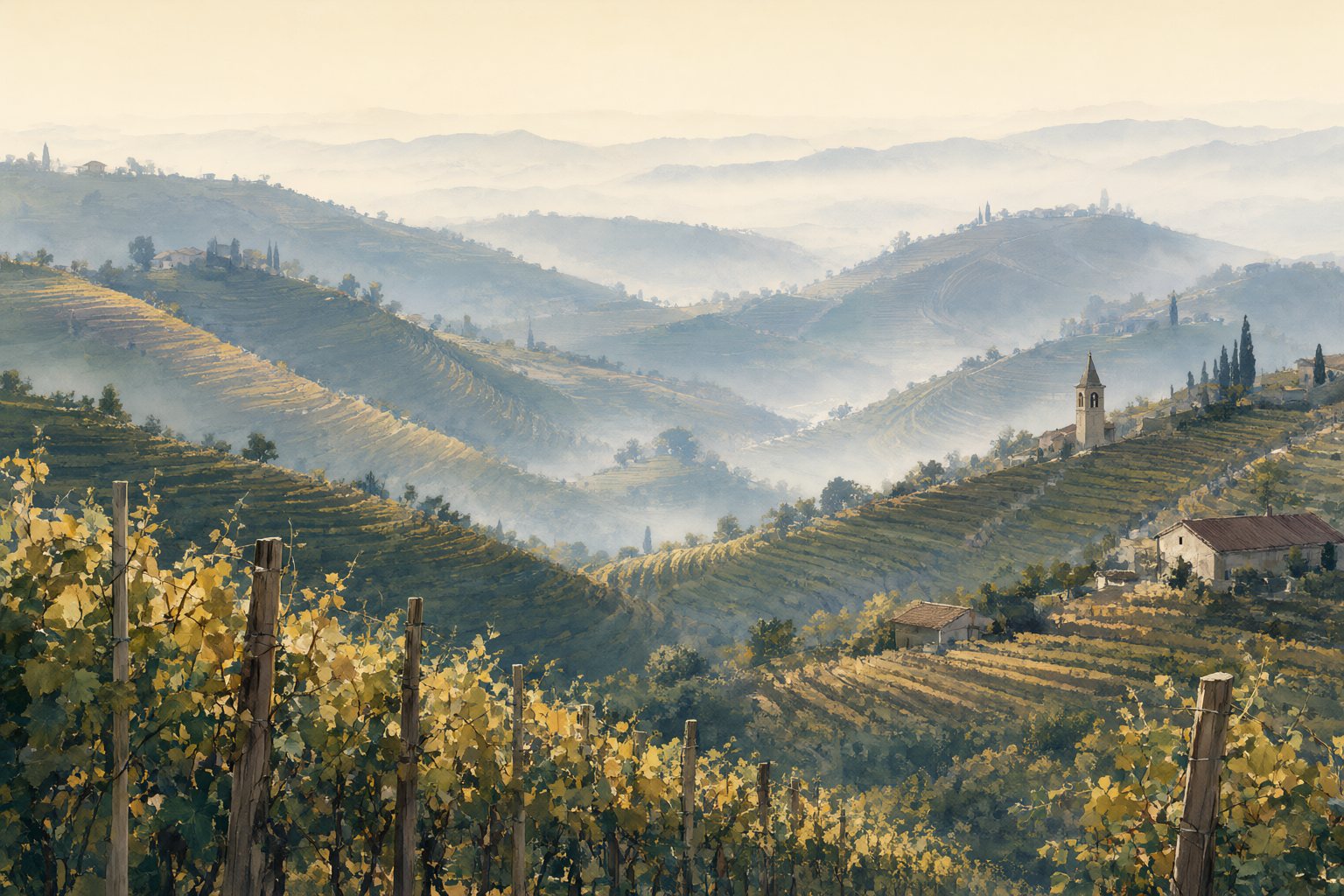
On 7 July 2019, in Baku, the World Heritage Committee inscribed the Colline del Prosecco di Conegliano e Valdobbiadene on the UNESCO list as a cultural landscape. What was recognised was not the wine but the design of the land: the steep “hogback” ridges, the grassy ciglioni terraces that hold up the rows, the mosaic of vines, woods and villages built by hand over centuries of work. You need only drive up to Valdobbiadene on a foggy morning to understand why.
And this, in our view, is the point of the whole business. The lowland DOC has made Prosecco a global word, and without those millions of bottles nobody would be talking about Rive or Cartizze. But the reason Prosecco deserves attention, and not just a distracted glass, lies on those hills that are impossible to mechanise. At the next bar, by all means ask for “a Prosecco”. Then ask where it comes from.
❦