Dolcetto isn’t sweet, and it may be Langa’s most honest red
Dry, dark and allergic to airs, Dolcetto has a name that lies. Dogliani, Diano d’Alba, Ovada, and why the grape is disappearing from Piedmont’s vineyards.
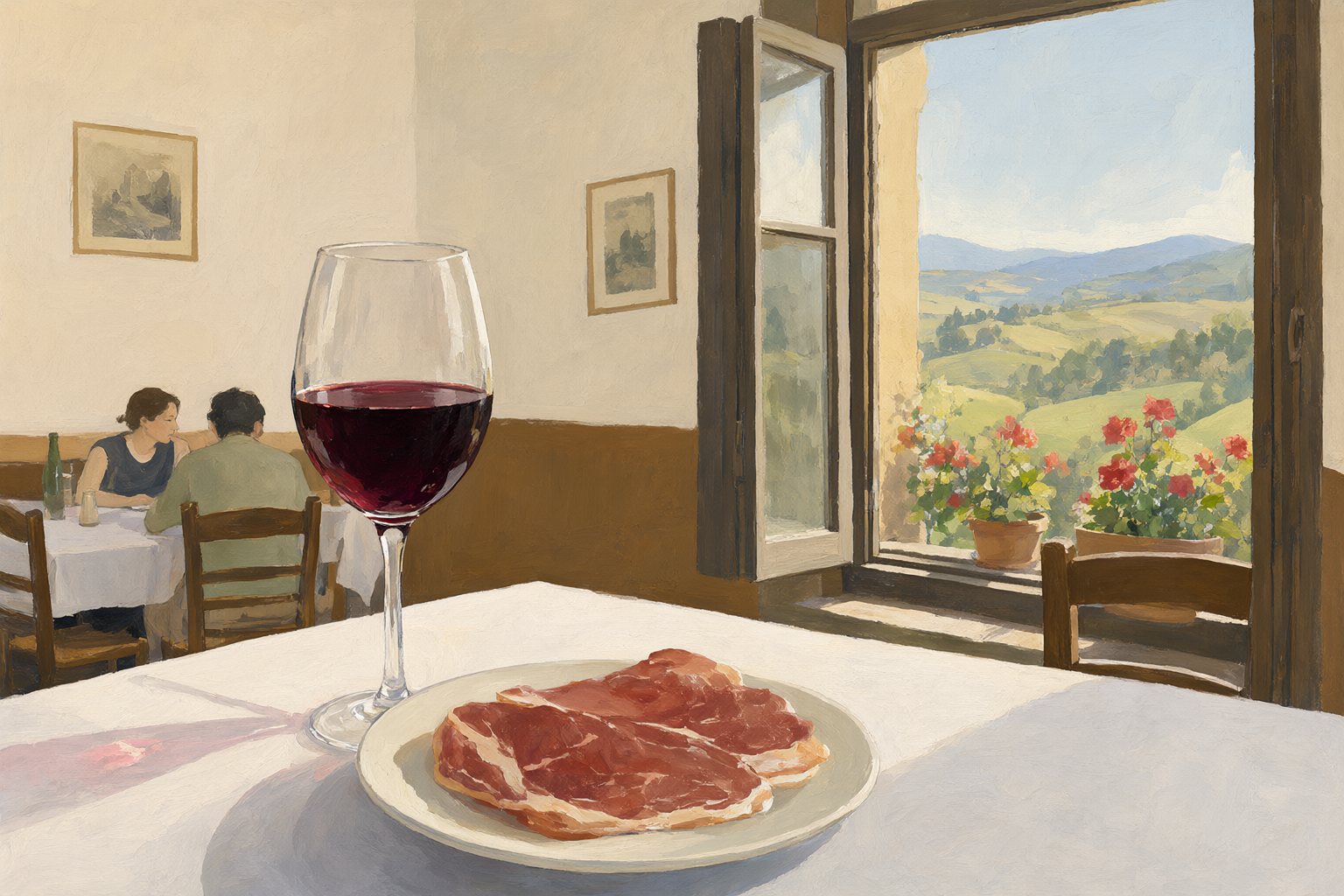
Order a Dolcetto hoping for something soft and sugary and the first sip will wrong-foot you. In the glass sits a violet-tinged red, close to ink; in the mouth, something dry, with a bitter-almond edge at the finish and a tannin that knows its own mind. The name promises a caress, the wine delivers a slap on the back. It is a joke Piedmont has been telling for centuries, and Dolcetto, unlike plenty of more celebrated wines, has never felt the need to explain it.
A name that doesn’t tell the truth
Where “Dolcetto” comes from, nobody knows for sure. The most convenient theory is also the most obvious: a sugary grape, hence “little sweet one”. But the sources I consulted caution that it is far from certain the name ever referred to sugar. Another trail ties it to the hills where the vine has always been grown, with the Piedmontese dialect acting as the bridge between landscape and grape. Neither is proven, and for once it is better to leave the question open.
The paper trail is on firmer ground. In Dogliani, a municipal ordinance of 1593 forbade picking certain grapes before St Matthew’s Day, and it is believed to refer to this variety; by 1633 Dolcetto turns up in the cellars of a local family. In short, its presence in the hills south of the Tanaro is old enough that it can afford not to be in a hurry.
Why it’s easy to love
Dolcetto is low in acidity and generous in colour and tannin: the exact opposite of Nebbiolo, which is pale, acidic and severe. That is why it took so naturally to the role the farmers of Langa gave it, that of the everyday wine. It ripens early, ahead of Barbera and Nebbiolo, and so it has traditionally been given the less favoured sites while the best slopes went to the varieties built for long ageing. The typical profile runs to black cherry, liquorice and a note of bitter almond. This is not a red for contemplation but a red for the table, which is exactly the highest compliment one can pay it.
Three DOCGs for a single grape
Here the story turns more institutional, but it stays interesting. According to the Piedmont Region, Dolcetto lives in twelve denominations: three DOCGs and nine DOCs. The three DOCGs are Dogliani, Dolcetto di Diano d’Alba and Dolcetto di Ovada Superiore.
Dogliani is the historic capital. The rules allow only Dolcetto, with maximum yields of eight tonnes per hectare for the standard wine and seven for the Superiore, which must age for at least a year. DOCG status arrived in 2005: a guarantee of origin for a wine born as an everyday drink, and a sign of how seriously people wanted it to be taken.
Diano d’Alba is a single village, and its DOCG, recognised in 2010, is one of the most finely detailed in Piedmont: the rules recognise 77 sorì, a dialect word for a well-exposed, sunny spot, which tells you how much thought goes into individual vineyards here. Once again only Dolcetto is permitted, with a minimum of 12% alcohol, 12.5% for the Superiore.
Ovada is another story: in the south-east of the region, towards Liguria, outside the perimeter of the Langhe. Dolcetto di Ovada Superiore carries its own guarantee too, and serves as a reminder that this grape is not a Langa monopoly.
Why it is vanishing from the vineyards
The available figures say that in 2018 Dolcetto vineyards in Piedmont exceeded 3,800 hectares. On the decline, the numbers in circulation are murkier: I found claims of a sharp contraction in plantings over the past decade, but could not verify them against an official source, so I give no percentages. What can be said, with more caution, are the reasons usually put forward by people who work in the area.
The first is economic. Barbera, according to those who follow the question, can deliver higher yields and, since proving itself capable of ambitious wines, enjoys greater prestige. Dolcetto, usually sold as an everyday wine, loses the argument on the balance sheet. The second is climatic: with the heat, late-ripening varieties find a home even where they once would not have ripened, and Dolcetto’s advantage of getting there first counts for less. The third is generational, and applies to everyday wine in general: if a red neither pays nor confers prestige, the son who inherits the vineyard chooses something else.
These are plausible explanations, not certified truths, and none is enough alone. But together they draw a coherent picture.
In defence of the everyday wine
The risk, of course, is that Dolcetto becomes a museum piece, celebrated at conferences and absent from tables. That would be a pity for a simple reason: in a landscape where everyone chases greatness, somebody has to look after lunchtime. A red that is inexpensive, drunk young, goes with Piedmontese antipasti and does not require a sommelier in attendance is cultural infrastructure, not a fallback.
My view is this: Dolcetto should not be saved out of nostalgia, it should be drunk out of convenience. Not because it is “authentic”, a word that by now means nothing, but because it does its job well. If a grape like this vanished from the vineyards, Langa would be left with more Barolo and more Barbera, and a little less trattoria.
❦