Chestnuts and wine: novello, and everything that comes after
Roast chestnuts, castagnaccio, marrons glacés and soups: why novello is the classic match for chestnuts and which wines do even better, from San Martino to Recioto.
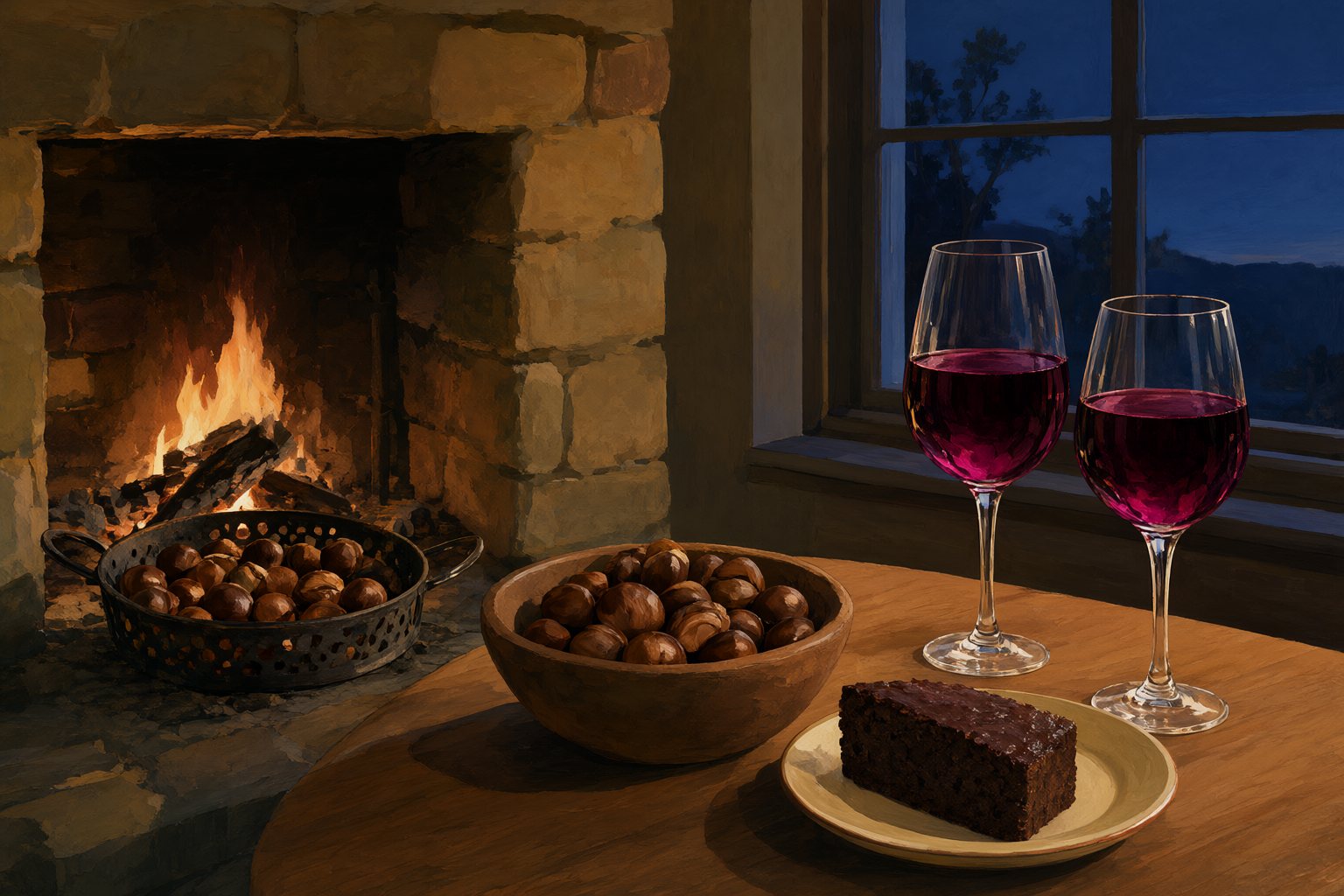
The chestnut has an image problem: it is autumn’s best-loved fruit and the most mistreated at the table. We roast it, peel it while burning our fingers, and then pour whatever is to hand beside it. Usually a novello, Italy’s new-season wine, because “it’s always been done that way”. And it is true, it always has been done that way. But the reason is more interesting than the habit, and the habit, every so often, deserves to be betrayed.
Why novello, of all wines
Let us start with the calendar, which in this story counts for more than taste. Chestnuts fall between October and November, exactly when, in the cellars, the must stops being must. “A San Martino ogni mosto diventa vino”, by St Martin’s Day every must becomes wine, goes the proverb, and for centuries 11 November has been the meeting point between the harvest of the woods and that of the vineyards. The date, incidentally, does not celebrate the saint’s birth but his funeral: Martin of Tours died on 8 November 397 and was buried three days later. Across half of Italy, on that day, the fire is lit, the chestnuts go into the perforated pan and the year’s wine is uncorked.
Novello is the modern, regulated heir to that new wine. In Italy it was born in the 1970s, in the wake of Beaujolais nouveau, and was officially recognised in 1987. Today the rules are precise: it may go on sale from 00:01 on 30 October (until 2012 the date was 6 November), it must contain at least 40% wine made by carbonic maceration of whole grapes, it must be bottled by 31 December of the harvest year and it cannot fall below 11 degrees. Carbonic maceration, which makes the berry ferment from within before it is even crushed, is the key to everything: it produces those aromas of strawberry, raspberry, banana and cherries in spirit that make novello so immediate, with tannins that are almost absent.
And that is why it works with roast chestnuts. The roasted chestnut is sweet, floury and dry, with that bitterness of burnt skin. A tannic red would make it powdery in the mouth; a fruity, fresh, slightly lively wine lightens it, gives it back some juice and accompanies its sweetness rather than contradicting it. It is a pairing of textures before it is a pairing of flavours.
When novello is not enough
The trouble is that the chestnut is not only roast chestnuts. And the more complicated the recipe, the more novello shows its limits.
Take castagnaccio. Chestnut flour, water, oil, pine nuts, raisins and, where tradition allows, rosemary and orange zest. It is a humble cake from the Apennines, lightly sweetened and highly aromatic, and it even has a declared inventor: Ortensio Lando, in his Commentario of 1553, credits a certain Pilade da Lucca with being the first to make “castagnazzi”, and with being praised for it. With castagnaccio, novello tends to disappear, crushed by the rosemary and the density of the flour. Better a young, fruity red with a little more backbone: a young Sangiovese served lightly chilled, a Ciliegiolo, a Schiava from Alto Adige, a Dolcetto. Wines with red fruit, little oak and enough acidity to cut through the oil.
With chestnut soups the story changes again. Chestnuts and chickpeas, chestnuts and mushrooms, chestnuts and beans, perhaps with a little lard or a parmesan rind: soft, earthy, savoury dishes. Here a young red remains an honest option, but there is a more elegant and less trodden path: a structured, slightly evolved white with body but no tannin. The criterion is always the same: do not add dryness to a dish that already has plenty.
The grand finale: marrons glacés and sweet wines
The marron glacé is the chestnut that made a career for itself. Its origins are disputed between France and Piedmont: the French claim the sixteenth-century confectioners of Lyon and La Varenne’s treatise of 1664, the Piedmontese the area around Cuneo and the court of Charles Emmanuel I of Savoy in the early seventeenth century. Industrial production arrived only at the end of the nineteenth century, with Clément Faugier in the Ardèche.
Here novello has no say whatsoever. A confection this sugary calls for a wine at least as sweet, otherwise the wine will seem sour and thin. This is passito territory, the wines made from dried grapes. Tuscan Vin Santo, from dried grapes and aged for years in small barrels called caratelli (the Vin Santo del Chianti rules require at least three years, four for the riserva), has notes of dried fruit, honey and caramel that seem written specifically for the syrup of a marron glacé.
And then there is the Veneto, with its two Reciotos. Recioto di Soave, from dried Garganega grapes, a DOCG since 1998, brings dried apricot, almond and a freshness that rescues the palate. Recioto della Valpolicella, a sweet red from dried Corvina and its companions, is Amarone’s forgotten grandfather: the name comes from the dialect word recie, ears, meaning the wings of the bunch, the parts most exposed to the sun and therefore the sweetest. Today it accounts for a tiny fraction of Valpolicella’s production, crushed by the success of its dry sibling, and that is one of the reasons it is worth seeking out. With a marron glacé, or a Mont Blanc, its dark fruit and its unsugary sweetness create a pairing of rare fullness.
From Bolzano to Sicily, the ritual is the same
The union of chestnuts and new wine is not a wine-shop invention: it is a ritual Italy practises from north to south under different names. In Alto Adige it is called Törggelen, from the Latin torquere, to twist, hence to press. Born in the Valle Isarco, between Chiusa, Barbiano, Villandro and Velturno, it consists of walking up to the farmsteads between September and November to eat canederli (bread dumplings), speck, sauerkraut, krapfen and above all Keschtn, roast chestnuts, while drinking the new wine or Suser, the still-fermenting must.
Heading south, the language changes but not the substance. In the Veneto, for San Martino, they make the cornmeal biscuits called zaeti, in Sicily dry biscuits flavoured with anise or wild fennel, and almost everywhere there is a castagnata, a chestnut feast, with the year’s wine in the jug. In Sicily the proverb is said in dialect, with “mustu” becoming “vinu”. The substance is always the same: new wine and chestnuts are two different ways of saying that the farming year is over, and that it is time to celebrate.
An opinion, to close
Novello has a bad reputation that is partly deserved: for years too much of it was made, too quickly and too uniformly. But with roast chestnuts it remains hard to beat, because it is the only wine designed to last exactly as long as a season. The point is not to stop there. A chestnut evening done well has an architecture: novello or a young red with the roast chestnuts, something more serious with the soups, a red with more nerve for the castagnaccio, a passito with the marrons glacés. You do not need a cellar, just a modicum of curiosity. The chestnut fed the Apennines for centuries: the least we can do is pour the right wine beside it.
❦