What wine goes with pizza: a practical guide, topping by topping
Margherita, cured meats, quattro formaggi, pizza bianca and vegetables: which wines work with pizza, and why bubbles and cool reds almost always win.
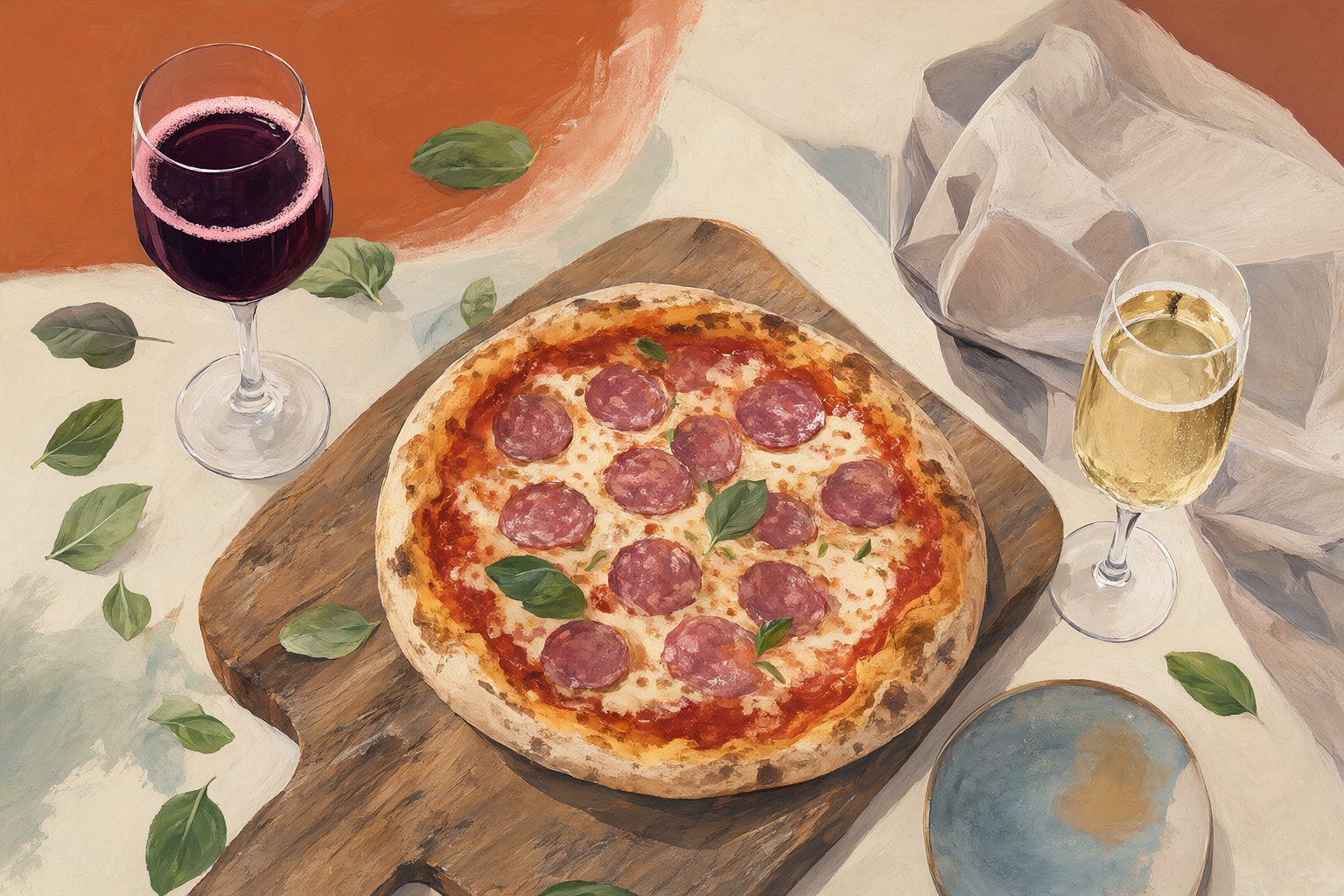
The conditioned reflex is beer. It has been for decades, and nobody here wants to put it on trial: cold, fizzy, undemanding, it does its job. But pizza is one of the hardest dishes to pair with wine only for those who choose the wrong wine. With the right one, the evening changes gear, and it often costs less than you might think.
The problem, at bottom, is that pizza is not a dish: it is a family. A Neapolitan margherita, with its puffy cornicione, the raised rim, and its lively tomato, asks for different things from a thin Roman pizza with mortadella and pistachio, or from a pizza bianca with friarielli (Neapolitan broccoli rabe) and sausage. Before even looking at a label, it pays to understand what we are up against.
Tomato, mozzarella, dough: the three opponents
Tomato is acidic, and acidity on the plate has a precise effect on wine: it makes it seem flatter, flabbier, sometimes bitter. A soft, low-acid red set beside a margherita loses its voice. What you need, then, is a wine with acidity at least equal to that of the sauce, so that the two balance each other instead of cancelling each other out.
Mozzarella, especially buffalo mozzarella or a good fiordilatte, brings fat and a milky sensation that coats the mouth. Two allies come into play here: bubbles, whose carbon dioxide “degreases” the palate and readies it for the next bite, and acidity again, which does the same job by another route.
Then there is the dough: leavened, salted, sometimes lightly charred at the edge. Salt amplifies the perception of alcohol and tannins. That is why structured, tannic reds, the ones that would be perfect with a rib steak, tend to turn hard, astringent and a little out of place with pizza, like someone turning up in a dinner jacket at a garden party.
The rule that emerges is easy to remember: freshness, little tannin, moderate alcohol and, if possible, a few bubbles. It is not dogma, but it is the right starting point.
Margherita and marinara: the territory of sparkling reds
For the margherita, the most sensible pairing is also the closest geographically. Gragnano and Lettere, subzones of the Penisola Sorrentina DOC created in 1994, are reds that the production rules allow only in a frizzante, lightly sparkling, version. They are made mainly from Piedirosso (locally “Pèr ’e palummo”, which must make up at least 40%), together with Aglianico and Sciascinoso. The result is a purplish red wine with crunchy fruit, fine tannin, a foam that dissolves quickly and generally moderate alcohol. It should be served cool, not ice-cold.
It is a wine born, quite literally, beside the Neapolitans’ wood-fired ovens, and it shows. With San Marzano tomato and basil it has an almost shameless rapport: the wine’s acidity stands up to the sauce’s, the bubbles clean away the mozzarella, the red fruit echoes the cooked tomato. If the pizza is Neapolitan, of the tradition protected since 2010 as a Traditional Speciality Guaranteed and whose art of the pizzaiuolo has been UNESCO intangible heritage since 2017, there is a certain consistency in not letting it make the journey alone.
For the marinara, with no cheese and with garlic and oregano to the fore, the same reasoning holds. Alternatively, a fresh rosé works, perhaps from Campania or Puglia, with the same acidity and more delicate fruit.
Cured meats and chilli: call in the Lambrusco
When spicy salami, sausage, cooked ham or the mortadella of more modern pizzerias land on the pizza, the fat goes up and the salt with it. Here Lambrusco becomes almost unbeatable, and not by chance: in Emilia it is the historic companion of cured meats.
It is worth knowing, though, that “Lambrusco” is an umbrella term. Lambrusco di Sorbara is the palest and the most acidic, sometimes almost rosé, taut and floral: perfect with cooked ham and mortadella. Lambrusco Grasparossa di Castelvetro is the opposite, dark, more tannic and fruity, and stands up well to sausage and spicy salami. Salamino di Santa Croce sits in between. Better to go for the dry versions, which often appear on the label as “secco”: an amabile, off-dry, Lambrusco with spicy salami is an encounter few would repeat.
With chilli in general, avoid very alcoholic wines: alcohol fans the burning sensation. A sparkling red, served cool, puts it out. Staying with red bubbles, the frizzante Gutturnio of the Colli Piacentini and the Bonarda of the Oltrepò Pavese in its vivace, lightly sparkling, version also do an excellent job with cured meats.
Quattro formaggi, pizza bianca and vegetables: make way for whites and the traditional method
The quattro formaggi is the fattiest and most savoury pizza on the menu. A red struggles here, a white that is too light disappears. The most elegant solution is a traditional-method sparkling wine: a Franciacorta, perhaps Brut or Extra Brut, has acidity, fine bubbles and bread-crust notes that converse with the dough. It is one of those cases in which a “serious” sparkling wine beside a pizza seems excessive, until you try it. If there is gorgonzola, a less obvious idea is a dry aromatic white, or that same Lambrusco di Sorbara, whose acidity cuts the fat without masking the cheese.
Pizza bianca, with mozzarella and perhaps mushrooms, potatoes or courgettes, opens the door to the whites of the South. Falanghina, Campanian like the margherita, has lively acidity, aromas of citrus and white fruit, and a light savouriness that marries well with mozzarella. Vermentino and Verdicchio are sound alternatives, as is a young Fiano if the pizza is richer. With grilled vegetables, aubergines and peppers in particular, a rosé or a very light red served cool gives more satisfaction than a white.
The special case is the bianca with friarielli and sausage, a Neapolitan classic: the bitter note of the greens and the fat of the meat can even take a young Aglianico, as long as it has not spent a long time in wood, or a pure Piedirosso. These are Campanian reds, with tannin that is present but not aggressive, and here they have something to say.
A few rules of service, and an opinion
Two tips apply to all pizza wines. The first is temperature: light, sparkling reds should be served cool, at around 12–14 degrees, whites and sparkling wines colder. A red at room temperature in a crowded pizzeria quickly becomes an alcoholic herbal tea. The second is the glass: you do not need tasting crystal, just a clean glass that is not too small.
As for price, the good news is that the styles that work best, Gragnano, Lettere, Lambrusco, Falanghina, are among the most affordable in the Italian landscape. Franciacorta calls for a bigger outlay, but it remains an exception for evenings when the pizza is an excuse to celebrate something.
And here is the opinion: beer with pizza is a habit, not a necessity. The sparkling reds of the South and of Emilia were born for a cuisine that is popular, rich, full of flavour and eaten in company, that is, for exactly this. The fact that so many pizzerias still have wine lists with three Chianti labels and an anonymous Prosecco is a missed opportunity, for them and for us. Next time you sit down in front of a margherita, ask for a Gragnano. If they do not have one, ask why.
❦