Lambrusco, the “cheap” wine that never really was
Sorbara, Grasparossa, Salamino: Lambrusco is a family of grapes, not just a sweet export wine. History, DOCs, bottle-fermented styles and the Emilian table.
There is a wine that, in Italy, people order with a slightly lowered voice, almost apologetically. They drink it happily enough, but they name it with a crooked smile, like a summer hit whose every word they know. It is Lambrusco, and its bad reputation is one of the most accomplished injustices in the history of Italian wine: built in America, fuelled by us, and dismantled only recently, one bottle at a time.
The starting point is simple: Lambrusco is not a wine. It is a family.
A large family, not a single grape
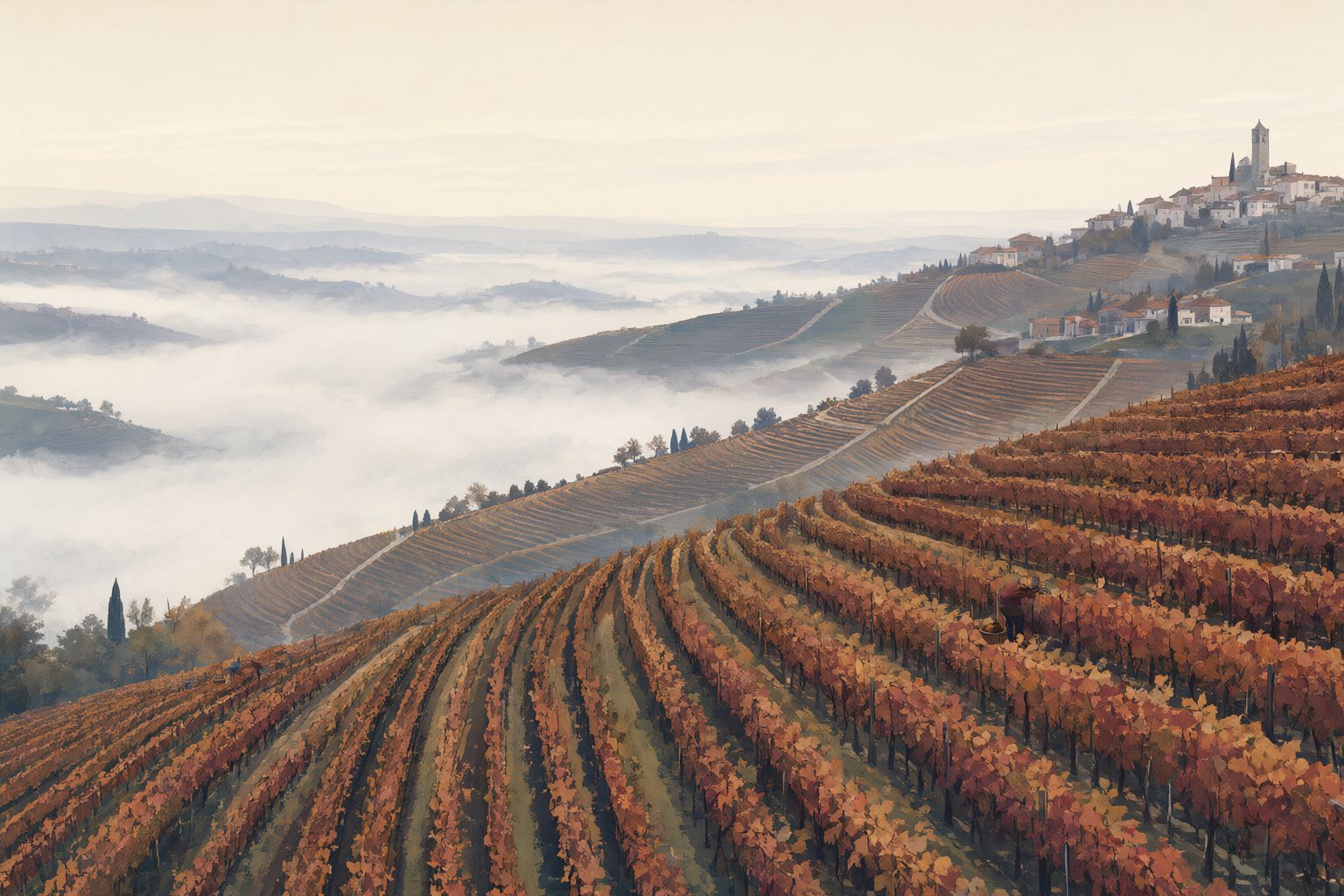
Under the same surname live grapes that are very different from one another. Trade guides count a dozen among those grown in the provinces of Modena and Reggio Emilia: besides the three most famous there are Maestri, Marani, Montericco, Viadanese, Oliva, Barghi, Benetti, Pellegrino and Lambrusco a foglia frastagliata. Ampelographers, widening their gaze to the whole of Italy, have catalogued many more. The name itself comes from the Latin labrusca, the wild vine of the field margins, and Roman authors were already writing about it: Cato praised its productivity with an accountant’s enthusiasm.
Three members of the family, however, deserve to be known by name.
Sorbara is the palest and the most highly strung. It gives wines whose colour ranges from light ruby to salmon, often closer to a rosé than a red, with a cutting acidity that is the highest of the group. It also has a curious botanical flaw: its pollen is largely sterile, the flowers drop and yields can collapse. That is why, for generations, growers have planted it alongside Salamino, which acts as a pollinator. The result is a wine that smells of violets, wild strawberries and citrus, and that asks for the dinner table rather than the sofa.
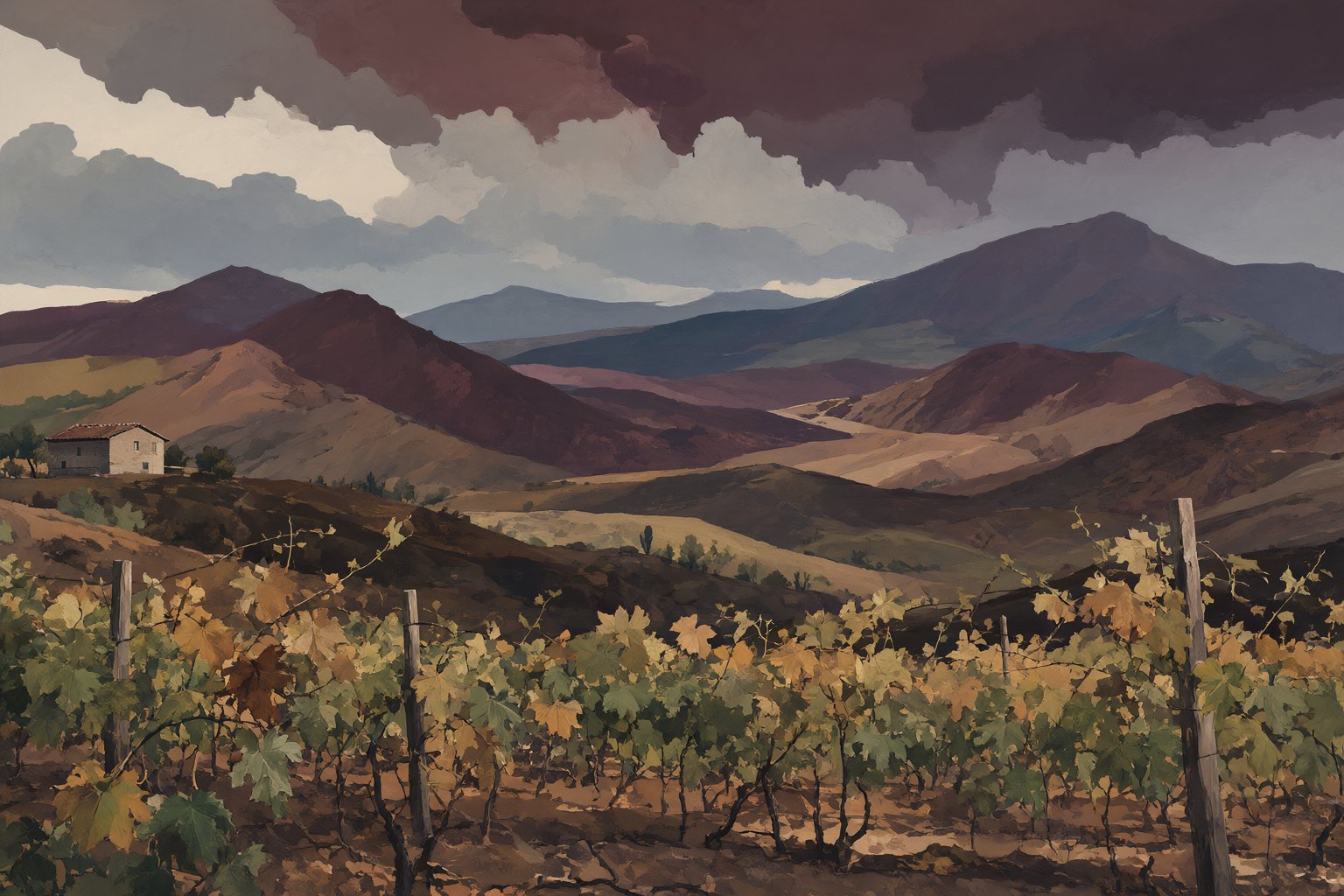
Grasparossa is the exact opposite: the name comes from the stalk, which turns red in autumn, and the wine it produces is dark violet, almost ink, with real tannin that you can feel. It is the Lambrusco of the hills of Castelvetro, the most structured and the most serious, at least in appearance.
Salamino sits in the middle. It owes its name to the bunch, small, compact and elongated like a little salami, and it is the most widespread member of the family: deep colour, generous red fruit, a balance between freshness and body. It is the Lambrusco many people have drunk without knowing it.
The DOCs: a geography worth learning
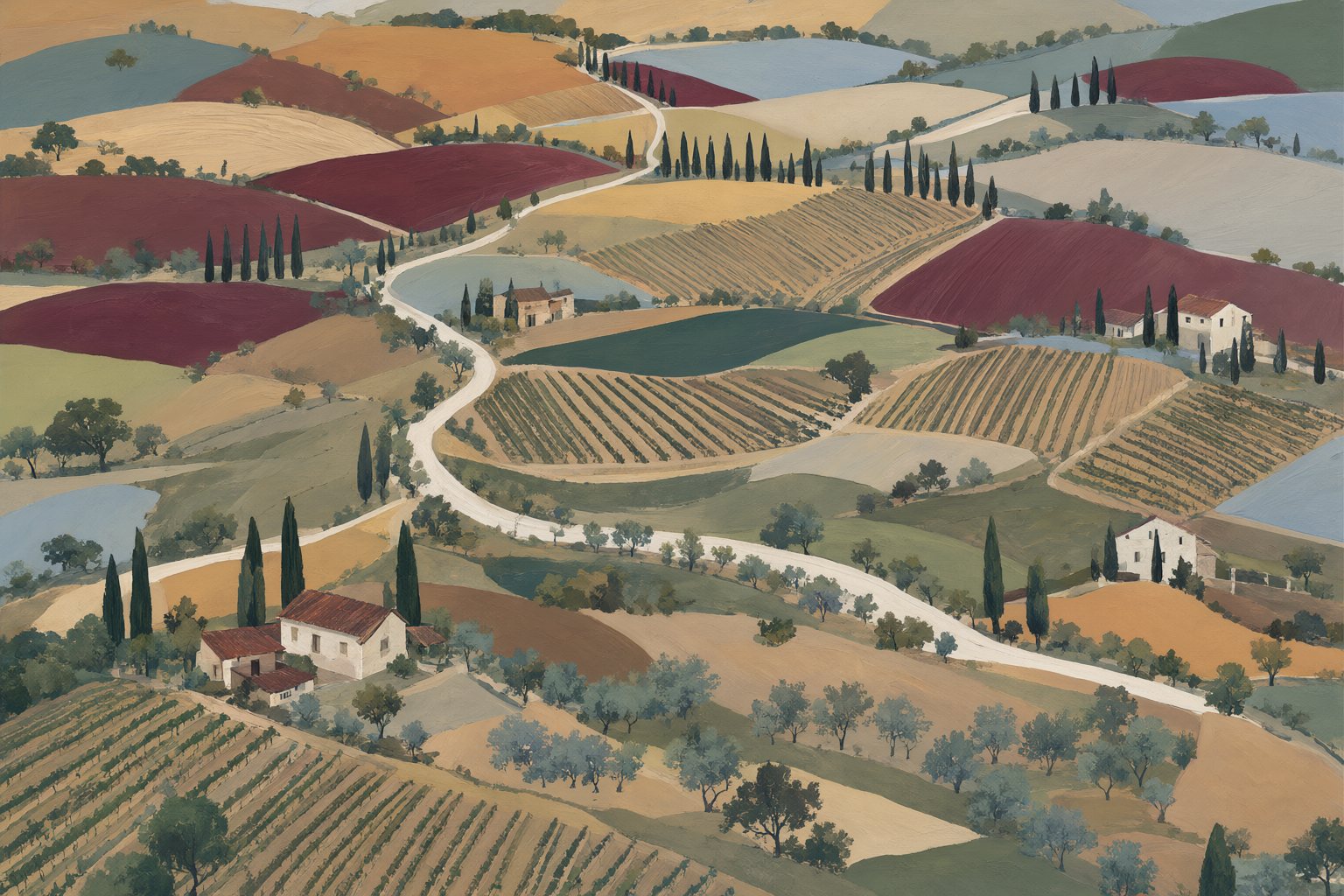
The three varieties give their names to three appellations, all born in 1970: Lambrusco di Sorbara, Lambrusco Grasparossa di Castelvetro and Lambrusco Salamino di Santa Croce. Each makes its own grape the protagonist: at least 85% for Grasparossa and Salamino, while Sorbara, for the reasons given above, leaves more room for Salamino in the blend.
Around these three are the broader appellations: Modena, Reggiano, Colli di Scandiano e di Canossa, Colli di Parma and, across the border in Lombardy, Lambrusco Mantovano. Within these labels coexist different blends, including Ancellotta, a teinturier grape that darkens and softens. There is no need to learn them by heart. It is enough to know that “Lambrusco” on a label, on its own, says little: it is the second word, the one indicating the variety or the place, that really tells you what is in the glass.
Bubbles in tank, bubbles in bottle
Lambrusco is sparkling by nature and by history. For centuries the fizz arrived of its own accord: the wine was bottled before it had finished fermenting, at the end of winter, and fermentation restarted in the bottle with the warmth of spring. The result was a cloudy wine, with the yeasts settled at the bottom, dry and a little rustic.
After the war things changed. Tank fermentation spread, the so-called Martinotti or Charmat method: the second fermentation takes place in large pressurised steel tanks, and the wine emerges clear, stable, consistent, ready to travel. It is the technique that made industrial Lambrusco possible, and it is still the most widely used today, including for many excellent wines.
Over the last thirty years, however, a group of artisan producers has revived the old way, and today Lambrusco that is rifermentato in bottiglia (bottle-refermented) or col fondo (“with the sediment”) has become a category of its own again. A clarification is useful here, because the words get muddled. Strictly speaking, the ancestral method involves a single fermentation, interrupted and then completed in the bottle; bottle refermentation, by contrast, is a second fermentation of a wine that is already made. In Emilian practice the two terms are often used as synonyms, but they are not the same thing. In both cases the result is a wine with a deposit, which can be decanted or, as many in Emilia do, shaken up and drunk hazy.
How to ruin a reputation
The story of the disgrace has a date and an address: the United States, from the late 1960s onwards. A cooperative in Reggio Emilia, Cantine Riunite, began exporting an amabile Lambrusco, sweet and easy to drink. By 1973 it was already the best-selling imported wine in the country, propelled by an advertising campaign that remains famous for its slogan: “Riunite on ice, that’s nice”. Lambrusco, in other words, on the rocks.
The peak came in 1985, when the cases shipped across the Atlantic exceeded, depending on the source, eleven or thirteen million in a single year: the figures differ, the scale does not. For an entire generation of Americans, and by reflection for the markets that looked to America, Lambrusco meant a red, sweet, fizzy soft drink. The commercial success was enormous. So was the damage to its image.
To be precise, sweet Lambrusco is not an American invention: amabile versions have always existed in Emilia, and some are made with care. The problem was the reduction of an entire family to a single style, produced in industrial volumes and sold as an alternative to soda. When the market’s taste changed, the name stayed stuck to that image.
The Emilian table as the final argument
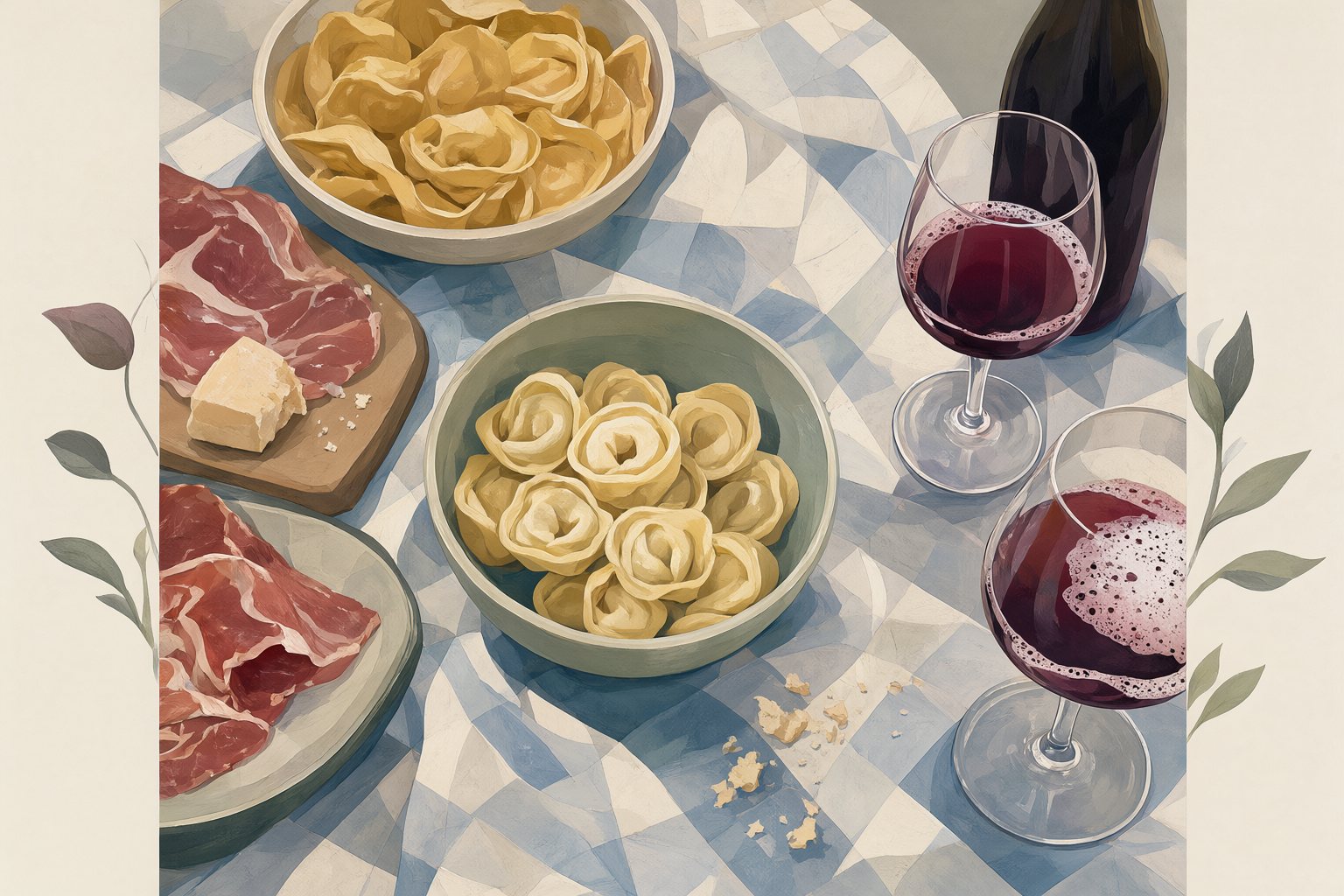
The revival, in the end, is better explained at the table than on paper. Dry Lambrusco is a wine built for the cooking that surrounds it: rich, savoury, generous. The acidity and the bubbles do what elsewhere is asked of tannin or lemon, namely cleanse the palate and prepare it for the next mouthful.
Sorbara, taut and floral, is perfect with gnocco fritto, tigelle and a board of prosciutto, mortadella and salame. It also holds up well to tortellini in brodo, where the rich broth finds a counterpoint. Grasparossa, darker and more tannic, is at ease with cotechino and zampone with lentils, with bollito misto, with ragùs that simmer for hours. Salamino goes with everything, even pizza, which in Emilia nobody considers heresy. And well-made amabile versions find their place alongside a crostata or a few shards of aged Parmigiano Reggiano.
Those who say Lambrusco is a cheap wine have usually tasted only one, and almost always the same one. It is like judging Emilian cooking by a frozen tortellino. The truth is more awkward and more interesting: Lambrusco is one of the few Italian wines that has managed to stay popular without being banal, inexpensive without being poor, fizzy without being frivolous. That it was mistaken for a soft drink says far more about the market that sold it than about the wine itself.
❦