Five wine pairing myths it’s time to leave on the table
Red wine with fish, sweet with dessert, cheese, artichokes and the rule of terroir: five food and wine pairing clichés, revisited with some common sense.
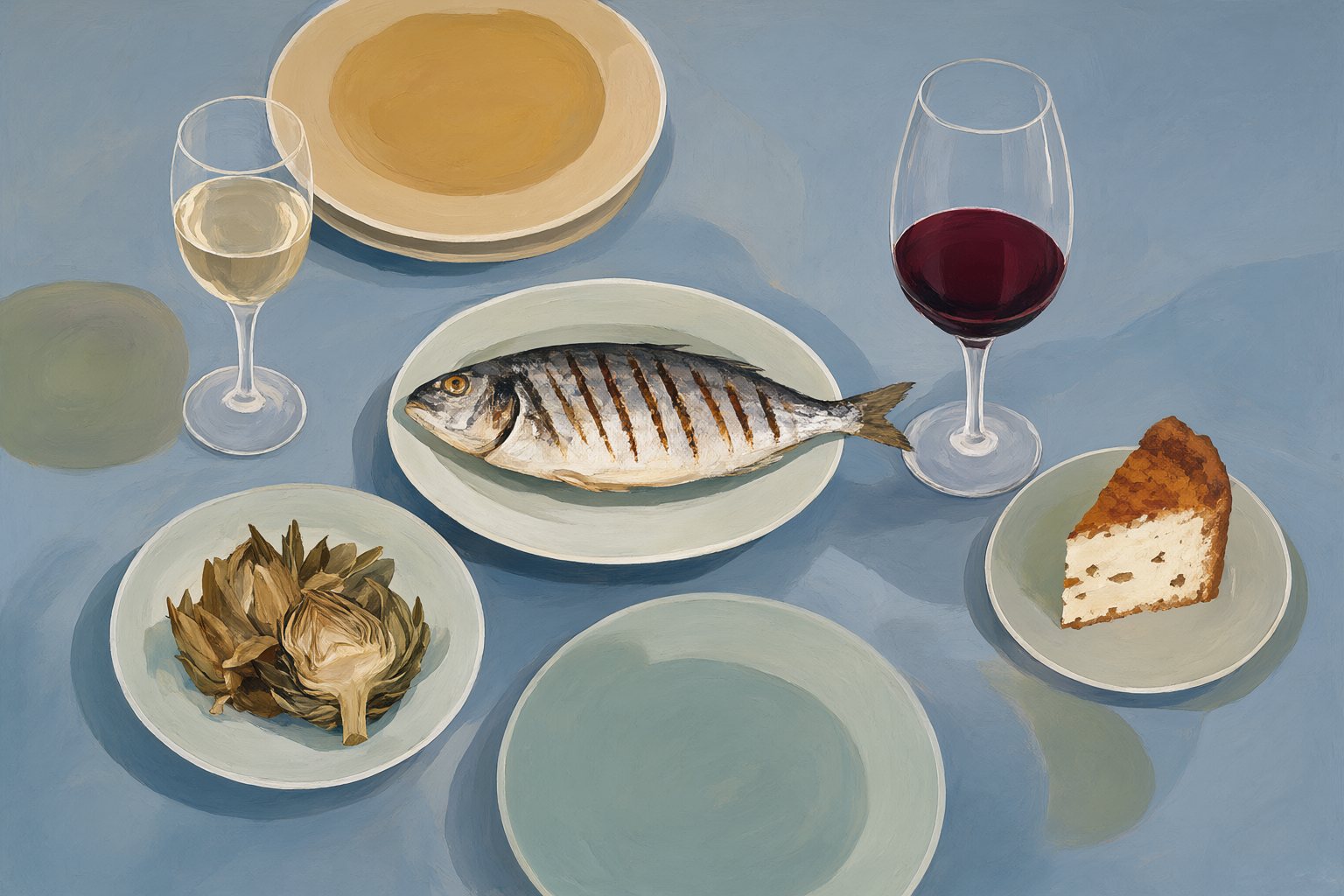
Pairing rules share the fate of proverbs: they start from a sound observation, then get repeated so many times that nobody remembers why. The result is a dinner table governed by prohibitions no one can explain and permissions no one has ever checked. Here are five commonplaces worth dismantling, or at least cutting down to size, with the caveat that pairing remains an exercise in common sense rather than an exact science.
Never red with fish
The most famous taboo has a grain of truth to it, but colour is not the culprit. Most of us have, at some point, noticed a metallic aftertaste, almost like rusty iron, when drinking certain reds with certain seafood dishes. For years the most quoted explanation was tannin, which on meeting the oils in fish would supposedly leave that unpleasant sensation in the mouth. In 2009 two researchers from Japan’s Mercian Corporation published a study in the Journal of Agricultural and Food Chemistry that moved the target: having tasters try dozens of red and white wines with scallops, they found that the off-flavour was driven above all by the wine’s iron content. More iron, more unpleasantness. And iron has nothing to do with colour: some reds had little of it and fared fine, while some whites had plenty and caused exactly the same problem.
A single study doesn’t settle the matter, and tannin and iron probably work together rather than ruling each other out. But the practical message is clear: the risk is real, it just isn’t solved by banning red. The trouble is that iron isn’t listed on the label, so caution is the sensible course. A delicate fish, sole in butter, sea bass baked in salt, a plate of crudo, has little to gain from a red and a lot to lose. A rich or full-flavoured fish, cooked with tomato or stewed, changes the game: a Livornese cacciucco or red mullet alla livornese stand up well to a young, low-tannin red served cool, such as a current-vintage Sangiovese or a Rossese di Dolceacqua. A seared tuna steak will actually welcome a Pinot nero or a Frappato more readily than many whites. The useful rule is not “no red”, but “light, low-tannin reds, and dishes with enough structure to carry them”.
Sweet wine with dessert always works
Here the myth is half true, and it’s the wrong half that does the damage. Only one principle matters: the wine must be at least as sweet as the dessert, preferably sweeter. When the opposite happens, the sugar in the dish flattens the sugar in the wine, which suddenly tastes thin, sharp, sometimes bitter. It’s the same mechanism that makes orange juice undrinkable after toothpaste.
The most common example in Italy is the end-of-meal toast with a Brut sparkling wine over the wedding cake or the panettone: a dry wine up against a dessert loaded with sugar and cream doesn’t stand a chance. A Moscato d’Asti with panettone works precisely because the sweetness is comparable and the bubbles cut through the richness. Likewise, a fruit tart can handle a light passito, while a dark chocolate cake or a very sugary dessert calls for richer, more concentrated wines. With chocolate, mind you, the odds are stacked from the start: the bitterness of cocoa trips up many wines, and the traditional Piedmontese pairing with sparkling Brachetto d’Acqui is one of the few that the textbooks cite with any real conviction. Sweet with sweet, then, yes: but in proportion.
Only red with cheese
The idea that a cheese board demands a serious red dates back to a time when cheese followed the meat course and the red was already on the table. Convenience, not affinity. In reality, many cheeses are happier with a white, a sweet wine or something sparkling. The tannin in reds tends to clash with the fat and salt of aged cheeses, and with fresh goat’s cheeses the acidity of a white often wins.
A few examples, with no claim to being exhaustive: a fresh goat’s cheese with a Sauvignon or a Friulano, buffalo mozzarella with a Falanghina or a Fiano, a long-aged Parmigiano Reggiano with a dry Lambrusco (a red, yes, but a fizzy one and almost free of aggressive tannin) or with a traditional-method sparkler. Blue cheeses such as piccante gorgonzola are the textbook case: the salt and the spicy bite cry out for sweetness, and a passito or a sweet wine from dried grapes does what no dry red can manage. Red with cheese can work, but it’s an option, not an obligation.
Artichokes and asparagus: mission impossible
“You can’t drink wine with artichokes” is something you hear often, and it’s the classic convenient advice for anyone whose job is to serve the wine. The problem does exist: artichokes contain cynarin, a substance that temporarily alters taste perception and makes whatever you taste next seem sweeter. A wine can come across as flat, cloying, sometimes metallic. Asparagus, for its part, has green, vegetal notes and sulphur compounds that quarrel with oak and tannin.
Difficult, however, doesn’t mean impossible. With artichokes, dry, savoury whites with lively acidity and no oak work best: a Verdicchio, a Vermentino, a Vernaccia di San Gimignano. The preparation matters a great deal too: carciofi alla giudia, fried and crisp, become an almost easy dish alongside a dry sparkler; carciofi alla romana, with wild mint and garlic, ask for an aromatic but bone-dry white. The same goes for asparagus: no tannic reds, yes to fresh, green whites. In the area of the Asparago bianco di Bassano DOP, for instance, people happily drink Vespaiolo from neighbouring Breganze, and not by chance.
The local rule never fails
“What grows together goes together” is the most elegant of the clichés, and the most treacherous. It often works: Lambrusco with cotechino, Barbera with bagna cauda, Vermentino with pesto. But it works because in those cases acidity, bubbles and structure are doing their job, not because of some geographical magic. Regional cooking wasn’t born with pairing in mind: people ate what there was and drank what there was, without asking too many questions. And today’s wines are often very different from the ones drunk when those dishes first appeared.
A single counterexample is enough to show the limits. The Veneto has baccalà alla vicentina and it has Amarone: next-door neighbours, but putting them in the same glass is a questionable idea, because a red that powerful and alcoholic risks steamrolling the dish. Terroir is a good starting point, never a guarantee.
Rules are there to be broken well
None of these myths is entirely false, which is why they endure. The real problem is that they turn an interesting question, what happens in the mouth when this wine meets this dish, into a list of prohibitions. Better to keep a few concrete things in mind: tannin and delicate fish don’t get along, dessert has to be outdone in sweetness, acidity rescues many awkward situations. The rest you learn by getting it wrong, which at the table is the most pleasurable way to learn.
❦