What wine for Thanksgiving: pairing America’s hardest table
Turkey, stuffing, cranberry sauce, sweet potatoes and pumpkin pie, all at once. The wines that survive Thanksgiving dinner, from Oregon to Italy.
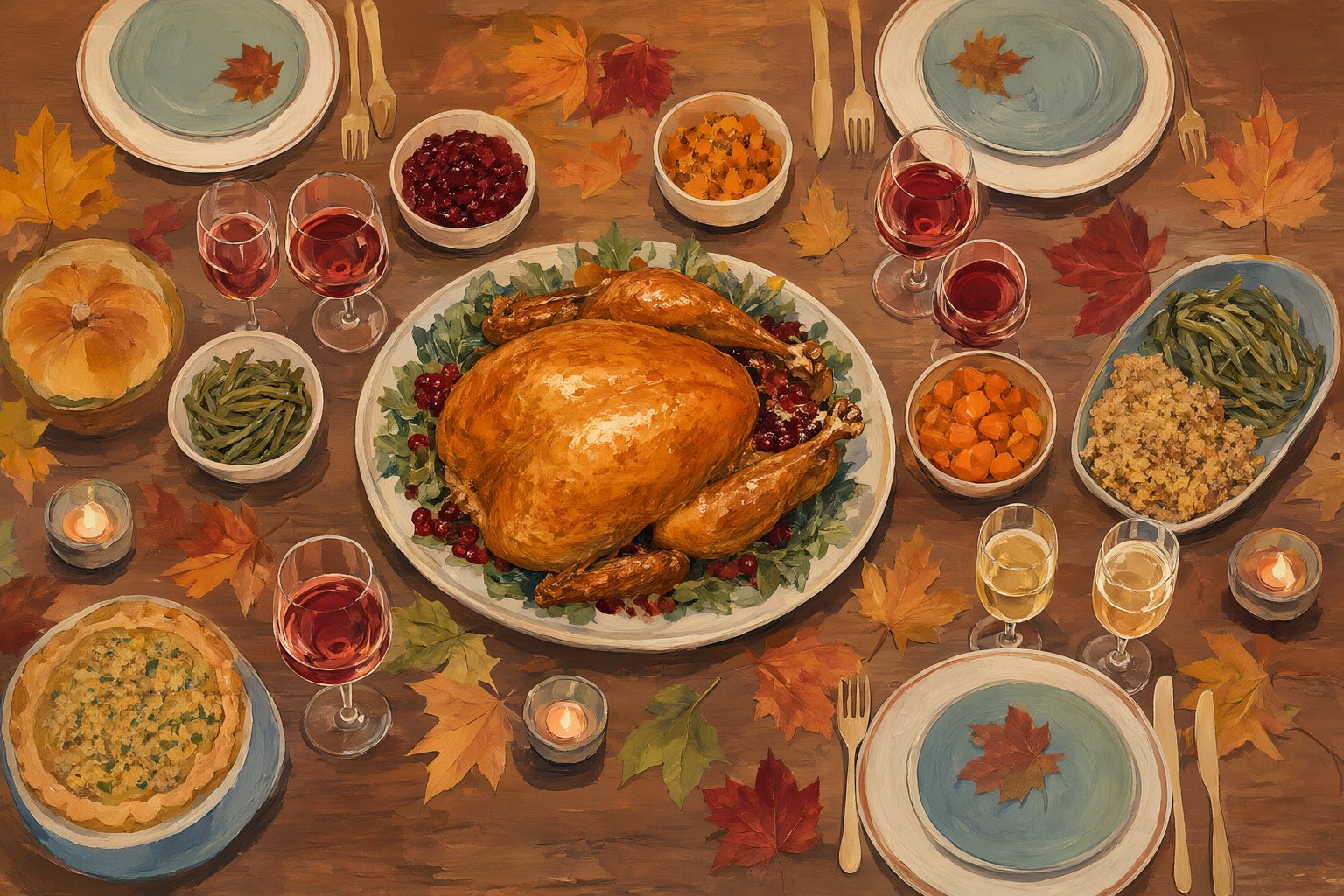
Every year, on the fourth Thursday of November, millions of Americans sit down to the most wine-hostile dinner ever devised. On November 26, 2026, the scene will play out again: a turkey with a tendency to dry out, a bread-and-sage stuffing, a cranberry sauce that is practically jam, glazed sweet potatoes, sometimes crowned with marshmallows, green beans, mashed potatoes, gravy, and at the end a spiced pumpkin pie. Everything on the table at the same moment, everything on the same plate. No sommelier would ever design a menu like this. Which is exactly why the question “what wine for Thanksgiving?” is more interesting than it looks.
The problem isn’t the turkey
We have already written about turkey itself, along with its Italian cousin, the Christmas capon: it is a gentle meat that asks for very little. The real opponent is everything else. Thanksgiving has no sequence of courses to match one by one; it is a buffet served at the table, where the sweetness of cranberry and sweet potato shares a forkful with the salt of the gravy and the fat of the stuffing.
That leads to one simple rule, which is also the only truly useful one: you are not looking for the perfect wine for a dish, you are looking for the wine that picks no fights. In practice that takes three qualities. High acidity, to keep pace with the fat and the tart sauces. Moderate tannin, because hard tannins turn bitter and metallic next to sweetness and white meat. And generous fruit, so the wine does not vanish beside the cranberry. Heavy oak and very high alcohol, on the other hand, are the evening’s two enemies: they wear you out, and at a dinner that lasts for hours, fatigue matters.
The American classics, and why they work
It is no accident that the most common answer in American guides is Pinot Noir, often from Oregon or the California coast. It has everything required: acidity, light tannin, red fruit that seems a close relative of the cranberry. Alongside it, more and more often, comes Beaujolais, above all from the crus, the ten best villages of the region, more structured than the Nouveau. The calendar lends a hand: Beaujolais Nouveau is released on the third Thursday of November, this year the 19th, exactly one week earlier.
Then there is Zinfandel, the red many Americans think of as most their own, and this is where the story turns Italian. DNA research launched in the late 1990s by Carole Meredith of the University of California, Davis, showed that Zinfandel is the same variety as Puglia’s Primitivo, and that both descend from a Croatian grape, Tribidrag, also known as Crljenak Kaštelanski, documented in Dalmatia as early as the 1500s. At the Thanksgiving table, Zinfandel brings ripe fruit and spice that get along with the stuffing and the sweet potatoes. One piece of advice only: pick one that isn’t too alcoholic, because the most powerful versions flatten the turkey.
Among whites, Riesling is the wild card nearly everyone agrees on. Dry or with a touch of residual sweetness, it has a cutting acidity that scrubs the palate clean of fat and a fruitiness that welcomes the sweet potato instead of fighting it. Chardonnay works if it is fresh and lightly oaked; the opulent, buttery kind is for those who like rich on rich, at their own risk.
The Italian alternative, explained to an American
For anyone who wants to bring a different idea to the table, Italy offers at least four answers, more convincing than their reputation abroad might suggest.
The first is Lambrusco, the sparkling red of Emilia, the region of Modena and Parma. In the United States it long carried a reputation as a sweet, cheap drink, but today’s dry Lambruscos are another thing entirely: bubbles, lively acidity, almost no tannin, colors ranging from the pink of Sorbara to the deep purple of Grasparossa. With turkey, gravy and cranberry, it is hard to think of a better companion.
The second is the family of pale, fresh reds: Sicily’s Frappato or Cerasuolo di Vittoria, Schiava from Alto Adige, Piedmont’s Grignolino, Italian Pinot Nero. Wines to serve a little cooler than usual, which do the same job as Pinot Noir with a different accent. Those who want more structure can look to Barbera, whose high acidity makes it surprisingly versatile, or to Etna Rosso, which has the grace of a mountain wine.
The third is traditional-method sparkling wine, refermented in the bottle like Champagne: Franciacorta in Lombardy, Trento DOC in Trentino. An excellent idea for the aperitif, and a sound choice for the whole meal, because bubbles are the quickest way to refresh a weary palate.
The fourth concerns dessert, and it may be the most useful of all.
The pumpkin pie problem
Pumpkin pie is where many dinners run aground. Cinnamon, nutmeg, ginger, sugar: with a dry red the result is bitter and flat, because the sweetness makes the wine seem more acidic and more tannic than it is. The rule here is ancient and admits no exceptions: the wine must be at least as sweet as the dessert.
English-language guides often point to a late-harvest Riesling. From Italy comes a lighter, almost playful alternative: Moscato d’Asti, a gently fizzy, aromatic, low-alcohol white from Piedmont that, after a dinner this heavy, feels like relief rather than one more thing. Those who want something more intense might think of a Tuscan Vin Santo or a passito, a wine made from dried grapes, while Brachetto d’Acqui, red, sweet and scented with roses, has the chromatic advantage of matching the season.
Our take
My view is that Thanksgiving is the one dinner where the obsession with the perfect pairing should surrender completely. There will never be a wine that gets along with marshmallow, sage and cranberry in the same bite. Better to choose two or three bottles with the right traits, a sparkler, a light and tangy red, an aromatic white, put them all on the table at once and let everyone find their own. It is, when you think about it, the very spirit of the holiday: a crowded, imperfect table where nobody insists on being right. And if you want one extra flourish, tell your guests that their Zinfandel has a brother in Puglia and a grandfather in Croatia. Usually, at that point, someone asks to taste the Primitivo.
❦