What wine with bagna cauda, Piedmont’s November ritual
Garlic, anchovies, olive oil and vegetables for dipping. Barbera, Freisa, Dolcetto or a structured white? How to choose the right wine for bagna cauda.
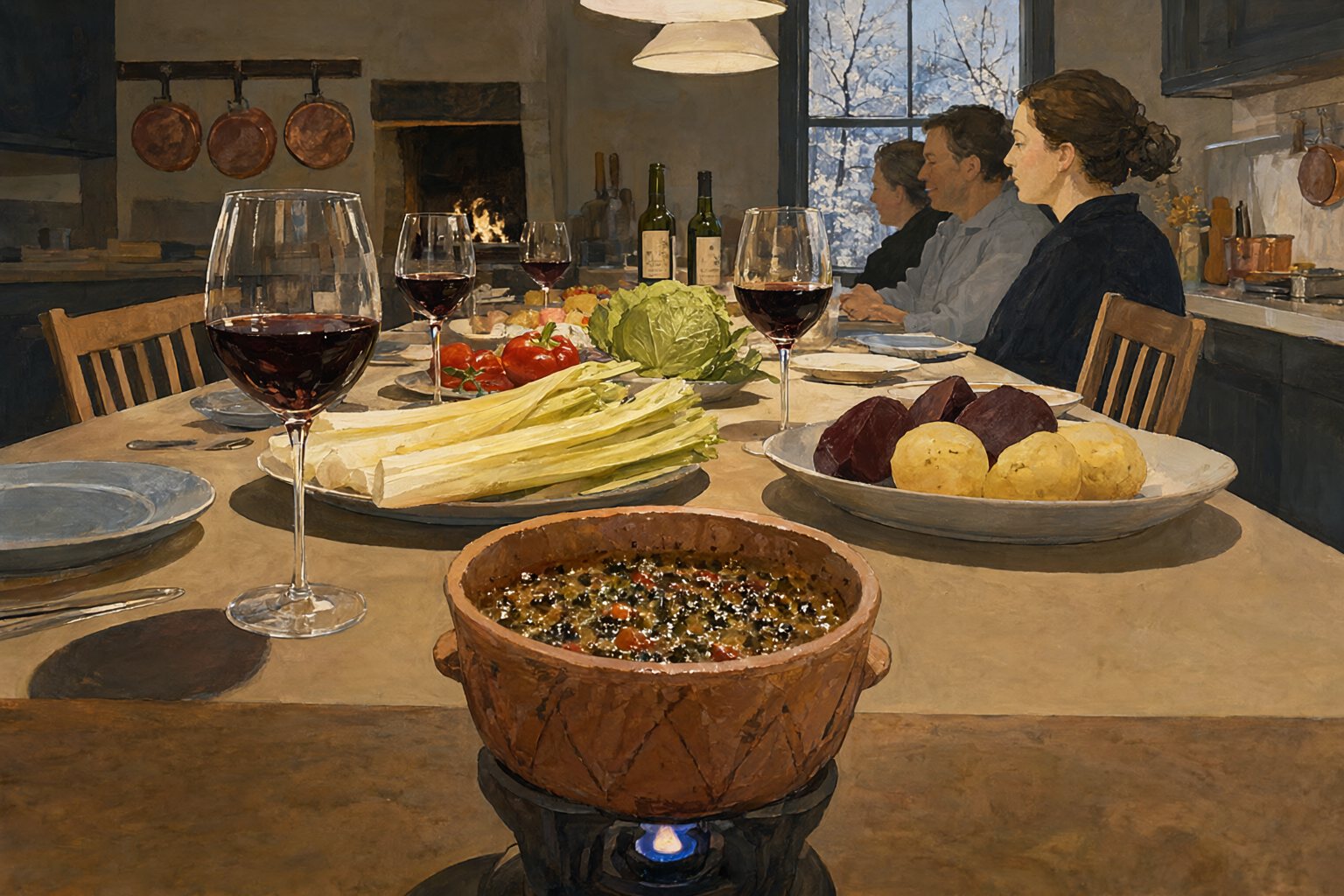
You can recognise a bagna cauda evening before you even step into the house: by the smell drifting out of the windows which, the next day, will still be in your hair, your jumpers, the corners of the sofa. It is the least diplomatic dish in Italian cooking, and that is rather the point. Whole heads of garlic, salted anchovies, oil, a little earthenware pot kept hot over a flame, and a mountain of vegetables for dipping. Nobody has ever eaten bagna cauda alone, and nobody has ever eaten it with a wine chosen at random. Or at least, nobody who did it twice.
A peasant dish born with the new wine
Bagna cauda, or bagna càuda, which in Piedmontese simply means “hot sauce”, is a dish of the Asti area, the Monferrato and the Langhe, with openly peasant roots. It was the meal of late autumn and winter, tied to the season when the new wine was drawn from the vat: it was eaten in company, around the same fire, and the wine came from the same cellar where fermentation had just finished.
The paradox is that the heart of the dish, the anchovy, does not exist in Piedmont. It arrived salted from the sea, along the roads linking the region to the coast, and a long tradition tells of the acciugai, itinerant anchovy sellers who set out above all from the Val Maira, in the province of Cuneo, and toured the countryside with their carts. Another story, often repeated but in all likelihood a legend, has it that salt was hidden beneath the anchovies to dodge customs duties. True or not, it says a great deal about how precious that fish from far away was to a cuisine of the land.
In 2005 the Asti delegation of the Accademia Italiana della Cucina lodged a reference recipe with a notary: for each person, one head of garlic, one glass of oil and 50 grams of anchovies, with an optional knob of butter to soften the sauce. It is served in the fujot, the terracotta pot warmed by a candle, and comes with cardoons, in particular the cardo gobbo of Nizza Monferrato, Jerusalem artichokes, cabbage, turnips, raw or roasted peppers, potatoes and fried pumpkin. At the end of the evening, many scramble an egg in the leftover sauce. It is a habit worth knowing.
The problem, explained to the wine
From the glass’s point of view, bagna cauda is a challenge on three fronts. There is the garlic, which after long cooking turns sweet and enveloping but stays pungent. There is the salt of the anchovies, intense and lingering. And there is the oil, which coats the palate and calls for something to clean it. The vegetables then change everything from one mouthful to the next: cardoon is bitterish, pepper sweet, Jerusalem artichoke tastes almost of globe artichoke.
Two rules follow. The first: you need acidity, plenty of it, because that is what cuts the fat and refreshes between one dip and the next. The second: no hard tannins. In contact with salt and with the bitter notes of some vegetables, tannin turns rough, almost metallic, and anchovy can leave the wine with an unpleasant aftertaste. Heavily oaked, high-alcohol wines are to be avoided for the same reason: with a dish this hot and intense, they turn heavy within a glass.
Barbera, the obvious answer (and the right one)
It is no accident that the wine most associated with bagna cauda is Barbera. We have told its story elsewhere; here it is enough to recall its character: dark colour, full fruit, low tannin and high acidity. Exactly the profile the dish calls for. Better a young, fresh Barbera d’Asti or d’Alba without too much oak than a Superiore or a serious Nizza, which would seem wasted and, worse, would tire the palate.
Barbera with a hint of fizz, which a few Monferrato producers still make, is perhaps the most traditional match of all: the bubbles clear the oil from the palate, the acidity cuts the salt.
Freisa, Dolcetto and the other house reds
Freisa is the choice for anyone who wants a more nervy alternative. It is a Piedmontese grape closely related to Nebbiolo, as DNA analysis has shown, and shares its acidity and a certain tannic energy, but with more immediate raspberry and strawberry fruit. It comes still, frizzante and even sweet: for bagna cauda, go for a dry version, ideally lightly sparkling, under the Freisa d’Asti, Freisa di Chieri or Langhe Freisa denominations. The tannin is there, but in young versions it tends to be more prickly than hard, and the fruit does the rest.
Dolcetto, which as we have explained is not sweet at all, is the softest companion of the evening. It has less acidity than Barbera and a tannin that can be slightly bitter, so it works best in its fresher, more gluggable versions, and with sweet vegetables such as peppers and pumpkin. Grignolino, the pale, spicy red of the Monferrato, deserves a mention: pale in the glass but with more tannin than its colour suggests, served slightly cool it is a connoisseur’s choice, best kept for the raw vegetables.
And whites?
Not a heresy. A structured Piedmontese white, with good acidity and enough body, can stand up to garlic and salt better than many reds. Timorasso from the Colli Tortonesi, with its savouriness and its tendency to evolve towards almost mineral notes, is the most convincing candidate. A Roero Arneis that is not too slight, or a Gavi with good structure, are sound alternatives, especially if raw, bitterish vegetables such as cardoon dominate the table. The rule remains the same: acidity and some substance, because a thin white would simply be erased.
Bagna Cauda Day and a final opinion
In recent years the ritual has also become an event. Bagna Cauda Day brings together restaurants and wineries across Asti, the Monferrato and the Langhe, all serving bagna cauda on the same days; for 2026 the announced calendar points to the weekends of 20 to 22 and 27 to 29 November, dates worth checking on the official website before setting off.
My view is that with bagna cauda the wine should take a step back, and that the worst mistake is to open the important bottle to honour the occasion. This is a dish that wants a wine to drink in long draughts, fresh, honest, to be refilled without a second thought. A young Barbera, a lively Freisa, at most a sturdy white for the curious. Leave the Barolo in the cellar: nobody would gain from it, and garlic, as everyone knows, shows no mercy.
❦