Magnum and beyond, why a bottle is never just a vessel
Why 75 centilitres, what changes in a magnum, and how to read giant formats and bottle shapes, from the Bordeaux to the Alba bottle.
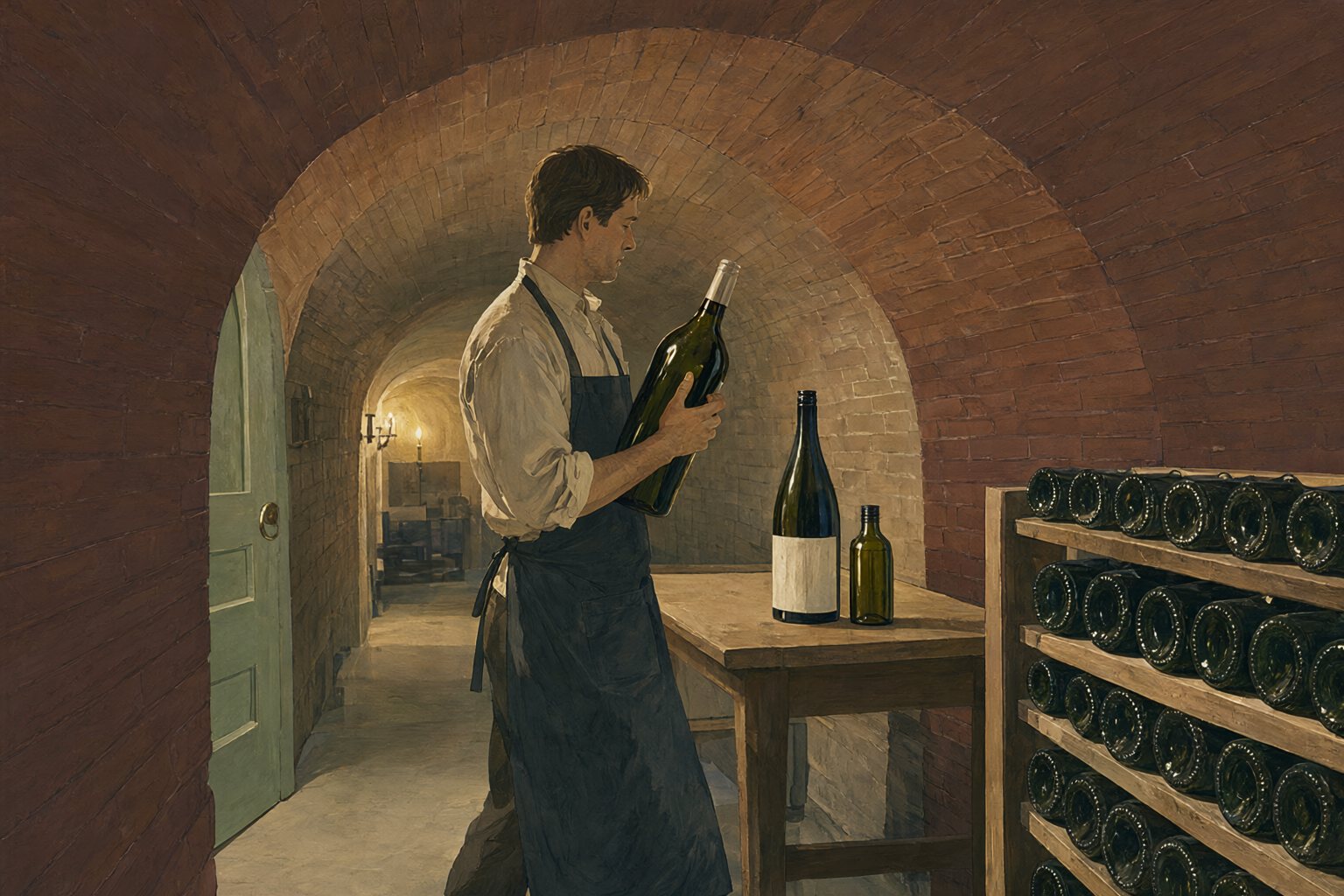
Nobody ever decided at a desk that a bottle of wine should hold 75 centilitres. Yet we take it for granted as though it were a law of nature, and anyone who has tried to split a bottle three ways without an argument knows the number is, to say the least, awkward. Where does it come from? The honest answer is that there are plenty of explanations and none is definitive.
The mystery of 75 centilitres
The most quoted theory is commercial. English merchants, great customers of Bordeaux, thought in imperial gallons; a barrique of about 225 litres corresponds to roughly fifty gallons, and to 300 bottles of 75 cl, or 25 cases of twelve. The sums work out with suspicious convenience, but it remains a hypothesis: nobody has found the minutes of the meeting where someone chose it.
There are others. The glassblowers’ theory, that the volume was the most a pair of lungs could inflate, is fascinating and hard to verify. The serving theory, six glasses of about 125 ml, has the merit of practicality and the flaw of having been written after the fact. The regulatory part is sturdier: from the 1970s a European directive on the volumes of prepackaged products fixed 75 cl as the reference size for wine, and the number has been rigid ever since. In the United States, meanwhile, the “fifth”, one fifth of a gallon or about 757 ml, was in circulation, close enough to bring the markets together.
When a figure has three or four possible fathers, the truth is usually that it had all of them, a little, at different moments.
From the half to the Nebuchadnezzar
Below the standard bottle sits the half, at 37.5 cl, useful when there are two of you or when you want to taste without committing. Above it the scale follows a precise rhythm: the magnum holds 1.5 litres, two bottles; the jeroboam holds four (3 litres) in Champagne, but in Bordeaux and Burgundy the same name often means 4.5 litres, one of those ambiguities worth clearing up before you order. The methuselah reaches 6 litres, eight bottles. The Nebuchadnezzar climbs to 15 litres, twenty bottles: an object that takes two people to handle.
The names come almost entirely from the Bible. Jeroboam and Rehoboam were kings of Israel, Methuselah is the patriarch who, according to the text, lived 969 years, a choice that probably alludes to the long wait a great wine demands. The system is a convention, and not every region follows it to the letter: always look at the litres, not the name.
Why wine ages better in magnum
Here, for once, oral tradition has a reasonable basis. In a magnum the pocket of air under the cork is similar to that of a normal bottle, and the cork is the same; but the liquid is double. Little oxygen for a lot of wine means slower evolution, and a wine that evolves more slowly has time to build complexity before it starts to tire. A second factor helps: a larger body of liquid is less affected by swings in temperature.
Producers say the same: in the same vintage, the half bottle evolves quickly, the magnum calmly. But do not turn it into dogma. There is no objectively “better” format: it depends on when you want to drink, and a wine meant to be enjoyed young has nothing to gain from waiting. The advantage also assumes a well-sealed, well-stored bottle; a badly kept magnum is just a large badly kept bottle.
A question of shape
Glass has its families too. The Bordeaux bottle has high, marked shoulders and a long neck: the shoulders, it is said, hold back sediment as you pour. It is one of the most widespread shapes in the world. The Burgundy bottle has soft, sloping shoulders and houses Pinot Noir and Chardonnay; clear glass for whites, green or dark for reds, and a line that has set the standard.
The Rhine bottle takes its name from the river and is tall, slim and almost shoulderless: it is used for wines that do not normally throw much deposit, Riesling first among them, and it is found in Alsace too. Finally the albeisa, tied to the town of Alba and the Langhe: it recalls the Burgundy bottle, with slightly more pronounced shoulders and dark glass, and it is the classic dress of Barolo and other Piedmontese wines.
One can argue about how much of shape is function and how much identity. Probably the second weighs more than we admit: a bottle recognisable from afar is a label that needs no words.
The opinion
Format is the most neglected decision in buying wine. For a red with twenty years ahead of it, a magnum is worth the effort, and not only for the scene when it reaches the table: it ages with more grace, and it forces you to invite more people, which is already half the recipe. Giant fifteen-litre formats are scenery; the magnum is substance. If I had to choose a single bottle to forget in the cellar, it would be that one.
❦