How to taste wine without sounding like a snob (or lying)
Look, swirl, sniff, sip: wine tasting explained without the posturing, with the physics of wine legs and a simple method for training your nose.
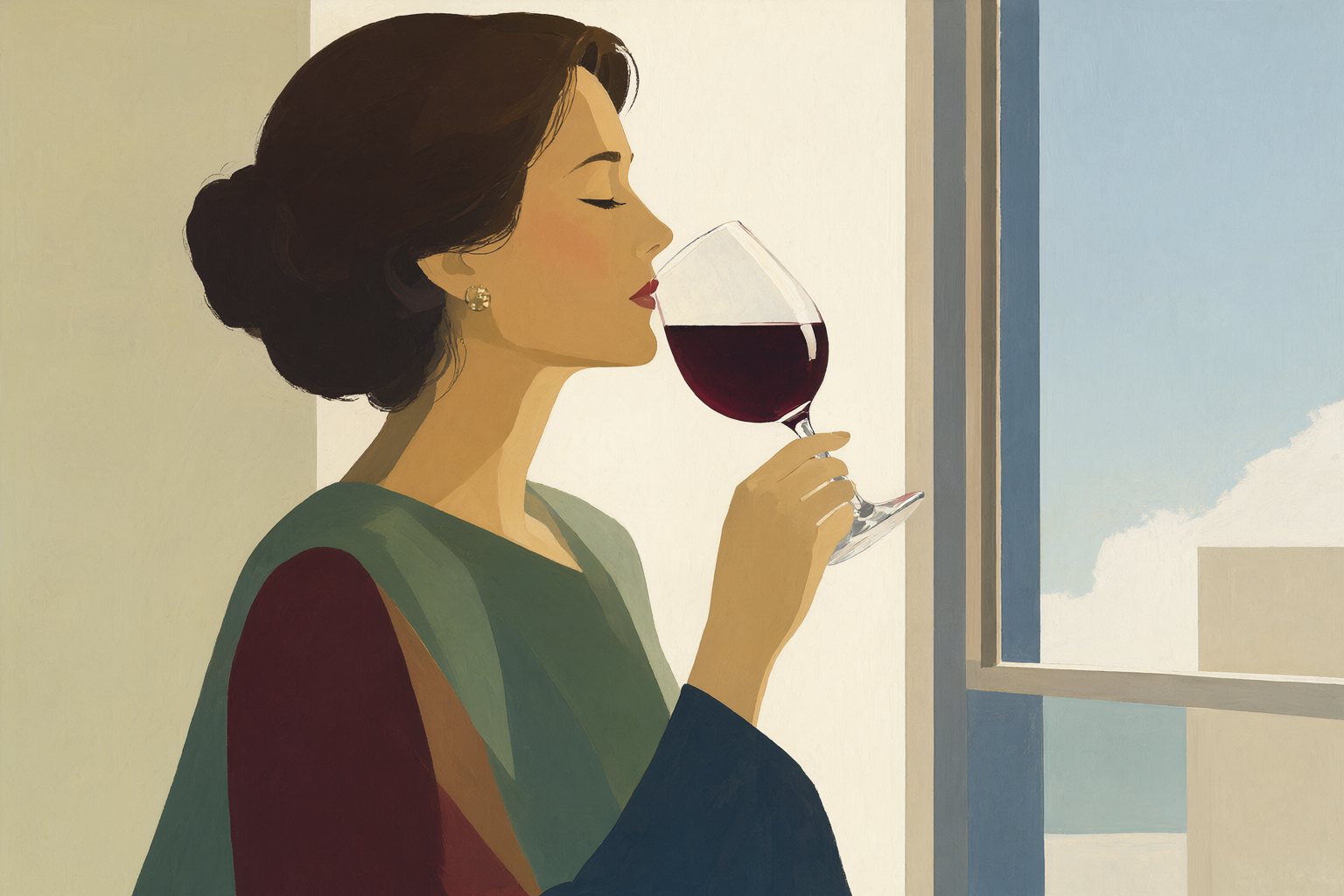
The trouble with wine tasting isn’t the wine. It’s the theatre. The glass spun like a top, the nose plunged in with a grave expression, the final pronouncement on “forest floor and leather”: all of it has persuaded generations of people that paying attention to what you drink is a rite reserved for initiates. It isn’t. It’s a way of slowing down, and it serves exactly one purpose: noticing what’s in your glass before it’s gone. The rest is costume, and it can stay in the wardrobe.
Looking, without reading the future
The first move is to tilt the glass against a pale background, a tablecloth or a sheet of paper, and look at the rim of the wine, where the layer is thinnest. You learn more there than at the centre. A young red leans towards purple; one with a few years behind it shifts towards garnet and then brick; a white moving from straw to gold may be telling you about age, oak or simply a grape that is naturally deeper in colour.
What colour won’t tell you is whether the wine is any good. It offers clues, not verdicts. Anyone who glances at a glass and claims to guess the vintage and the appellation is doing a parlour trick: occasionally it comes off, more often it’s luck.
Tears: physics, not pedigree
Then comes the moment when someone points at the drops running down the inside of the glass and announces: “Look at those legs, this is a great wine.” Well, no. Tears, arches or legs, as English speakers like to call them, are among the most photographed and most misunderstood phenomena in the world of wine.
The correct explanation dates back to the mid-nineteenth century. The first to offer it was the Scottish physicist James Thomson, brother of Lord Kelvin, in 1855; ten years later the Italian Carlo Marangoni studied the mechanism in depth, and today it bears his name: the Marangoni effect. Here is how it works. Wine is mostly water and alcohol, and alcohol has a lower surface tension than water and evaporates faster. In the thin film that creeps up the side of the glass, the alcohol leaves first, the surface tension there rises and “pulls” more liquid up from below. The liquid gathers, grows too heavy and slides back down in drops.
What does any of this tell us about quality? Nothing. Tears are linked above all to alcohol content (and to the conditions for evaporation, meaning temperature and air): more alcohol, more show. The idea that “lots of legs” means a sweeter or better wine is a myth that survives out of sheer laziness. Glycerine often gets the credit, but the main engine is still alcohol. If you want to test it at home, cover the glass with a saucer: evaporation stops and, before long, the tears fade. A mediocre wine at 15 degrees will weep more than an extraordinary 8-degree Riesling. By all means look at them; they’re beautiful. Just don’t make them talk.
Swirling and sniffing: the nose does almost everything
Swirling has a practical purpose: it increases the surface area of the wine and sends more aromatic molecules towards your nose. A little is enough, holding the glass by the stem or keeping it on the table. It pays to sniff twice: first with the glass still, to catch what is most volatile, then after giving it a turn. And in short sniffs, not one long inhalation: the nose tires quickly and stops registering a smell it is continuously exposed to.
This is also where you find out if something is wrong. Wet cardboard, mould, a damp cellar can point to so-called cork taint; a smell of vinegar or too much nail varnish, excessive volatile acidity; notes of bruised apple in a young white, oxidation. Recognising faults is the most useful part of the whole exercise, because it’s the only part with practical consequences: sending a bottle back.
Tasting: retronasal aroma and length
In the mouth, move the wine around so it touches the whole tongue and palate. The tongue picks up little, but picks it up well: sweet, sour, bitter, salty, plus tactile sensations such as tannin drying the gums, the warmth of alcohol, body. The bulk of the aroma, though, arrives by another route: the retronasal one. As the wine warms in the mouth and is swallowed, the volatile compounds rise from the back of the throat into the nasal cavity. The retronasal impression is often more eloquent than the first sniff: wines that seem closed in the glass open up in the mouth, and vice versa.
That business of drawing in a thread of air with wine in your mouth, the slightly noisy slurp that makes the neighbouring table smile, is meant precisely to push the aromas towards the nose. It can be done discreetly. Nobody is obliged to sound like a sink.
Then there’s length: how long the aromatic sensation lasts after you swallow or spit. Technical sheets sometimes measure it in “caudalies”, that is, in seconds. It’s a sensible yardstick, because length is one of the few indicators that genuinely tends to go hand in hand with quality, but it should be kept apart from the mere lingering of bitterness or alcoholic burn, which persist even in clumsy wines.
Red fruits, useful conventions
Which brings us to vocabulary. When someone says “red fruits”, they are not declaring that the wine contains strawberries and raspberries. They are using a shared shorthand for a family of sensations, some of which depend on molecules that are actually present in fruit too, and some of which don’t. Descriptors are a vocabulary, not a chemical analysis. They exist to communicate, and they only work if speaker and listener understand them the same way.
That is why, in 1984, Ann C. Noble, a researcher at the University of California, Davis, proposed the Wine Aroma Wheel: a wheel that organises aromas into twelve broad families, from fruity to floral, from vegetal to woody, with progressively more specific terms. Its merit was not to dictate what you “ought” to smell, but to give everyone the same words, and concrete ones where possible. “Elegant” and “harmonious” are judgements; “grapefruit” and “black pepper” are descriptions you can check.
Training your nose
A good nose is not a gift, it’s a memory. You train it the way you train any memory: by linking a smell to a name, many times over. The simplest method is also the cheapest: smell, deliberately, whatever you have in the kitchen and at the market. A strip of lemon peel, an apple cut a few minutes ago, a tomato leaf, freshly ground pepper, vanilla, the leather of a belt. Each time, give it a name.
The second step is comparison. Tasting two wines side by side teaches you more than ten drunk on different evenings: two different grapes, the same grape from two areas, two vintages of the same wine. The differences surface on their own, and the words come with them.
In the end, the best test of a tasting is a simple one: does it make you want to take another sip with more attention, or does it make you feel guilty for not getting it? If it’s the latter, someone has turned curiosity into an exam. Serious tasting doesn’t need solemnity: it needs attention, a few shared words and the nerve to say “I can’t smell anything” when you can’t smell anything. It’s the most honest sentence anyone can utter over a glass, and also the rarest.
❦