How wine is made, red and white, from vineyard to bottle
Harvest, crushing, fermentation, maceration and ageing: how wine is made, what changes between red, white and rosé, and what the law actually says.
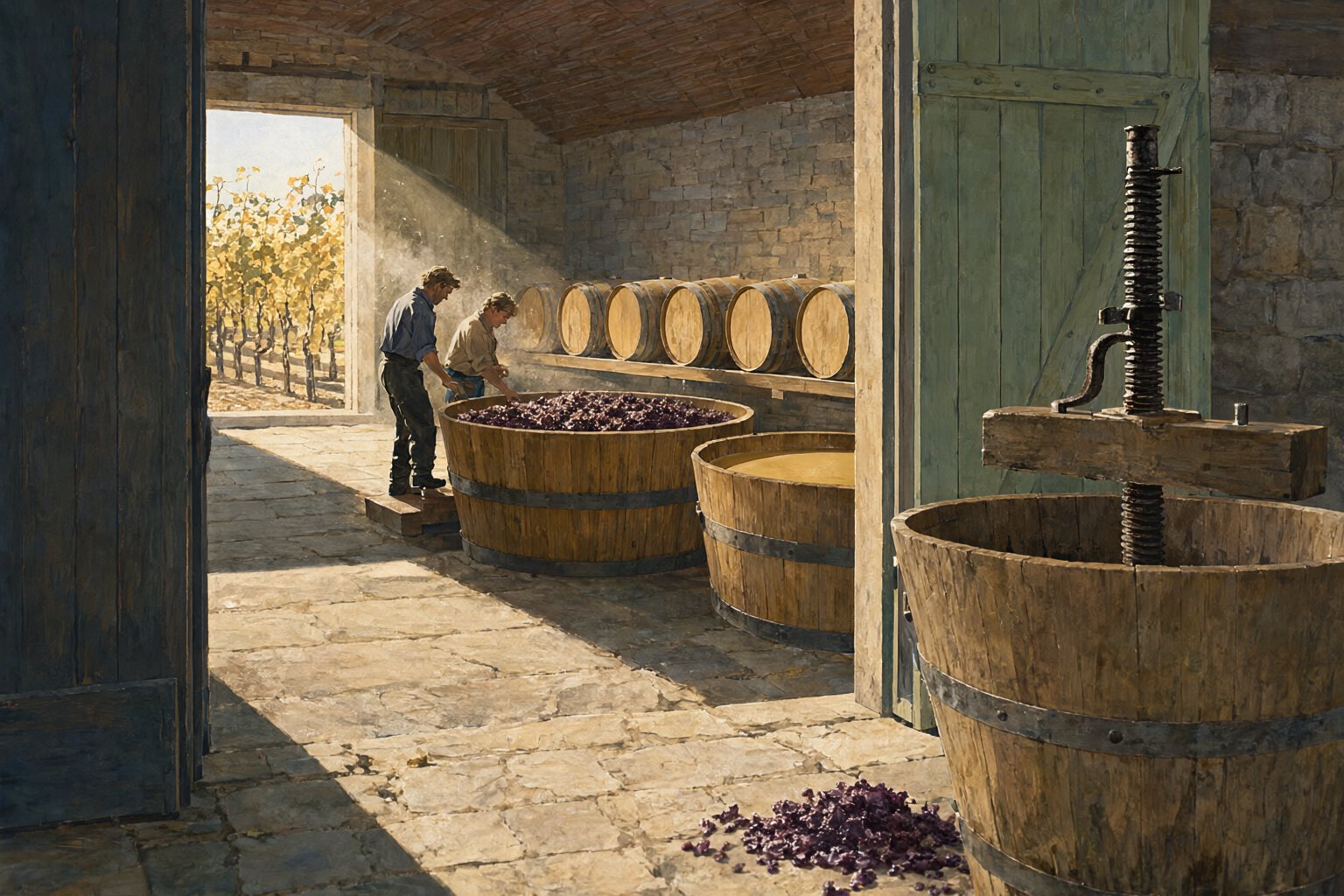
Wine is one of the few foods that almost makes itself. Crush some ripe grapes in a container and wait: the yeasts living on the skins and in the surroundings start eating the sugar, and within a few days the sweet juice becomes an alcoholic drink. The hard part is not bringing wine into being. It is stopping it from turning into vinegar, and deciding what it should become.
The definition, first of all
Under European law, wine is the product obtained exclusively from the total or partial alcoholic fermentation of fresh grapes, whether or not crushed, or of grape must. That is what Regulation (EU) No 1308/2013 says, and its Annex VII also sets a minimum: at least 8.5% actual alcohol in Europe’s coolest wine-growing zones, 9% in the others. Anything made from other fruit, however good, cannot be called wine.
The chemistry is simple to tell: yeasts turn the grape’s sugars, glucose and fructose, into ethyl alcohol and carbon dioxide, releasing heat. Everything else, which is to say almost everything that makes one wine different from another, depends on how four variables are handled: the grapes, contact with the skins, temperature and time.
From harvest to crushing
The first act is choosing the day to pick, which is already a decision about style: grapes picked early give sharper, lighter wines; grapes left long on the vine give more sugar, and therefore more alcohol, and riper fruit. In the cellar the bunches usually pass through a destemmer, which separates the berries from the stalk, the woody part that brings green, bitter tannins. Then comes crushing: the berries are broken, not violently squeezed, to release the juice.
There is a detail that surprises beginners. The pulp of almost all grapes, black ones included, is colourless: the juice is clear. The colour lies in the skins. That is why Pinot Noir can be made into the palest sparkling wines, the so-called blanc de noirs, and why the real difference between red and white is not the colour of the grape but what is done with the skins.
Red: fermenting with the skins
In red wine, the must ferments together with skins and seeds. This is maceration: the alcohol being formed and the heat of fermentation extract from the skins the anthocyanins, meaning colour, and the tannins, meaning the structure that dries the mouth. During fermentation the skins are pushed up by carbon dioxide and form a compact layer, the cap, which has to be wetted and broken up several times a day: with pump-overs the must is drawn from the bottom and poured over the top, with punch-downs the cap is pushed towards the bottom.
Temperature matters enormously. Reds are fermented warmer than whites, often between 25 and 30 degrees and sometimes above, because heat helps extraction. But there is a limit: the Australian research institute AWRI points out that above 35 degrees yeasts suffer and fermentation risks getting stuck, and that colour is extracted before tannins. The length of maceration is the great lever of style: a few days for a fresh red to drink young, weeks for a wine built for long ageing.
Once fermentation is over the wine is racked off: the free-run wine is separated from the pomace, which then goes under the press to recover the wine it still holds.
White: press first, then ferment
For white wine the order is reversed. The grapes are pressed straight away, often gently, and only the juice is fermented, after being left to settle so that suspended particles fall to the bottom. No skins, so very little tannin and no extracted colour: everything rests on acidity and aroma. To protect them, fermentation takes place at lower, controlled temperatures, in chilled stainless-steel tanks, and contact with oxygen, which yellows the wine and dulls its aroma, is kept to a minimum.
There are important exceptions, though. Some whites are left for a few hours in contact with their skins before pressing, to gain aroma and body; others ferment at length on the skins like a red, and there you have orange wines. Rosé sits in between: black grapes with very short skin contact, from a few hours to a couple of days. In Europe it cannot be made by blending white and red wine, with exceptions such as some sparkling wines.
After fermentation: time
Newborn wine is cloudy, rough and still unstable. Many reds and some whites then go through malolactic fermentation, carried out by bacteria that turn sharp malic acid into softer lactic acid. Then come rackings, which separate the wine from its sediment, and ageing: weeks in steel for a white to be drunk within the year, months or years in large casks, barriques, concrete or amphorae for more ambitious wines. The vessel is not a detail: wood gives off aromas and lets through a thread of oxygen, steel preserves the fruit.
Before bottling, wine is often fined, that is, cleared of the particles that might cloud it, and filtered. In almost every stage sulphur dioxide also comes into play, used in controlled doses to protect the wine from oxidation and unwanted microorganisms. Then the bottle and, for some wines, another period of rest in the cellar before release.
Why all this matters to the drinker
Knowing these steps is not about making wine in the garage, but about reading it in the glass. A pale, crunchy red tells of a short maceration; a golden, broad white perhaps of time in wood or on the skins; a red that dries the mouth, of weeks of extraction. Almost every trait of a wine has a technical name behind it.
Our view is that winemaking is overrated when it is told as magic and underrated when it is described as chemistry. It is a series of choices, each with a price: more extraction means more structure and less freshness, more wood more complexity and less fruit, more time more depth and more risk. The best wine is not the one where the most was done, but the one where every choice feels like a consequence of the vineyard, not a cellar trick.
❦