Phylloxera, the louse that redrew the map of wine
From America to France, then to Italy: how an insect a millimetre long destroyed Europe’s vineyards and why almost every vine today has American roots.
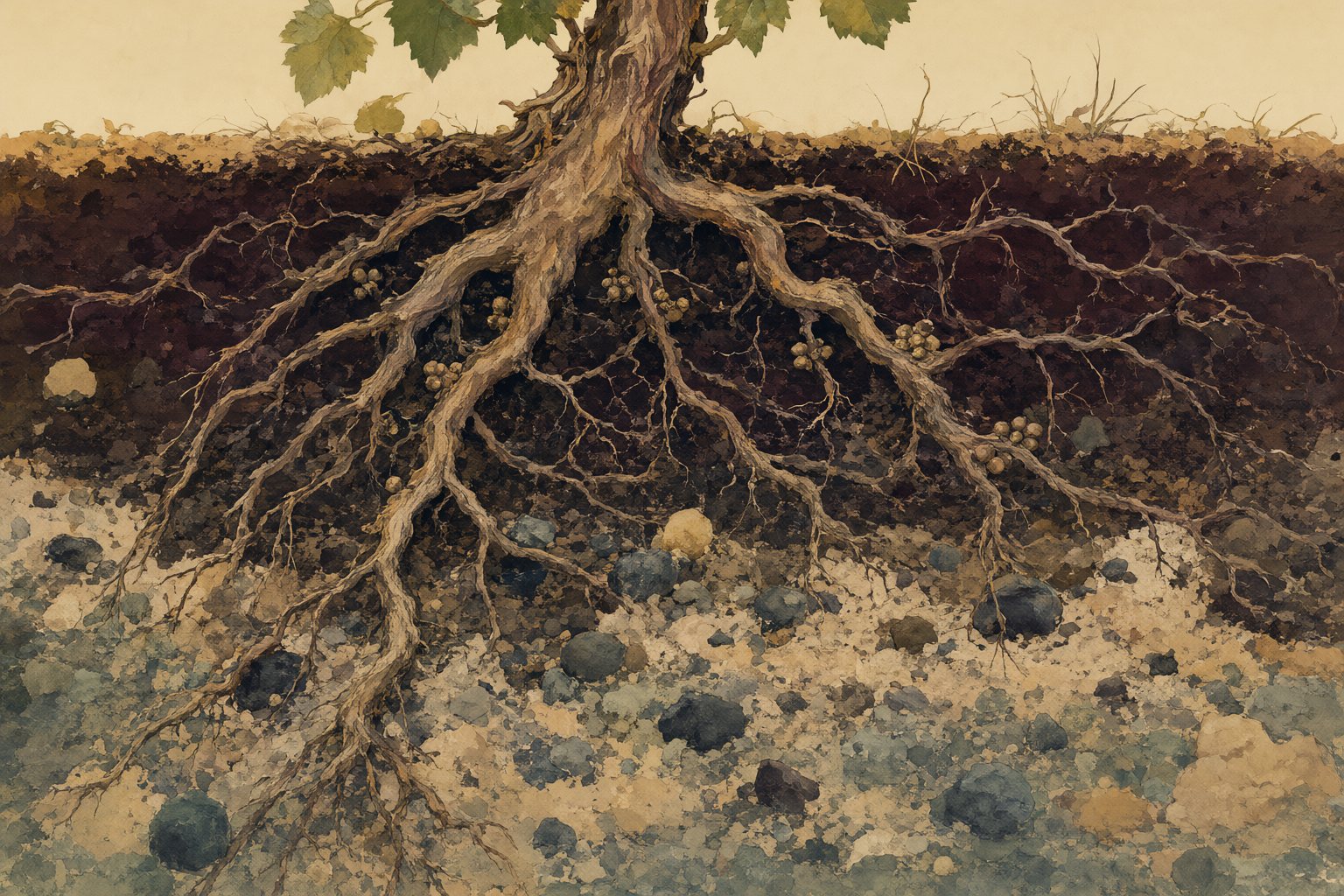
Almost every glass of European wine you will ever drink holds a secret below ground: the plant that gave the grapes is, from the waist down, American. Above is Nebbiolo, Sangiovese or Pinot Nero; below, a root born of wild North American species. This compromise, so normal today that nobody gives it a thought, is the legacy of an insect about a millimetre long that, in the second half of the nineteenth century, brought the continent’s viticulture to its knees.
A stowaway
Phylloxera (today Daktulosphaira vitifoliae, long known as Phylloxera vastatrix) is an aphid native to North America. There it had always coexisted with the local wild vines, which over time had learned to defend themselves: when the insect pierces the roots, the American plant seals off the wound and carries on. European Vitis vinifera does not. Its roots swell with galls, rot and open up to infection, and within a few seasons the vine dies.
The trouble is that in the nineteenth century American vines travelled. They were imported out of botanical curiosity and to experiment against another scourge of the period, powdery mildew. With the plants came the guest. Sources place its introduction into France between the late 1850s and the early 1860s; the first documented case dates from 1863, at Pujaut, in the Gard département, not far from the Rhône. For a few years nobody understood what was happening. In 1868 the botanist Jules-Émile Planchon, called in by the local growers, found the insect on the roots of vines that were still alive and linked it to the dieback. Not everyone believed him: for a long time it was debated whether the aphid was the cause of the decline or merely an opportunist feeding on vines that were already sick.
France runs dry
While the scientists argued, phylloxera marched on. In twenty years it climbed from the Midi to Bordeaux, Burgundy and Champagne. The figures say more than any adjective: according to the historical series compiled by the National Bureau of Economic Research, French production fell from about 84 million hectolitres in 1875 to about 23 million in 1889. The government offered a prize to whoever found a remedy, and the remedies proposed were of every kind: flooding the vineyards in winter, injecting carbon disulphide into the soil, even burying a live toad beneath every vine. Some methods half worked; almost all of them cost too much.
The way out came from the enemy itself. If American vines resisted, it was enough to take their roots and graft the European varieties onto them. The idea was already circulating in the early 1870s, but it took years to work out which species to use: many American ones could not tolerate France’s limestone soils. The contribution of nurserymen and scholars from across the Atlantic proved decisive, among them the Texan Thomas Volney Munson, who made available species suited to lime-rich ground. Since then the rootstock has become a technical choice in its own right, with its own codes and crosses, which the grower weighs as carefully as the clone of the grape.
There was also a shortcut, and many took it: planting American grapes directly, or hybrids between American and European vines, the so-called direct producers. Resistant and generous, but with a taste that palates used to vinifera found wild. Isabella, from which fragolino is made, is a relic of that era: even today the grape cannot produce wine that may be sold as such.
Italy, first the beneficiary then the victim
Italy lived through the crisis in two acts. In the early 1880s, with France short of wine, the reds of the South headed for French ports in unprecedented quantities, often to end up blended with what little the French were still producing. The party did not last. In 1888 a trade war broke out between the two countries and wine was among the goods hardest hit: those who had planted vineyards with the market across the Alps in mind found themselves with cellars full.
Meanwhile the insect had reached Italy too. According to the Enciclopedia Italiana, a suspicious decline had been noticed near Lecco as early as 1875, but official confirmation came in 1879, at Valmadrera and in the countryside around Agrate. The following year outbreaks appeared in Sicily, in the provinces of Caltanissetta and Messina, and in Liguria; Piedmont was reached in 1886, Tuscany in 1888, Puglia in 1899. By the end of the century more than nine hundred municipalities had been affected. In 1931 phylloxera was present in 89 provinces out of 92, and about a quarter of the vast national vineyard area of the time, which also included vines trained up trees among the fields, had been destroyed or seriously damaged.
Who was spared, and why
The insect has a weak point: it moves through the soil via cracks and tunnels. In loose sand those passages collapse, and phylloxera cannot travel from one root to the next. That is why vineyards on dunes and on sandy volcanic soils have remained largely immune. In Portugal, at Colares, on the Atlantic coast, Ramisco vines sink their roots through the sand down to the clay beneath. On Santorini, vines trained in low basket shapes grow on ash and pumice. The most striking case is Chile, which has never seen phylloxera: desert to the north, the Andes to the east, the Pacific to the west, ice to the south. Not even Chilean nurseries, however, can consider themselves safe for ever, and imports of plant material are strictly controlled.
In Italy the pockets of piede franco, vines on their own roots, follow the same logic. The volcanic soils of Etna and the sands of the Sulcis, which we have written about on these pages, are the best-known examples; to these can be added high-altitude vineyards in the Valle d’Aosta, where cold and loose soils have acted as a barrier, and scattered patches in Campania and elsewhere. They are precious plants as a genetic archive. How much ungrafted vines change the wine in the glass, on the other hand, remains an open question, and anyone who promises to recognise it blind always bears something of the burden of proof.
A map redrawn
The deepest damage, in Italy, was not only the loss of vineyards but the way they were rebuilt. Replanting on American rootstock was expensive: new plants, grafts, years without a harvest. People replanted where it paid, and with whatever yielded most. Many mixed vineyards, where dozens of local varieties had coexisted, gave way to a few reliable, productive grapes. Many minor varieties, painstakingly revived today, left the stage at precisely that moment. In the same period, with downy mildew adding to the troubles and emigration emptying the countryside, certain arduous hillsides were never replanted at all.
The result is that the geography of Italian wine we know today is largely a product of the twentieth century, born of reconstruction rather than of the thousand-year continuity some labels like to claim. That is no bad thing. But it is a good reason to be wary of marketing built on unchanging tradition: beneath almost every vineyard there is an American root, and above it a choice made by some great-grandfather with the accounts in his hand. Phylloxera, which is still there in the soil and has never gone away, reminds us that wine is a successful compromise between nature and necessity. And that, more than the myth, is what makes it interesting.
❦