Wine in a Warming World: Earlier Harvests, Higher Vineyards
Earlier harvests, vineyards at 1,000 metres, English sparkling wine and PIWI grapes. How a changing climate is redrawing the map and style of wine.
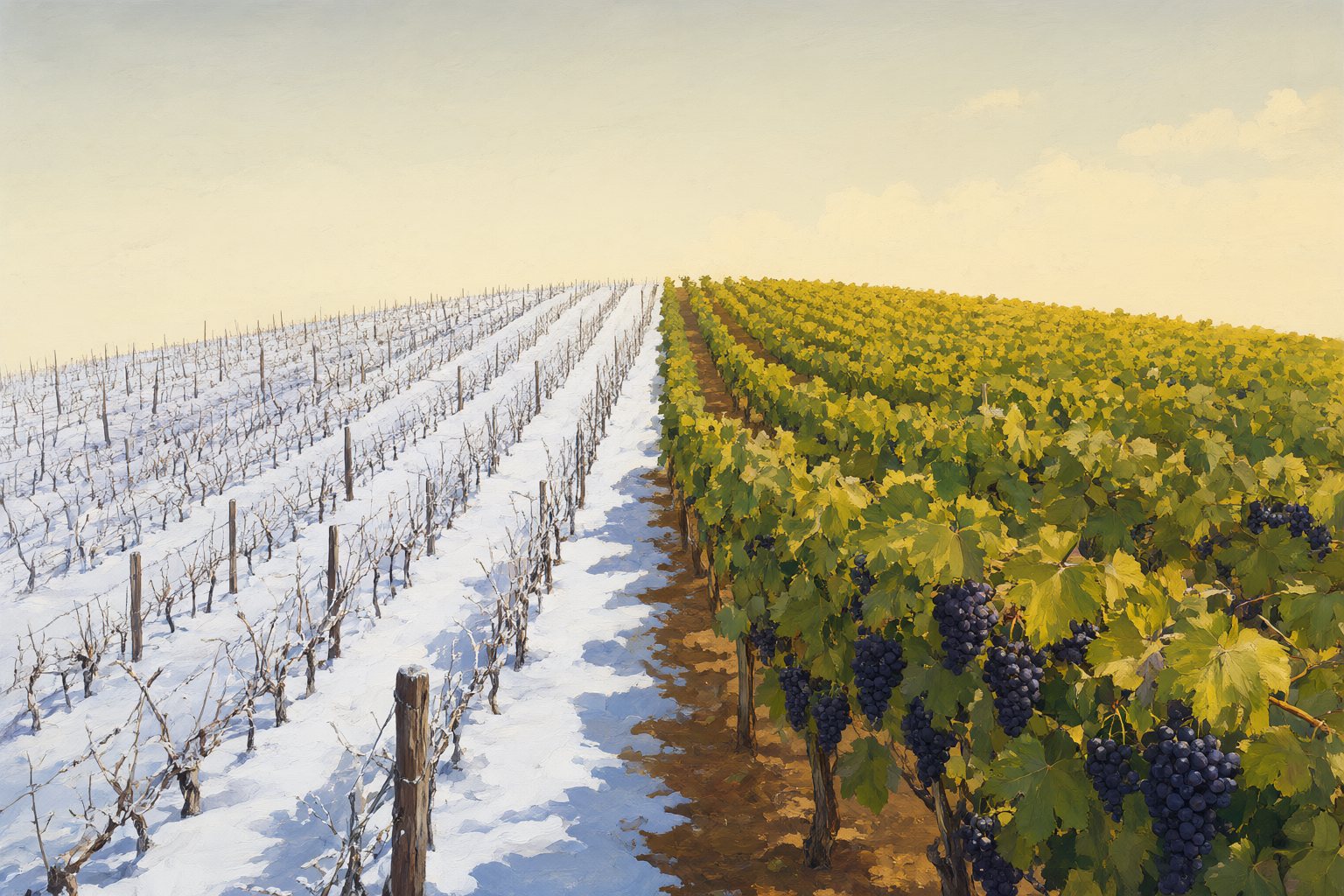
For centuries the grower looked at the calendar with a certain fatalism: you picked in October, sometimes late September, and a hot vintage was a rare stroke of luck. Today the calendar has become a matter of opinion. In many European regions the grapes ripen weeks earlier than they did for our grandparents, and the wine that results is not the same. This is not a prophecy. It is already in the glass.
Earlier harvests, surplus sugar
The most solid evidence comes from the archives. A study led by Ben Cook (NASA) with Elizabeth Wolkovich (Harvard), published in Nature Climate Change in 2016, lined up four centuries of harvest dates in France and Switzerland. Up to 1980, picking came earlier mainly in hot, dry years. From 1981 onwards it comes earlier even without drought: background warming is enough on its own.
The sharpest recent example comes from England, where in 2025 many producers began picking in late August and most had started by mid-September, about three weeks earlier than in 2024. One year does not make a trend, but it shows the direction well.
The corollary is chemical. More sun means more sugar, and therefore more potential alcohol, while the acids that give wine its nerve and freshness burn off quickly. I give no average alcohol level by region here, because the numbers vary too much from zone to zone and vintage to vintage to be quoted without reservations. The mechanism, though, is familiar to anyone who has tasted a red from a scorching Mediterranean year: more body, more heat, less tension. The grower’s task becomes holding on to freshness, with earlier picking, more generous canopies to cast shade, and soils and aspects chosen with care.
Going uphill, as long as there is mountain
The most intuitive move is to go where it is cooler. In Italy people now plant at altitudes that would once have seemed reckless: in Calabria, in the Sila National Park, someone grows white grapes at around 1,300 metres, while on Etna there are documented vineyards at 1,200 metres and red-grape plantings pushed up to roughly 1,500. In Valle d’Aosta, Prié Blanc is grown at around 2,000 metres.
Beware of selling altitude as a cure-all, though. Climbing costs money: terracing, transport, tiny yields, the risk of frost and hail. And mountains are finite, because above a certain height there is nothing left to plant. Those who can climb, climb; those on the plain have to invent something else.
England, the surprise winner
If the climate takes from some, it hands to others. The most striking case is England, where the chalky soils of the south recall those of Champagne and where grapes once struggled to ripen. According to WineGB, the trade body, English and Welsh vineyards passed the thousand mark for the first time in 2025. The area covered by its survey is 2,063 hectares, 1,700 of them in production, and in ten years the planted area has grown by 123%. The 2025 harvest was estimated at between 15 and 16 million bottles, the second largest ever.
Traditional-method sparkling wine is the calling card, and not by chance: the acidic, lean base wines that are a problem elsewhere are a gift for second fermentation in the bottle. Industry observers note, however, that very ripe vintages are also opening the door to still wines, Chardonnay and Pinot Noir above all. England long had the opposite problem to everyone else: too little sugar. The paradox of warming is that one region’s advantage grows out of many others’ disadvantage. And the boom has a flip side, since there is already talk of oversupply after the abundant harvests.
Changing the grapes, in small steps
The biggest taboo concerns the grape itself. Appellations are built on specific varieties, and touching them means touching identity. Yet something is moving. In 2021 Bordeaux admitted six new varieties, four red (Touriga Nacional, Marselan, Castets, Arinarnoa) and two white (Alvarinho and Liliorila), with strict limits: at most 5% of an estate’s vineyard area and 10% of the final blend. It is a prudent, almost symbolic choice, but a significant one for a region that has turned its rulebook into a religion.
Then there are the PIWI, from the German Pilzwiderstandsfähig, meaning fungus-resistant. They are crosses between the European vine and naturally resistant American or Asian species, with more than 95% Vitis vinifera in their genetic make-up. They withstand powdery and downy mildew better and therefore need fewer sprays, although resistance is not immunity and varies from variety to variety. In Italy in 2022 they covered about 2,000 hectares, 0.3% of the country’s more than 680,000 hectares of vines. Few, but growing, above all in Trentino-Alto Adige and Veneto.
It should be said that PIWI answer disease pressure, made worse by wet and unstable vintages, more than heat in the strict sense. They are part of the answer, not all of it. And they still have an image problem: the consumer buys a name they know, not a German acronym.
My view
The greatest risk is not that wine disappears, but that we get used to it. That the more alcoholic, softer red becomes the norm and freshness becomes a luxury. The honest answer lies in the middle: fewer shortcuts and more shade in the vineyard, a little courage with varieties where identity allows it, and less hypocrisy about appellations, which have always been works in progress rather than monuments. Wine has always been a thermometer. The difference is that now we can all read the fever.
❦