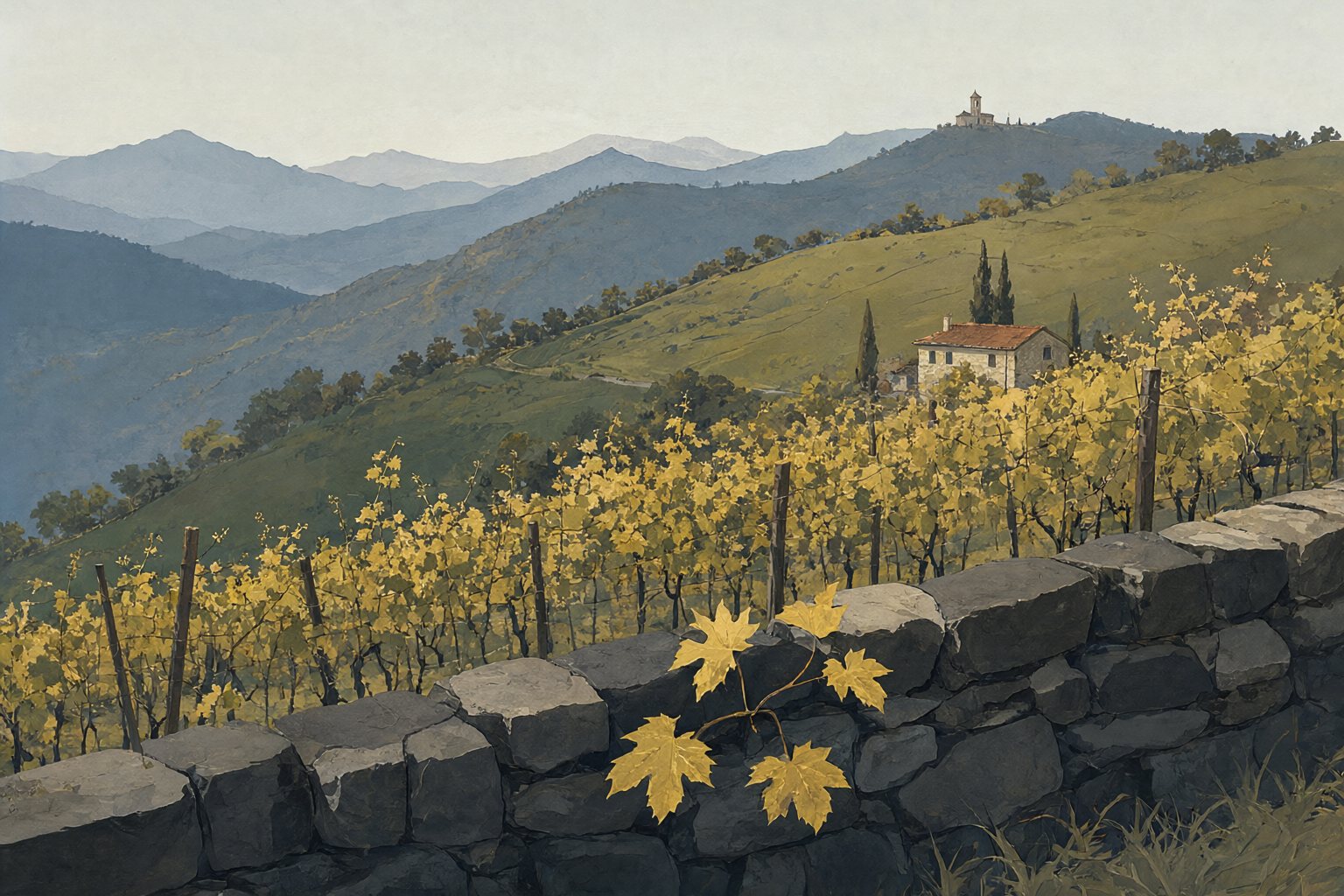
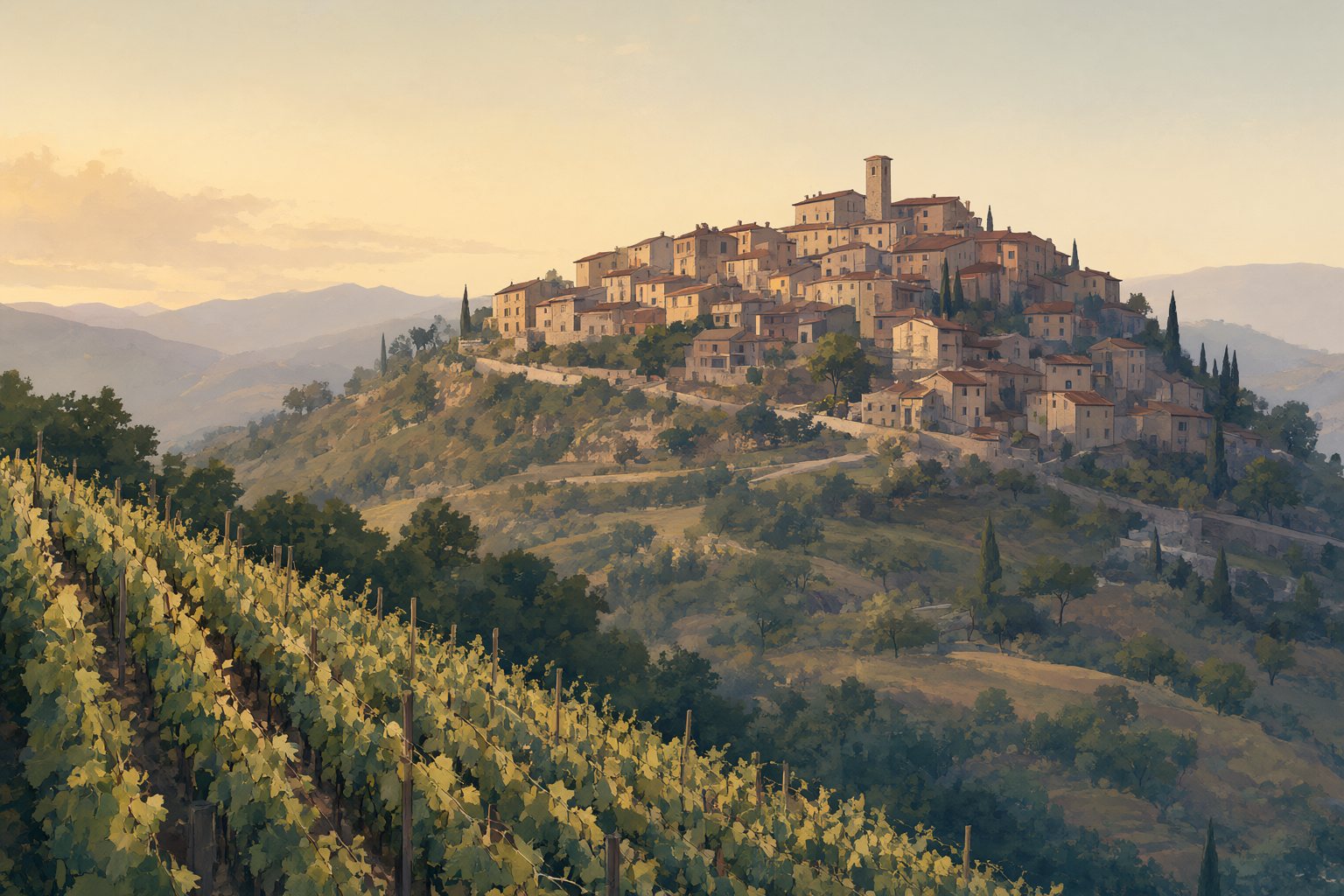
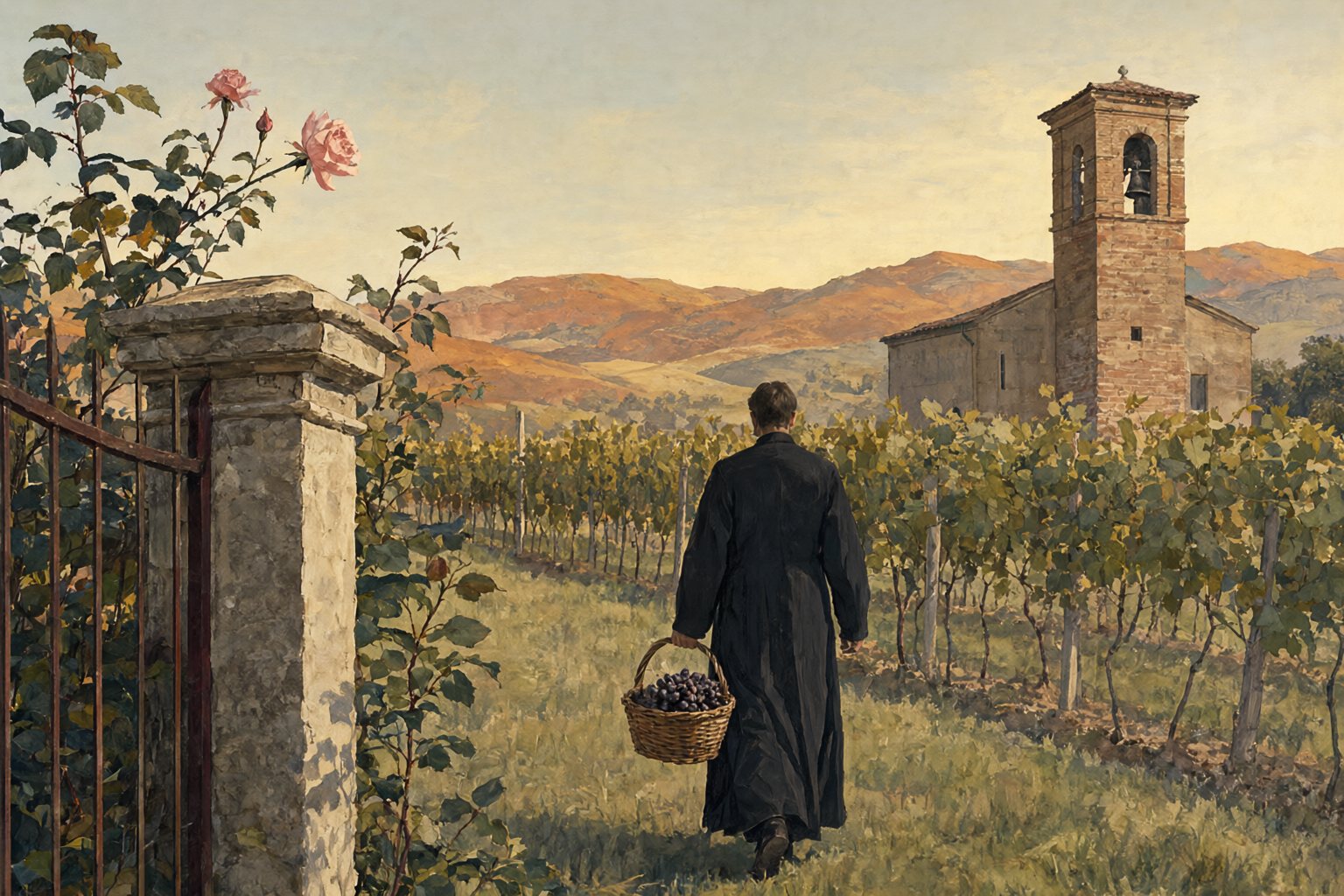
Sagrantino di Montefalco, the red that bites (and waits)
From festive passito to a dry red with 37 months of mandatory ageing: the history, DOCG and character of Sagrantino di Montefalco, one of Italy's most tannic wines.
Some wines introduce themselves and some impose themselves. Sagrantino belongs firmly to the second camp: in the glass it is almost black, with violet glints, and at the first sip the mouth dries as if after a long argument with someone who is always right. Tannin is the undisputed lead, and it has no intention of playing a supporting role. Drink it young and you understand at once; wait for it, and you discover that behind all that severity there was a character.
A wine born sweet
The most surprising thing is that for much of its history Sagrantino was not an austere red for roast meat at all. Tradition has it as a passito, that is, made from dried grapes, and reserved for important occasions: feast days, religious celebrations, the table of someone who could afford a sweet, dark wine. Some sources link this vocation to the presence of Franciscans in the area, but scholars do not agree on the exact origin of the grape or its earliest records, and it is wise to distrust genealogies that are too elegant.
What is known with more certainty is its twentieth-century trajectory. Sagrantino came close to disappearing: over the last century the planted area shrank to tiny numbers, and at one point only a few hectares remained, mostly in the hands of farmers who kept it for the family. It was saved by the gamble of a handful of producers who, between the 1970s and 1980s, began to bottle it and believe in it, among them Arnaldo Caprai, who bought his estate in 1971, and Paolo Bea. Without that stubbornness we would be talking about an encyclopaedia curiosity, not an appellation.
Tannin as biography
Why is Sagrantino so tannic? Because the skin of the berry is thick and rich in polyphenols, and because the variety ripens slowly, late in the season. The result is an imposing structure that in young wines can seem almost hostile, and that needs time, oxygen and wood to soften. It is no accident that producers often speak of a red to be “tamed”, and that many styles of recent decades have been, at heart, attempts to negotiate with this tannin: riper picking, gentler extraction, large casks in place of new barriques.
To say it is one of Italy’s most tannic reds is not marketing; it is a reasonable description, though rigorous scientific rankings, with numbers in hand, are another matter. The fact remains that on the Italian scene few wines ask as much patience of those who serve them and those who drink them.
DOCG, dry and passito
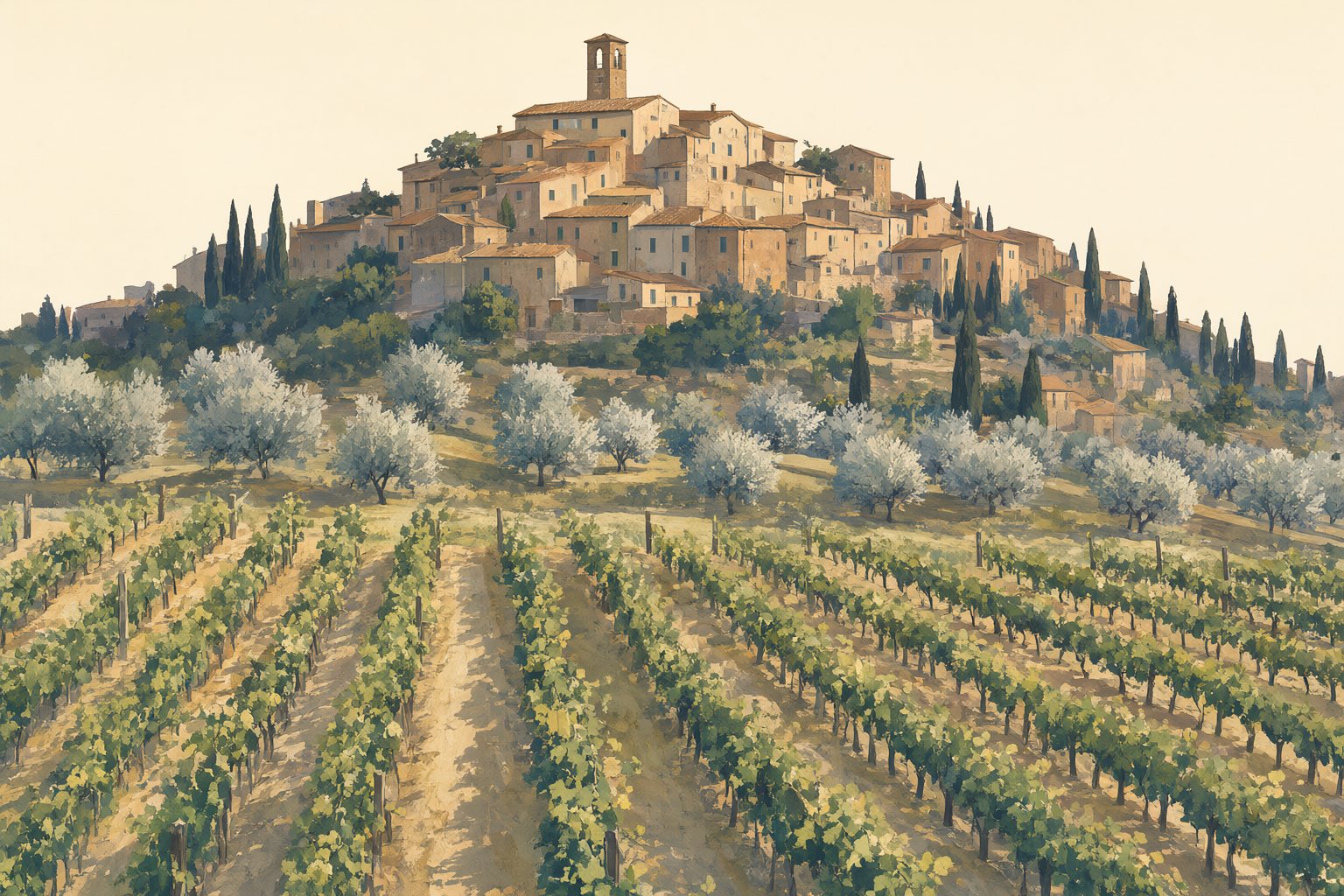
The appellation was awarded DOCG status in 1992 under the name Sagrantino di Montefalco, changed in 2009 to Montefalco Sagrantino. The production zone, in the province of Perugia, covers five communes: Montefalco, Bevagna, Gualdo Cattaneo, Giano dell’Umbria and Castel Ritaldi. There is a single grape, Sagrantino, in purity.
The rulebook recognises two souls. The dry version, by far the better known today, requires a minimum of 37 months of ageing, at least 12 of them in wood and at least 4 in bottle. The passito, a return to origins, also requires 37 months in total, with at least 4 in bottle, and is made from grapes left to dry to concentrate sugars and other substances. For both, some of the technical data (minimum strengths, residual sugar, exact release date) varies depending on which sources one consults; anyone wanting the precise values would do well to read the official text of the current rulebook, not a summary.
One thing, however, is clear: 37 months is an eternity in an age when many reds reach the shelves after a few months. The appellation chose to impose by law a patience that the market, left to itself, would hardly have chosen.
The younger brother: Montefalco Rosso
If Sagrantino is the champion who inspires fear, Montefalco Rosso is the team-mate who lets you come close. The Montefalco DOC dates from 1979, and the Rosso is a blend dominated by Sangiovese, with a share of Sagrantino and other red grapes completing the picture. The exact percentages, and the minimum ageing period, are reported inconsistently by the sources I consulted, so I prefer not to quote them: the advice is the same as for the Sagrantino rulebook, better to check the official text.
Its reason for existing, though, is clear. Sangiovese brings freshness and a more immediate drinkability, while Sagrantino contributes colour, backbone and a touch of the tannin that elsewhere would be too much. It is a wine that lets you get to know the territory without sitting a final exam, and at the table it tends to be more versatile than its elder brother.
Time as an ingredient
Sagrantino has a bad reputation that it has partly earned: too hard, too alcoholic, too constructed. But recent history suggests the problem was often haste, on the part of those who made it and those who opened it. With gentler extraction and a few more years in the cellar, the wine lets dark fruit, spice and forest-floor notes emerge, along with an austerity that, by then, looks like elegance.
My view is that Montefalco Sagrantino is the Italian red least suited to those who seek consensus and best suited to those who seek character. It does not try to please everyone, and that is exactly why it remains recognisable in a world of ever smoother wines. If it has a future, it lies in its very hardness: to file it down completely would be like taking away an actor’s voice because he speaks too loudly.
❦