Gavi, the Piedmont white that looks out to sea
Cortese, DOCG since 1998, Gavi di Gavi and three soil types: how a border white between Piedmont and Liguria became one of Italy's most exported.
Piedmont is the land of slow reds, of tannins that ask for twenty years of patience. Then, in the south-eastern corner, a step from Liguria, there is a white that asks for almost none, and which, curiously, has travelled further than many celebrated reds. It is called Gavi, and to understand it you have to accept an uncomfortable idea: it is a border wine, and borders always produce a slightly ambiguous character.
A border you can taste
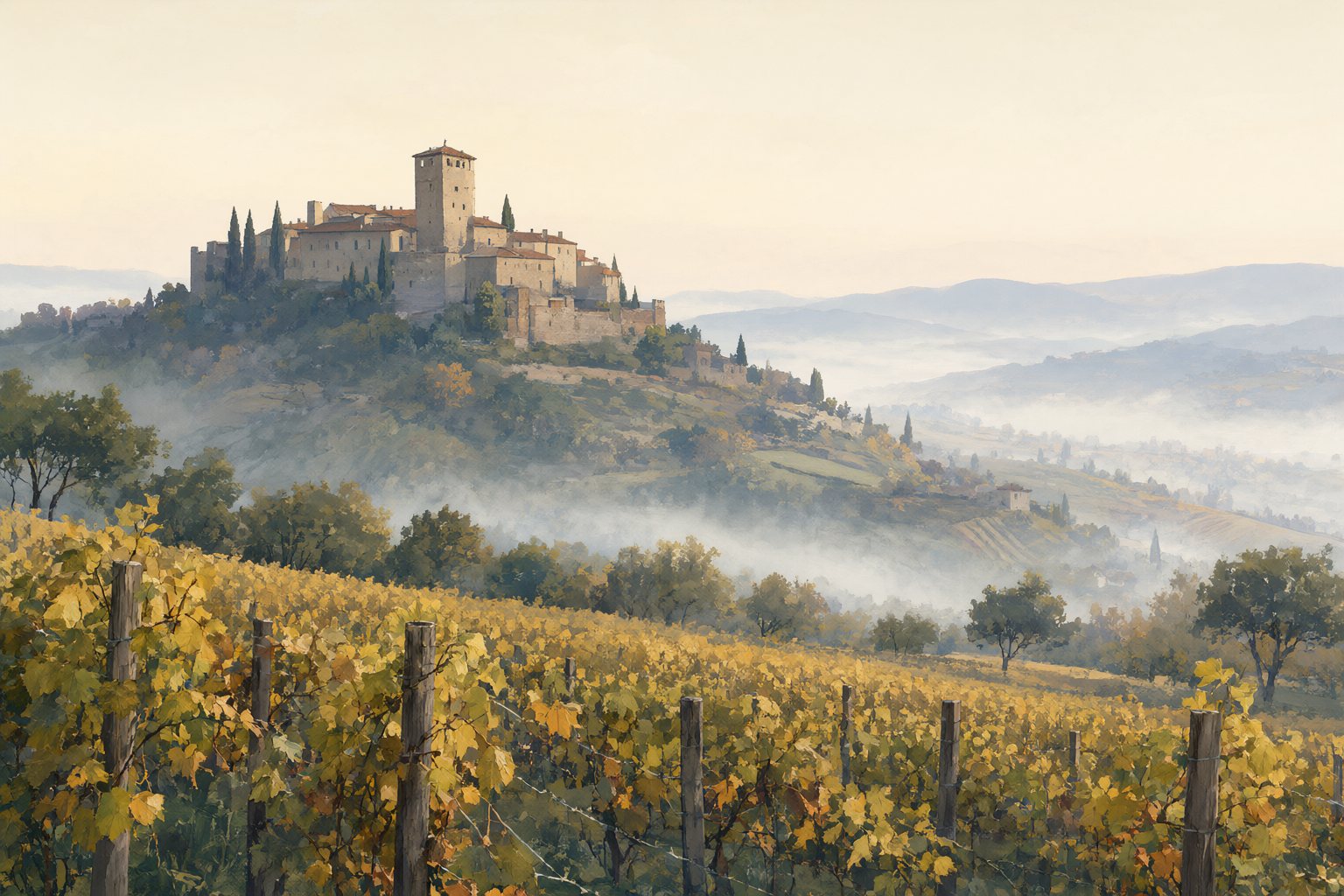
The town of Gavi lies in the province of Alessandria, but it looks towards Genoa. The fortress that dominates it tells the story: built by the Genoese in the seventeenth century to a design by Vincenzo Maculani, a military outpost planted on the ridge to watch whoever climbed up from, or down to, the Apennines. Geography did the rest. Here the influence of the sea meets the Apennine hinterland, and the grape that results is a single one: Cortese, a variety whose presence is documented as far back as the seventeenth century.
Cortese is not a grape that makes a scene. It has a discreet, citrusy profile, with a mineral vein and a freshness that, in lightly handled whites, translates into precision rather than opulence. It is a variety appreciated by subtraction: it does not drown you in aromas, it leaves you room to recognise the place.
Success, or how a white becomes fashionable
The official story is dry: DOC arrives in 1974, DOCG in 1998. What lies in between, and above all before, is harder to document precisely, and here I prefer to say so: tradition holds that between the 1960s and 1970s Gavi won over the tables of the Riviera and the northern cities with an idea of a dry white that suited fish, in an Italy discovering prosperity and the restaurant. I found no precise figures on volumes and prices from that period in verifiable sources, so I will not invent them.
The result, though, can be observed. Over the past twenty years the vineyard area has grown from about 1,021 to about 1,600 hectares, and around 85% of bottles head abroad, to over a hundred markets. For a Piedmontese white from a small area, these are numbers that explain why in Gavi people talk about export as naturally as elsewhere they talk about harvest. A paradox remains that Italian commentators often point out: Gavi is far better loved outside Italy than inside it.
Eleven communes and one exception
The denomination spreads across eleven communes in the province of Alessandria: Bosio, Capriata d’Orba, Carrosio, Francavilla Bisio, Gavi, Novi Ligure, Parodi Ligure, Pasturana, San Cristoforo, Serravalle Scrivia and Tassarolo. The rules also allow sparkling and traditional-method versions, but almost all production is still wine.
In this list one name weighs more than the others. Gavi made from grapes grown within the commune of Gavi may be called Gavi di Gavi. It is not a quality mention guaranteed by decree, and it would be naive to treat it as a miniature grand cru: it is a narrower geographical indication, which says where the grapes grew. It is then up to the individual producer, and the vintage, to show that the difference exists in the glass. For readers who love Burgundian precision, it is a good exercise in scepticism: the narrow zone is an interesting hypothesis, not a theorem.
The soil, less uniform than it seems
Anyone who thinks of Gavi as a uniform white should look at a soil map. Current descriptions distinguish three broad zones: the Terre Rosse to the north, rich in clay; a central band of mixed marl and sandstone; and the Terre Bianche to the south, where marls of marine origin prevail. In theory different soils should give different wines, and many producers say they do; in practice every vintage and every cellar hand enjoys complicating the pattern, and I do not claim here to offer a sensory map.
It is the most interesting part of the subject, and the least told. Because Gavi is not just a white that is easy to drink with fish: it is a wine that can change register within a few kilometres, and that deserves more curiosity than aperitif whites usually receive.
An opinion, to close
Gavi’s risk is its own good fortune. A white that pleases everywhere tends to become an anonymous aperitif wine, chosen by elimination from the list. That would be a shame, because beneath the patina of ease there is a denomination with real geography, three distinct soils and a grape of subtle character. My advice, if advice is needed, is to stop asking for “a Gavi” and start asking which side of the hill it comes from. The border, after all, was always its best part.
❦