Soave, the white that grew tired of playing second fiddle
From supermarket staple to Garganega on volcanic and limestone soils: why Soave deserves a second look, from the Classico hills to Recioto.
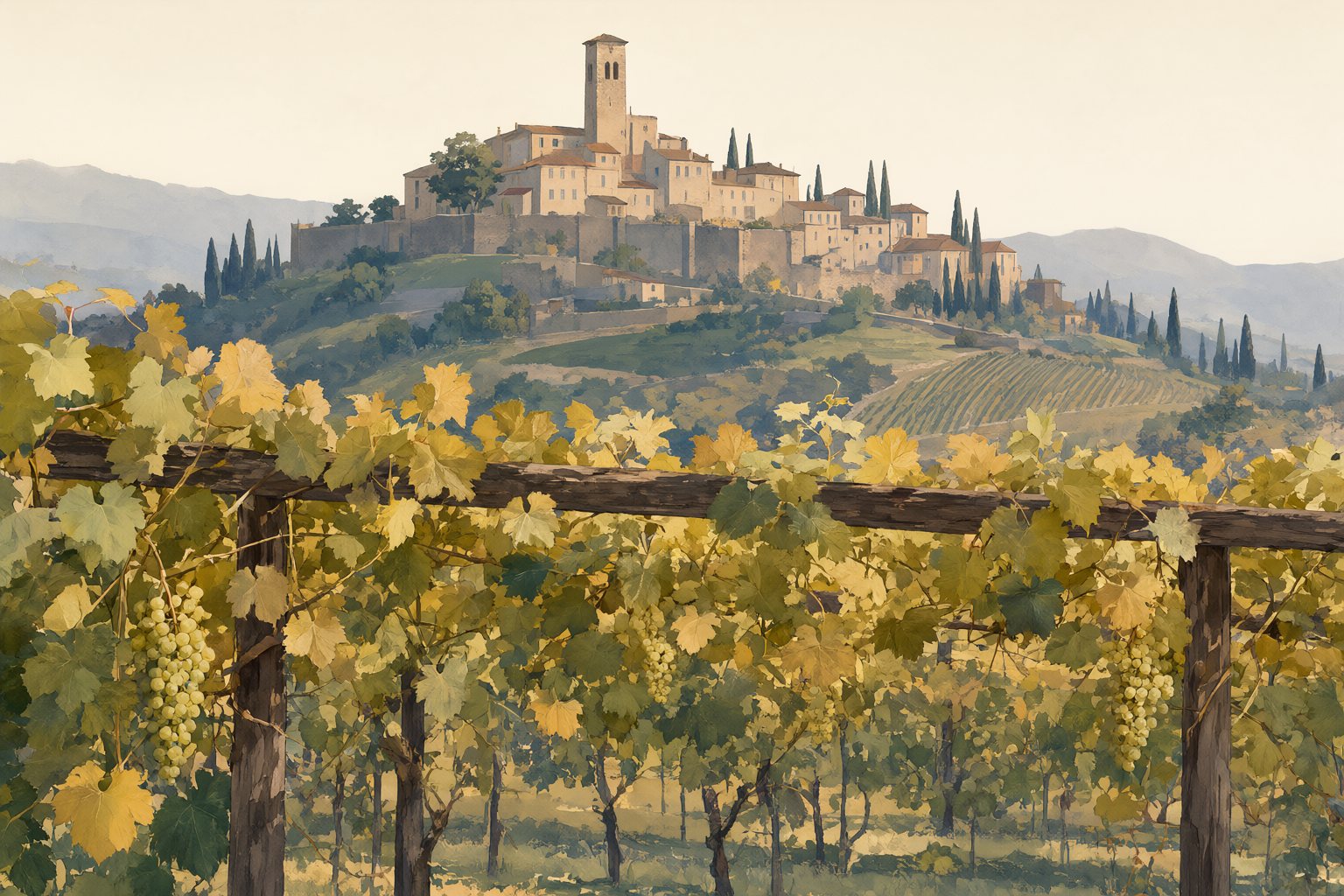
For a whole generation, Soave was the white you ordered when you didn’t know what to order. Cold, neutral, harmless. If a wine can suffer from a bad reputation, this one inherited it for decades, and with some injustice, because behind that anonymous label stood one of Italy’s noblest white grapes, treated for far too long as a commodity.
How to ruin a great white
It is the story of many successful denominations: the name gets famous, demand grows, yields rise, quality thins out. The Soave DOC was born in 1968 and, in the boom years, volumes became enormous (in the mid-1990s we are talking about some six million cases a year). The vineyard slid down from the hills to the plain, where the vine yields more and says less, and Soave settled into its role as a cheap, dependable wine. Dependable in the worst sense of the word: predictable.
The institutional response was to write stricter rules. The Soave Superiore DOCG arrived in 2001 (the first vintage concerned was 2002), with lower yields and a higher minimum alcohol than the basic DOC, and with production confined to the hills. It is no magic wand, but it shifts the centre of gravity: anyone who wants to make a serious wine finally has an enclosure to do it in.
Garganega, a grape that doesn’t show off
The heart of Soave is Garganega, which by regulation must make up at least 70% of the wine; the rest may be Trebbiano di Soave and, in limited measure, Chardonnay. In practice, many ambitious producers use it pure or nearly so.
It is a paradoxical grape. It keeps its personality in check: white flowers, almond, pale-fleshed fruit, and a savoury tension that arrives late, almost as a surprise. That is why it makes no impression at a quick tasting, and why it keeps so well over time. Let it overcrop and it turns watery and anonymous. Keep it low in the vineyard, on a good soil, and it starts to speak. It is the classic grape that punishes the laziness of whoever grows it, and that, treated with respect, returns far more than it promised.
Two soils, two accents
Geography is the real argument in Soave’s favour. The area stretches east of Verona, across a band of hills where two geological worlds meet. In the east, towards Monteforte d’Alpone, soils of volcanic origin dominate, with basalt and dark earth derived from its decomposition, tending to give wines that are tauter, more saline, almost sharp. In the west limestone prevails, generally associated with broader, fuller whites. These are generalisations, of course, which every vineyard enjoys contradicting, but they explain why two Soaves from the same vintage can seem like distant relatives.
The Classico is the historic cradle: the zone around the communes of Soave and Monteforte d’Alpone, whose delimitation goes back to a decree of 1931. Here the hills are steep and the vineyards wedged between villages and slopes. In 2018 the FAO recognised these historic vineyards among the world’s important agricultural heritage systems, a title that says less about the wine in the glass and more about how rare it is for a landscape to have survived so intact.
The pergola, or when the old system is right
On those hills the typical training system is the pergola veronese: the canopy spreads overhead, above the heads of those who work beneath it, and the bunches hang under the foliage. It is often said to be a system for productive vineyards, one to be left behind, and that is true if you load it with fruit. Managed patiently, however, it has concrete advantages: the shade shields the bunches from excess sun, air circulates, and a well-balanced vine ages without tiring. Some producers have bet on the old plantings precisely because they give smaller, more concentrated berries. It isn’t nostalgia, it’s agronomy with a long memory.
Recioto, the sweet side nobody talks about
Anyone who knows only dry Soave is unaware that the same grape produces a great sweet wine. Recioto di Soave has been a DOCG since 1998: the grapes are laid out to dry for months in a fruttaio (a drying loft), the sugars concentrate, and the finished wine starts from a high natural strength and keeps a substantial residual sugar (the regulation specifies at least 70 g/l). The result has a profile of honey, dried apricot and withered flowers, held up by the acidity typical of Garganega, which keeps it clear of cloying. Little is made, even less is sold, and it is one of Italy’s most underrated sweet wines.
A question of expectations
One can argue at length over how far Soave has really risen again. The picture moves at two speeds: on one side there are still large volumes of simple wine, on the other a group of producers working with old vines, restrained yields and longer ageing, showing that Garganega can age well. The public is slower than they are: many still carry around the image of twenty years ago.
My view is that Soave doesn’t need to be reinvented, but to be taken seriously. The landscape is there, the grape is there, the history is there. All that is missing is that we stop ordering it by elimination and start choosing it for precise reasons. A wine’s redemption always begins with whoever drinks it.
❦