Barolo and Barbaresco: same grape, two characters, a few kilometres apart
Communes, soils, minimum ageing and named vineyards: what really separates Barolo and Barbaresco, two Nebbiolo wines with the town of Alba between them.
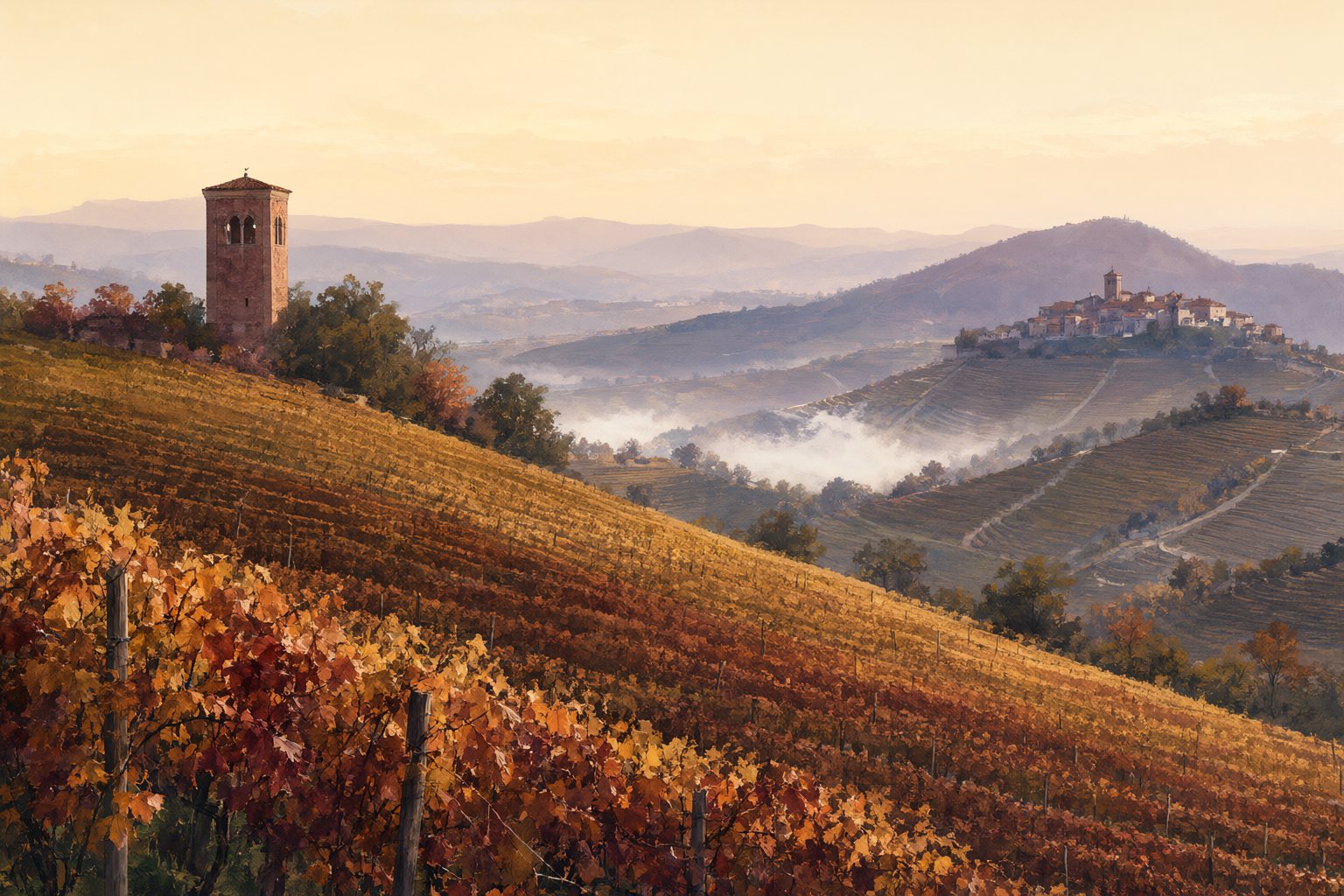
Between the tower of Barbaresco and the castle of Barolo lies little more than half an hour’s drive, with the town of Alba in the middle like a slightly absent-minded referee. Same grape, same province, same October fog. And yet for more than a century the two appellations have eyed each other with the affectionate wariness of two brothers forced to share a bedroom. Confusing them is a venial sin; considering them the same thing in two sizes, a graver one. To understand where the difference lies you need no poetry: a geological map, a production code and a little history are enough.
Two maps, two scales
The first difference is one of size. Barolo is made in eleven communes: three lie entirely within the zone (Barolo, Castiglione Falletto and Serralunga d’Alba), the other eight only in part (La Morra, Monforte d’Alba, Novello, Verduno, Grinzane Cavour, Diano d’Alba, Cherasco and Roddi). Barbaresco makes do with four territories: Barbaresco, Neive, Treiso and the hamlet of San Rocco Seno d’Elvio, which administratively belongs to Alba. In hectares the ratio is roughly three to one: Barbaresco counted some seven hundred registered hectares in the 2021 figures, while Barolo exceeds two thousand (the exact number shifts from year to year and the sources do not agree).
Geography divides them too. Barolo spreads out to the south-west of Alba, in an amphitheatre of hills rising towards the Alta Langa. Barbaresco lies to the north-east, closer to the course of the Tanaro, on hills that are lower on average. It is a proximity to the river which, according to the reading most widely shared by producers and scholars, translates into a slightly milder climate and ripening that often comes a little earlier. It is not a law, it is a tendency: but it is the kind of tendency that, added up over thousands of rows, ends up in the glass.
Underfoot: marls, sands and an invisible border
The Langhe are an ancient seabed thrust upwards, which explains their obsession with rocks. The most widespread formation in both zones is the Marne di Sant’Agata Fossili, of Tortonian and Messinian age: thin layers of calcareous marl and clay alternating with sands, pale, crumbly and able to hold water without drowning the roots.
In Barolo, however, the story becomes more complicated. The zone is crossed by a geological boundary that roughly divides the western side, dominated by Tortonian marls (La Morra, much of the commune of Barolo), from the eastern side, where older formations of Serravallian age come to the surface, such as the Lequio Formation, more compact, rich in sandstone and less fertile (the central and southern part of Serralunga and the eastern slope of Monforte). This is the geological basis of a distinction anyone who spends time in the Langhe has heard repeated: more open, perfumed Barolos on one side, more austere and slow-developing ones on the other. A simplification, of course, but one rooted in the rock.
Barbaresco, by contrast, rests mainly on Tortonian formations, with marls and sands alternating in different proportions from hill to hill. Less variety to begin with, then, and a more consistent imprint. Hence the idea, shared by critics but impossible to turn into a rule, of a wine that on average is finer in tannin and readier in fruit, set against a Barolo broader in the shoulders and more demanding.
The production code: the law of time
On paper, the sharpest difference lies in the calendar. Barolo must be aged for at least 38 months, 18 of them in wood, and the Riserva for at least 62. Barbaresco stops at 26 months, 9 of them in wood, and 50 for the Riserva. In both cases the count starts on the first of November of the harvest year. The minimum alcohol level marks a gap as well: 13% for Barolo, 12.5% for Barbaresco. The maximum yield in the vineyard is the same, 80 quintals per hectare, and this year the Consorzio left that ceiling untouched, unlike what it decided for Langhe Nebbiolo and Barbera d’Alba.
The two appellations were born together: DOC in 1966, DOCG in 1980. The latest changes approved by the Consorzio in 2024 treated them in parallel, with an obligation to bottle within the zone of origin; rejected, on the other hand, was the proposal to admit north-facing vineyards, a sign that here even climate change has to go to a vote.
The MGAs, or Burgundy with a Piedmontese accent
The Menzioni Geografiche Aggiuntive, or MGAs, are the way the Langhe have codified their crus without calling them that. Barbaresco got there first, with 66 MGAs approved in 2007. Barolo followed in 2010 with a more elaborate system: 170 vineyard names plus 11 village names, for a total of 181. The village names, of the “Barolo del comune di Serralunga d’Alba” kind, make it possible to state the origin of a wine made from several vineyards in the same village: an intermediate step that does not exist in Barbaresco.
The rules are strict in substance: to put the name of an MGA on the label, the grapes must all come from there. Those who want to go further can add the word “Vigna” followed by the name of a parcel, accepting a lower yield. The result is a map that, read carefully, tells you more than many technical data sheets. And one that has also produced some grumbling: certain Barolo MGAs are so large, or so heterogeneous within their boundaries, that the name on the label says less than it promises.
A cooperative against oblivion
If Barbaresco has an identity of its own today, it owes this partly to its social history. In 1894 Domizio Cavazza, director of the Royal Oenological School of Alba, founded a cooperative winery in Barbaresco to give small growers the chance to make and sell wine under the name of their own village. This is considered the moment when modern Barbaresco, dry and recognisable, began to exist as a wine in its own right. That cooperative was dissolved under Fascism.
In 1958 the village priest, Don Fiorino Marengo, gathered nineteen growers and refounded the winery under the name Produttori del Barbaresco. Today it has more than fifty members and the cooperative has become one of the benchmarks of the appellation, with a series of single-MGA Riservas made only in vintages judged worthy of them. It is a rare thing in the world of fine wine: an area whose reputation has been built partly through a collective project, and not only thanks to a few illustrious names.
Brothers, not twins
You hear it said that Barbaresco is Barolo’s “younger brother”. It is a convenient formula and, in my view, a wrong one. Smaller in hectares, yes; shorter in the months of waiting imposed by law, that too. But not lesser in ambition. Barbaresco is Nebbiolo said in fewer words; Barolo is Nebbiolo taking all the time it needs to finish its sentence. Comparing them is the most honest way to understand how much place matters for this grape: same variety, same fog, a few kilometres apart, and two voices that no one should mistake for an echo.
❦