Barbera, the people’s grape that decided to grow up
Bright acidity, gentle tannin: how Barbera went from everyday red to serious contender in Asti, Nizza and Alba, and on to California and Argentina.
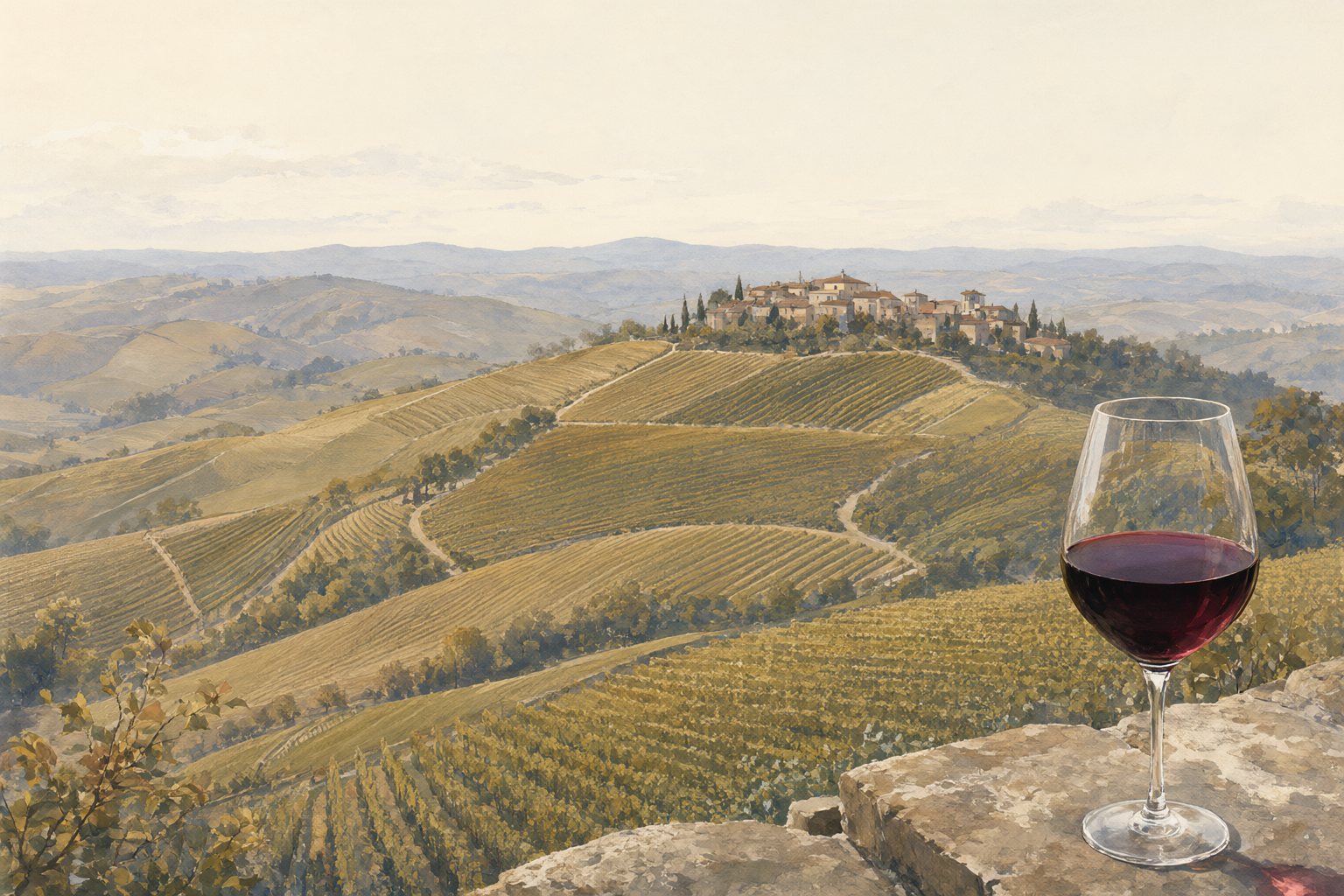
For generations Barbera was the wine that was already on the table before anyone decided to open it. It needed no introduction and no great vintage to remember: it arrived in a carafe, kept company with agnolotti and bollito misto, and nobody dreamed of calling it “great”. Then, within a few decades, that taken-for-granted red began to demand respect. The question today is whether it lost something along the way.
The red that seems the opposite of Nebbiolo
Just look in the glass. Where Nebbiolo is pale and austere, Barbera is dark, almost inky, with cherry and plum fruit that arrives at once. And where Nebbiolo scratches with its tannin, Barbera has little: its distinguishing trait, familiar to anyone who studies it, is the combination of deep colour, full body, low tannin and high acidity.
This oddity explains nearly everything. The acidity brings freshness and length, and makes Barbera a natural partner for the rich, savoury dishes of Piedmontese cooking. The modest tannin makes it approachable young, with no need to wait ten years as for a Barolo. The flip side is that the balance is delicate: from overly productive vineyards, with high yields, the acidity is left as bare sourness and the wine turns thin and shrill. That is why the difference between a table Barbera and a serious one almost always begins in the vineyard, with bunches left to ripen and reduced crops.
It is also, according to the most widely cited sources, the most planted grape in Piedmont, with a share approaching half of the region’s vines. A people’s grape, then, in the most literal sense: the one that is everywhere.
Asti and Nizza, two rungs of the same ladder
The historic heart is the Monferrato around Asti. Barbera d’Asti has been a DOC since 1970 and a DOCG since 2008. The rules allow up to 10% of other local red grapes (Freisa, Grignolino, Dolcetto), so Barbera must make up at least 90%. The Superiore version requires at least 14 months of ageing, six of them in wooden barrels, and a minimum of 12.5% alcohol.
Higher up sits Nizza. Born as a subzone of Barbera d’Asti, labelled Superiore Nizza from 2008, it became a DOCG in its own right with the 2014 harvest. The rules are stricter: 100% Barbera, lower yields, an area limited to 18 communes and a minimum of 18 months’ ageing, six of them in wood. The Riserva rises to 30 months, with at least 12 in wood. It is the answer of a territory that decided not to settle, and understood it had to tell the world, in writing, that this is not the carafe Barbera.
It is worth noting that the hierarchy here is built not on inflated prices but on agronomic choices and time. For a young denomination, that is a sound foundation.
Alba, where Barbera plays second fiddle
In the hills of the Langhe and Roero the story is different. Barbera d’Alba, the DOC, shares the land with Nebbiolo, and as in any cohabitation someone calls the shots. The best sites, well exposed and of great vocation, usually go to Nebbiolo, which commands more on the market. Barbera often has to make do with lesser positions.
Yet it is here that it has found one of its cleanest voices: wines with more intense, more powerful fruit than those of Asti, and a fuller body. Anyone who drinks it for what it is, without expecting a Barolo substitute, discovers that the comparison between the two Piedmontese towns is worth making.
Oak, and the price of ambition
The most debated chapter is the one about wood. After the collapse of confidence that followed the methanol scandal of the mid-1980s, which hit the image of Piedmontese wine hard and, according to several accounts, the area planted to Barbera too, a group of producers chose the opposite road: less quantity, more concentration, ageing in small oak barrels. The result was a Barbera that was darker, softer, more vanilla-scented and more expensive to make.
The risk is plain: Barbera’s acidity stands up well to oak, but new and intrusive wood threatens to cover precisely what made Barbera interesting, namely the living fruit and the tension. Today more and more bottles spend a measured time in oak, and the most convincing compromise seems to lie in the middle: a touch of wood that gives structure, not make-up.
Beyond Piedmont
Barbera has travelled, and not only within Italy, where it is also grown in Lombardy and Emilia-Romagna. According to 2010 figures, Italian vineyards covered about 20,500 hectares, California almost 4,700, Argentina over a thousand and Australia around a hundred. The numbers are dated, but they tell a story: its acidity is precious in hot climates, where other grapes lose theirs all too easily.
A wine that need not be ashamed of being easy
My view is that Barbera was right to grow up, but would be wrong to forget where it comes from. Its strength is precisely that double nature: it can be the Sunday wine at the family table and, with the right care, a cellar red. Denominations such as Nizza remind us that ambition, when it comes from the vineyard and not from marketing, suits it very well. But the day a Barbera stops being a cheerful, immediate wine as well, we will have lost the reason we fell in love with it.
❦