Noble rot, the fungus that turns grapes to gold
How Botrytis cinerea, every grower's enemy, makes Sauternes, Tokaj and Germany's great sweet wines, and why it needs morning fog and afternoon sun.
Faced with a bunch of grapes covered in grey mould, every grower in the world sees a disaster. Then there are a few valleys, in a few weeks of autumn, where that very same fungus is awaited with anxiety, almost prayed for. Botrytis cinerea is the one case in agriculture where the parasite, if it arrives at the right moment, raises the value of the harvest instead of wiping it out.
The same fungus, two fates
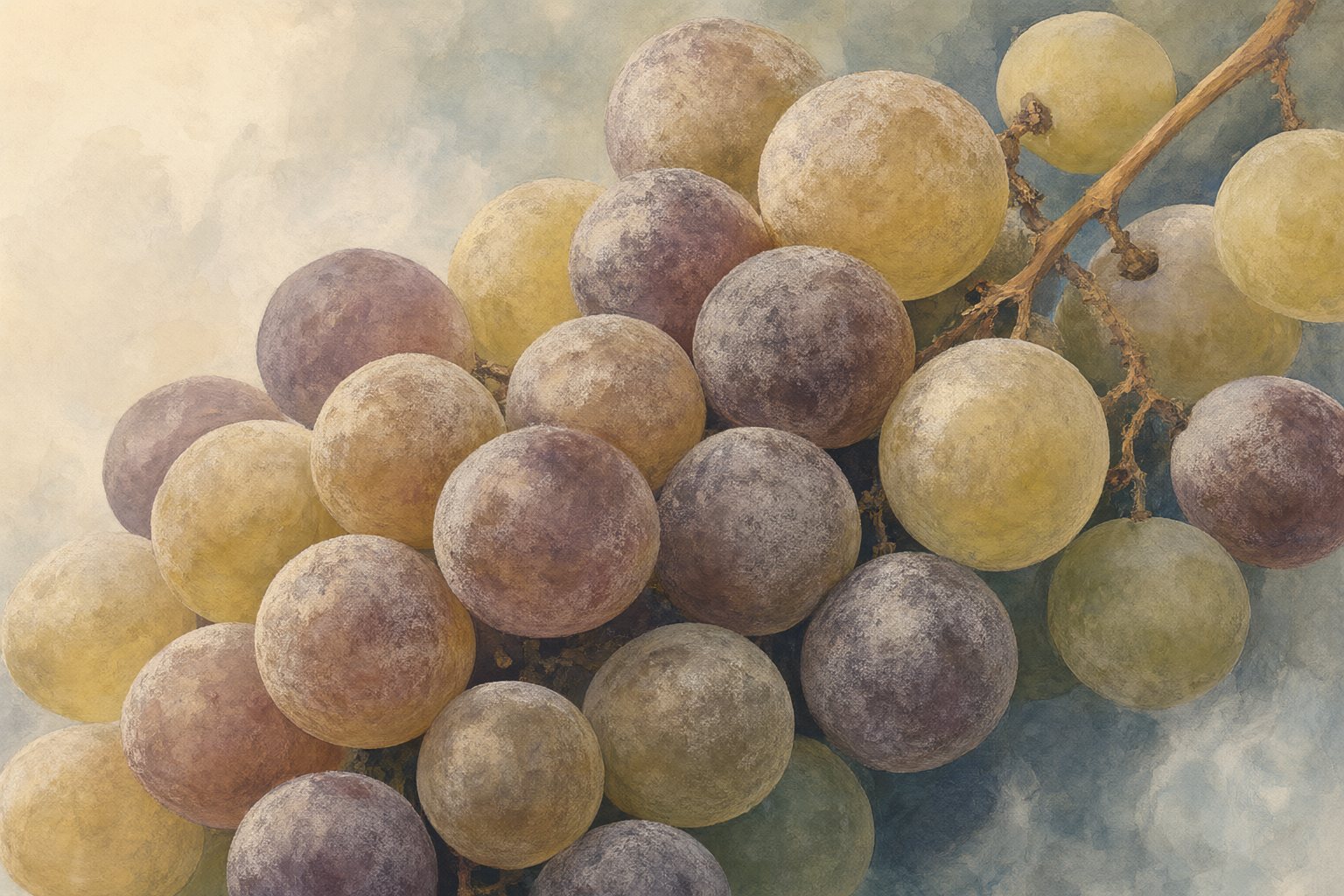
The difference lies entirely in timing and humidity. If it rains for days while the grapes are still unripe or barely ripe, botrytis spreads everywhere, attacks healthy berries and ruins colour and aroma: that is grey rot, the thing to be fought. If instead the grapes are already perfectly ripe and the season leaves them alone, the fungus pierces the skin delicately, without making the berry rot. Water evaporates through the microscopic holes, and the berry shrivels and turns a brownish purple.
The result is a concentrate. According to technical sources, affected berries lose more than half their water and the sugars concentrate in proportion. The fungus then consumes some of the sugar and acidity for its own needs and produces glycerol, which gives the wine a silky texture. Sugar, acidity and aromas of honey, dried apricot and saffron: all of it comes from an organism that, in another season, would have wrecked the vintage.
Morning fog, afternoon sun
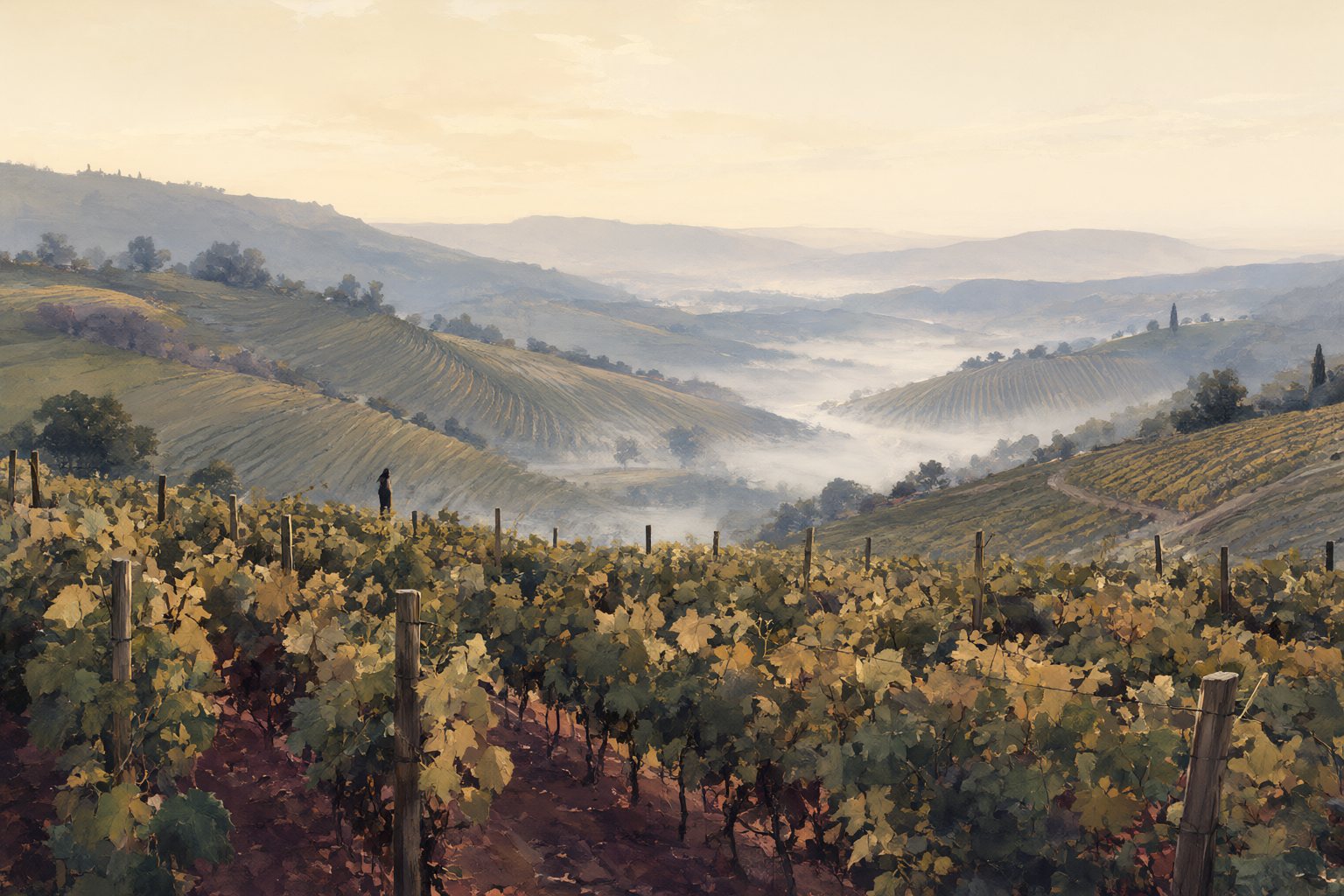
The climatic recipe is so precise that very few places can guarantee it. You need damp, foggy mornings, often created by a nearby river or lake, which give the fungus the humidity it needs to take hold. Then you need warm, dry, breezy afternoons, which halt the infection and evaporate the water from the berries. If the damp lingers, noble rot becomes grey rot; if it is missing, botrytis never gets started.
In Sauternes, in Bordeaux, the cold Ciron flows into the warmer Garonne and generates the autumn mists. In Tokaj, Hungary, the humidity comes from the Bodrog and Tisza rivers. The geographies differ, but the pattern is identical: a watercourse that breathes in the morning, a sun that dries things out after lunch. And above all, thin-skinned grapes: Sémillon in Sauternes, Furmint in Tokaj.
Sauternes and Tokaj, two ways of making gold
In Sauternes, botrytis never reaches the whole bunch at once. That is why the harvest is carried out in several passes, each time picking only the berries that have reached the right point: costly work, tiny yields, vintages in which almost everything is given up. It is no accident that in the 1855 classification a single wine was placed above all the others as Premier Cru Supérieur, Château d’Yquem: a historical fact, which shows how exceptional this style was considered even then.
In Tokaj the method is different, and more original. The botrytised berries, the aszú, are picked separately and then steeped in a must or a young wine. For centuries sweetness was measured in puttonyos, the baskets of aszú berries added to each 136-litre barrel. Since 2013 the rule has changed: the three and four puttonyos categories have disappeared and every Aszú must equal at least five, with a minimum of 120 grams of residual sugar per litre (150 for six puttonyos). A small revolution, for a wine that boasts of existing for centuries.
Germany and its ladder
In Germany noble rot is written into the very hierarchy of the wines. Trockenbeerenauslese, the top rung of the Prädikat ladder, is by definition a wine made from berries shrivelled by botrytis and picked one by one. Most Beerenauslese also come from botrytised grapes. Riesling, with its sharp acidity, is the ideal candidate: the sugar never becomes cloying, because there is a blade underneath. These are wines that often have little alcohol and a very long life. The exact must-weight thresholds depend on region and grape, and here I prefer not to quote them without having checked.
And in Italy?
In Italy the picture is more nuanced, and it is only fair to say so. Orvieto, in Umbria, is the Italian area most associated with noble rot: the autumn mists on the hills allow botrytis to develop, and a local estate has produced since 1987 a white from botrytised grapes, made from Sauvignon Blanc, Grechetto and other varieties, with a composition that has changed over the years. It is a historically solid case, but it remains an exception.
The Torcolato of Breganze, in the Veneto, is the example often cited alongside it and which in fact has nothing to do with it: it is a passito of Vespaiola, with the bunches tied with string and hung from the rafters for three or four months, a DOC since 1995 with at least 14% alcohol achieved before fermentation. The rulebook I consulted does not mention botrytis: the drying is a matter of air, not of fungus. Telling the two methods apart, noble rot on one side and appassimento (drying) on the other, is the first rule for not confusing a Sauternes with a passito.
A small heresy
I like the fact that the world’s most celebrated wines are born from something agriculture considers a mistake. We are used to thinking of quality as the absence of faults; here it is the opposite, a fault brought to such a degree of ripeness that it becomes a virtue. Perhaps that is why noble-rot wines are also the most resistant to fashion: they cannot be manufactured, only waited for. A vintage without the right fog cannot be recovered by technique. And that is, let’s admit it, a lesson in humility that cellars of a certain kind would do well to remember more often.
❦