Nebbiolo, Italy’s most difficult (and greatest) grape
Pale colour, fierce tannin, late ripening: why Nebbiolo tests both those who grow it and those who drink it, from Barolo to Valtellina.
Poured into the glass, a young Barolo seems almost to apologise. A translucent red, already shading towards orange at the rim, light years from the dense purple of a Syrah or a Cabernet. Then you raise it to your lips and the apologies stop: the tannin grips the gums, the acidity pulls like a taut rope, and for a few seconds the wine feels more like an exam than a pleasure. This is the paradox of Nebbiolo, and the reason those who love it do so with something close to obstinacy. No other Italian grape promises so much and gives away so little, at least at first.
A grape that forgives nothing
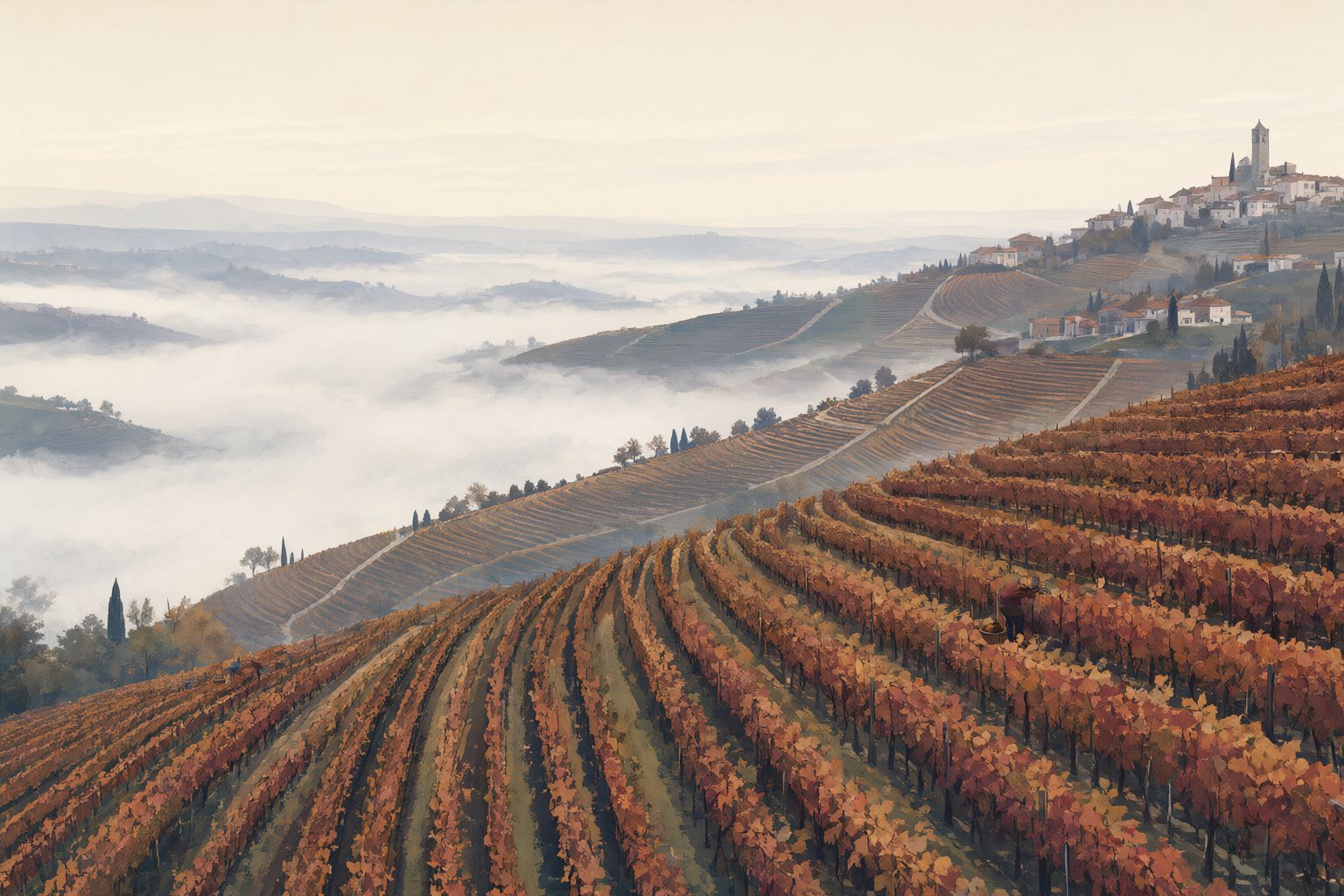
The difficulty begins in the vineyard, long before the cellar. Nebbiolo is among the first varieties to bud in spring and among the last to ripen: harvest normally falls between mid and late October. That means exposing the young shoots to late frosts and, at the other end of the season, staking everything on the autumn weeks, when rain can arrive from one day to the next. The name itself, according to the most widely held theory, comes from nebbia, the fog that wraps the hills of the Langhe at that time of year; others link it to the whitish bloom that veils the ripe berries. Either way, it is a grape picked when the rest of Italy has already closed its cellar doors.
Add to this an almost tyrannical demand for place. Nebbiolo wants precise exposures, lean soils and marked swings in temperature. Move it a few hundred metres and it changes character; outside its habitat, it often fails to find one at all. It is no accident that, unlike Cabernet or Pinot Noir, it has never truly conquered the world: attempts elsewhere exist, but its greatness remains stubbornly alpine and sub-alpine.
History, for that matter, bears this out. The first documented mention of a wine called “nibiol” dates back to 1268, in the Rivoli area near Turin. Two centuries later, the statutes of La Morra laid down severe penalties for anyone who damaged Nebbiolo vines. A community does not legislate like that over just any plant: it does so over something it considers a heritage.
The colour that deceives
The pale colour is neither a winemaking flaw nor a stylistic choice: it is chemistry. The anthocyanins, the pigments that give red wines their colour, are dominated in Nebbiolo by peonidin-3-glucoside, a less stable molecule than the malvidin that prevails in most red grapes. The result is a wine that starts out a light ruby and turns garnet sooner than many others, and that sometimes, even when young, shows the orange glints that elsewhere would signal fatigue.
That is why Nebbiolo is a terrible candidate for judging by eye. Anyone who equates depth of colour with structure is proved wrong at the first sip. The substance is there, but it is not in the pigment: it is in the tannins and the acidity, which in this variety reach levels few Italian grapes can match. It is a wine to be read on the palate, not held up to the light.
For decades this drove some producers to try to “correct” Nebbiolo, with extreme macerations or new oak capable of giving it more colour and immediate softness. The quarrel between traditionalists and modernists that swept through the Langhe in the 1980s and 1990s was, at heart, an argument about precisely this: accept the nature of the grape or tame it. Today the pendulum has largely swung back towards respect for its original character, with large casks and a lighter touch.
Barolo and Barbaresco: two ways of waiting
Barolo and Barbaresco were, together with Brunello di Montalcino and Vino Nobile di Montepulciano, Italy’s first DOCGs, approved in 1980. The rulebooks say a great deal about the time Nebbiolo demands. Barolo cannot be released before 38 months of ageing, at least 18 of them in wood; for the Riserva this rises to 62. Barbaresco requires at least 26, with nine in wood, and 50 for the Riserva.
The two designations are neighbours, separated by a few kilometres on the right bank of the Tanaro, but the difference in character is perceptible. Barbaresco, produced in four communes, tends towards a subtler tension and a little more readiness; Barolo, larger and more varied in its soils, carries a tannic severity that calls for patience. Generalisations, of course, which every vintage and every vineyard take pleasure in contradicting.
And it is the vineyard that is the real key. With the introduction of the Menzioni Geografiche Aggiuntive, the officially recognised vineyard areas, in 2007 for Barbaresco and 2010 for Barolo, the Langhe put in black and white what producers had known for generations: that Nebbiolo from one slope is not Nebbiolo from the next. It is an approach reminiscent of Burgundy, and not by chance: Nebbiolo and Pinot Noir share the same transparency, the same ability to render a place with an almost cruel fidelity.
Beyond the Langhe: the mountains and Alto Piemonte
Reducing Nebbiolo to Barolo and Barbaresco is the commonest injustice one can do it. In Valtellina, where it is called Chiavennasca, it grows on terraces wrested from the rock along the Rhaetian slope, heroic viticulture in the most literal sense. Valtellina Superiore, a DOCG since 1998, is divided into five subzones, Maroggia, Sassella, Grumello, Inferno and Valgella, and requires at least 90% Nebbiolo. Sforzato, or Sfursat, made from grapes left to dry, has been a DOCG since 2003 and is the most concentrated expression of a grape that elsewhere plays the game of subtraction. But it is in the Valtellina Superiore wines that you grasp the variety’s alpine soul: fresher fruit, sharper tannins, an almost mineral note that seems to come from the stone itself.
In Alto Piemonte, across the provinces of Novara, Vercelli and Biella, Nebbiolo goes by the name of Spanna. Gattinara, a DOCG since 1990, and Ghemme, a DOCG since 1997, are the best-known names, but around them cluster designations such as Boca, Bramaterra and Lessona, where Nebbiolo is often blended with small amounts of Vespolina or Croatina. Here the soils are volcanic or porphyritic in origin, acidic, and give wines of great nerve, sometimes less immediate than those of the Langhe but capable of surprising finesse. It is an area that suffered a long decline in the twentieth century and is now enjoying one of the most interesting revivals in Italian wine.
The virtue of waiting
Finally there is the question of time, which for Nebbiolo is not a detail but the very substance. Tannin and acidity, which can seem like sharp edges in youth, are also the structures that allow these wines to evolve for decades. The great bottles of Barolo and Barbaresco, in the right vintages, easily cross the twenty-year mark and often go beyond it, turning red fruit into dried rose, tar, truffle, leather, forest floor. It is in that phase that the pale colour stops looking like a weakness and becomes consistent with everything else: a wine that never relied on apparent strength.
Nebbiolo is difficult because it asks everyone to give something up. It asks the grower to risk an entire season on the autumn. It asks the winemaker not to force it. It asks the drinker to distrust first impressions and, often, to wait years before opening a bottle. In an age that rewards immediacy, it is an almost anachronistic request. And that, in my view, is precisely why it remains Italy’s greatest grape: because it does not bend to the taste of the moment, but forces taste to grow up to meet it.
❦