Etna, the volcano that redrew the map of Italian wine
Nerello Mascalese, Carricante, ungrafted bush vines and 142 contrade: why Etna is Italy’s most talked-about wine region, and what lies beyond the myth.
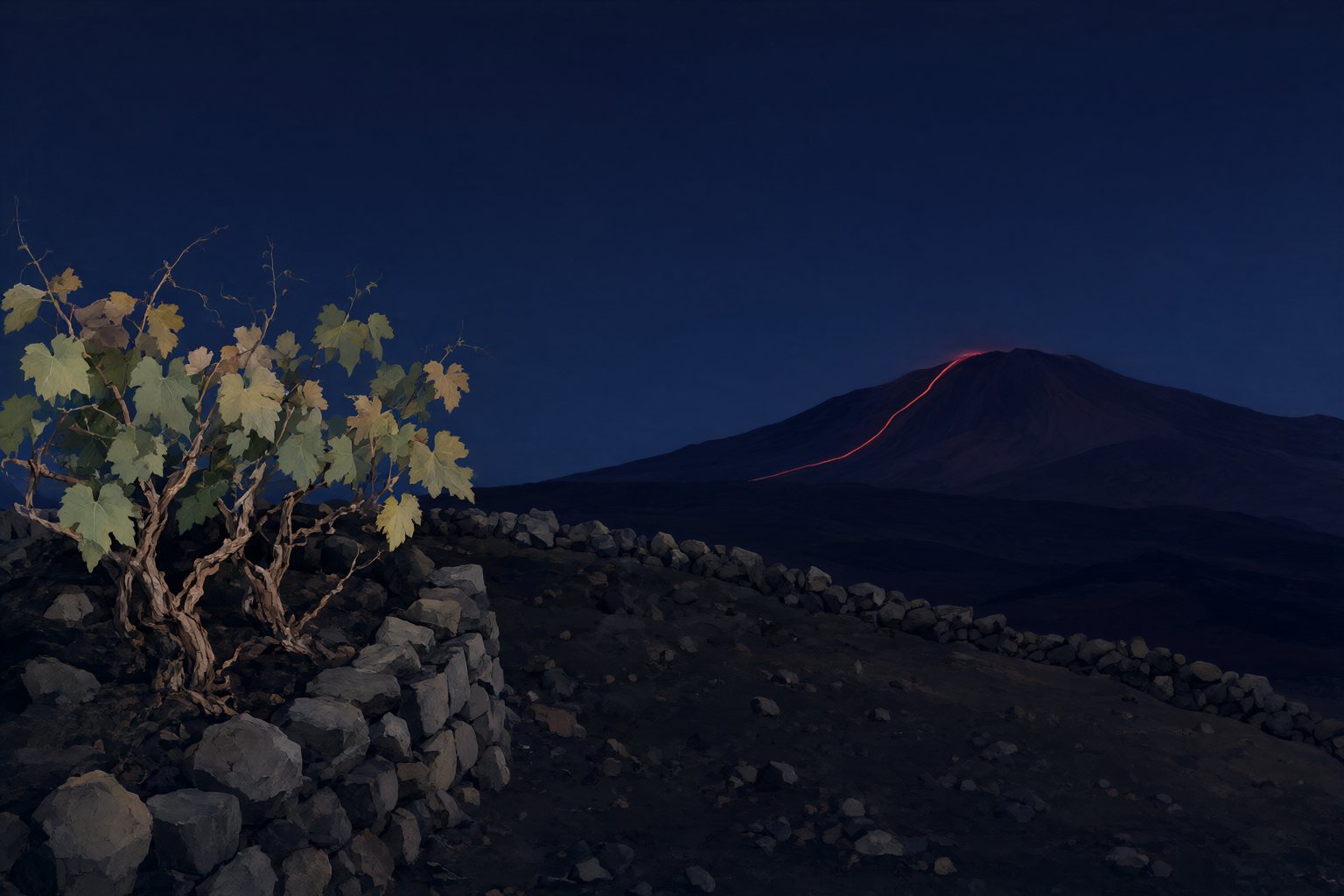
Few vineyards in the world grow on top of something that, every now and then, decides to take the land back. On Etna it happens. A lava flow can wipe out a vineyard, a shower of ash can mark a vintage. Perhaps it is precisely this precariousness, more than any score, that has made the volcano the most talked-about territory in Italian wine today. The rest was done by the grapes, the altitude and a group of outsiders who arrived at the start of the century with very clear ideas.
Two grapes, no shortcuts
The story begins, as always, with the grape. Nerello Mascalese is a red that concedes nothing easy: colour often translucent, taut tannin, high acidity, aromas ranging from sour cherry to dried herbs, right down to a smoky note that everyone ends up attributing to the volcano, rightly or wrongly. The rules for Etna Rosso require at least 80% of it, with Nerello Cappuccio as a possible supporting player.
Carricante is its white counterpart, and for a long time it was the least told part of the story. It’s a late-ripening, acidic grape, not very aromatic in youth, which with age develops almost petrol-like and briny nuances. In Etna Bianco it must make up at least 60%; for Etna Bianco Superiore the threshold rises to 80% and the grapes must come from the commune of Milo, on the eastern slope. It’s a technical detail that says a great deal: as early as 1968, when Etna became Sicily’s first DOC, the lawmakers had already understood that white wine had a precise place of choice there.
Altitude, bush vines and ungrafted roots
If there is one fact that explains Etna better than any adjective, it’s elevation. The vineyards climb from roughly 300–400 metres to over a thousand, in one of the highest viticultures in Europe. In Sicily, that is, on an island that the popular imagination associates with warm, generous wines, this means wide swings between day and night temperatures, harvests that can stretch well into October, and wines that think in terms of tension rather than power.
Then there’s the shape. In the old vineyards the alberello dominates: free-standing bush vines, each supported by a chestnut stake, often planted densely on terraces held up by dry-stone walls of lava rock. It’s a system that makes mechanisation all but impossible and the work gruelling, and for decades it was abandoned in favour of more convenient plantings. Today it has become a banner again, sometimes with a pinch of rhetoric, but for concrete reasons: the plant adapts to the slope, the exposure, the wind.
Finally, the piede franco, ungrafted rootstock. The volcanic soils, sandy and poor in clay, made life hard for phylloxera, the insect that at the end of the nineteenth century destroyed most of Europe’s vineyards. So on Etna ungrafted vines still survive, some of them very old. How much ungrafted roots really change the taste of the wine is a matter of debate, and anyone who swears they can spot it blind should be taken with caution. But the historical and genetic value of those vines is beyond question.
The contrade, or the land registry of lava
The word behind Etna’s recent good fortune is contrada. It denotes a historically recognised area, often with an ancient name, and on the volcano it has an almost geological meaning: each lava flow has left soils of different age and composition, sometimes just a few metres apart. A contrada on recent lava and one on older ground can yield surprisingly different wines, from the same grape and the same hands.
With the 2011 revision of the production rules, the contrade that may be named on the label were set at 133; an updated map presented by the Consorzio in 2022 brought them to 142, spread across several communes. Castiglione di Sicilia, on the northern slope, has the most, followed by Randazzo. That’s no coincidence: the north is the heart of the revival of the past twenty years, with names such as Calderara Sottana, Feudo di Mezzo, Rampante or Sciaranuova now familiar to anyone who reads an ambitious wine list.
The risk, it must be said, is that the contrada becomes a marketing label before it has become a proven identity. A hundred and forty names is a lot, and not all of them have enough of a track record in bottle to say what sets them apart.
The outsiders of 2000
For a long time Etna was a reservoir of bulk wine, with few exceptions. Among them was Benanti, which from the late 1980s had begun working seriously with Nerello and Carricante, thanks in part to the oenologist Salvo Foti, later the driving force behind the I Vigneri group and a central figure in defending traditional practices.
The media breakthrough, however, came around 2000, when three outsiders settled on the northern slope within a few kilometres of each other. Andrea Franchetti, a Roman already behind Tenuta di Trinoro in Tuscany, founded Passopisciaro. Marc de Grazia, raised in Florence and known as an importer of Italian wines in the United States, created Tenuta delle Terre Nere. The Belgian Frank Cornelissen, with a radical, uncompromising approach, took the path of minimal-intervention wines.
Three wildly different styles, one shared effect: turning the international spotlight on a territory that until then few people knew. Other investors followed, Sicilian and otherwise, and land prices tracked the curve of interest. Today the area under DOC has passed a thousand hectares, still a small number compared with the fame.
Really the Burgundy of the South?
The comparison with Burgundy has become almost compulsory, and it has some basis. There’s a pale-coloured red that aims at finesse rather than structure, like Pinot Noir. There’s a mosaic of plots with names of their own, like the climats. There’s a hierarchy of place that matters more than the brand.
But taken literally, the comparison flattens more than it explains. In Burgundy the classification of the crus is the fruit of centuries of monastic and commercial observation; on Etna the map of the contrade is young and the hierarchy of quality simply doesn’t exist yet. Nerello has a rougher tannin than Pinot Noir and a more Mediterranean profile, all scrubland and citrus. And above all, no vineyard on the Côte d’Or risks being buried by an eruption. Several local producers, for that matter, urge using the comparison with care.
The truth is that Etna doesn’t need Burgundy to be interesting. The comparison served as a shortcut to make itself understood in foreign markets; today it risks becoming a cage, pushing producers to imitate a model instead of defining their own.
Etna has the hardest part ahead of it: proving, vintage after vintage, that its contrade express real differences and not just evocative names on a label. If it succeeds, in twenty years no one will call it “the Burgundy of the Mediterranean” any more. They’ll simply call it Etna, and that is the finest compliment it could be paid.
❦