Gattinara and Ghemme: the Nebbiolo the twentieth century forgot
Spanna, volcanic rock and two DOCGs beneath Monte Rosa. The history, decline and revival of Alto Piemonte Nebbiolo, from Gattinara to Ghemme.
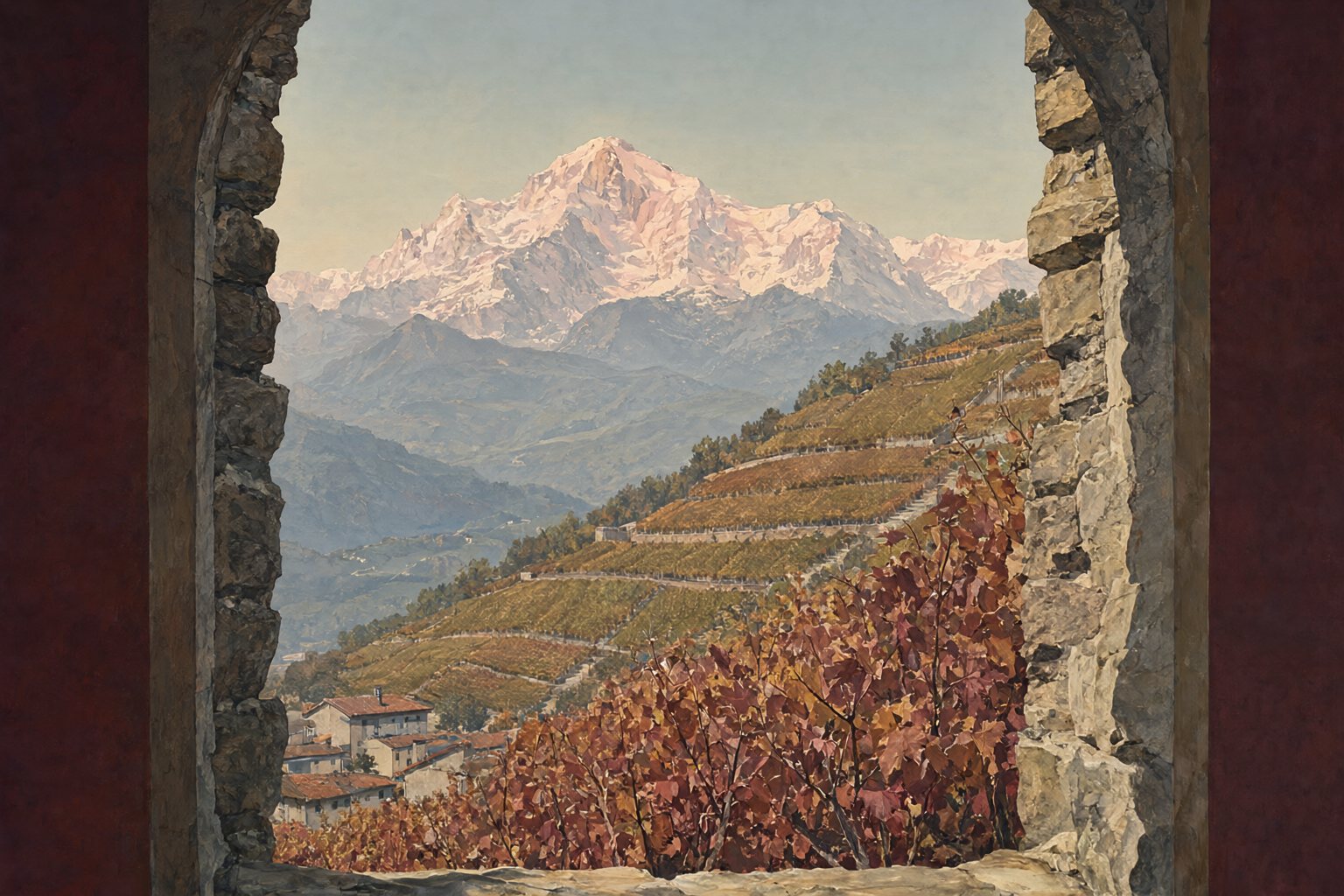
Anyone leaving Turin in search of Nebbiolo almost always takes the motorway south, and quite right too: the Langhe are there, beautiful and booked to the last room. But there is another road, heading north, that in little more than an hour leads to a place where Nebbiolo goes by the name of Spanna, vineyards emerge in patches from the woods and Monte Rosa serves as a backdrop. Between Vercelli and Novara, on either side of the river Sesia, Gattinara and Ghemme tell a story the Langhe have never known: that of a great wine that genuinely came close to disappearing.
A greatness lost along the way
For centuries these hills were nobody’s periphery. Alto Piemonte, northern Piedmont, was one of the largest wine-growing areas in northern Italy, and its reds travelled. The figures quoted for the extent of its vineyards at the end of the nineteenth century are impressive, in the order of tens of thousands of hectares, but they should be handled with care: the sources do not even agree on the unit, with some citing 40,000 hectares and others 40,000 acres. What everyone agrees on is the shape of the curve.
First came phylloxera, which struck vineyards on steep slopes, expensive to replant for people who lived on very little. Then, in the twentieth century, came the factories. The areas around Biella and Novara were industrial country, textiles and more, and factory work paid with a regularity the vineyard has never offered. Families came down from the hills, their children did not return, and the woods did the rest. According to the most widely cited accounts, by the end of the Second World War only a few hundred hectares were left. Walk today above Gattinara or Lessona and you still find dry-stone walls among the chestnut trees: vineyards that nobody remembers ever working.
The paradox is that this very abandonment preserved something. No boom, no vineyards pushed down onto the plain to chase the market, no season of muscular export reds. When, between the end of the twentieth century and the early 2000s, a new generation of growers came back to clear the woods, they found a landscape that had stood almost still.
A volcano beneath the vines
To understand why Nebbiolo tastes of something else here, you have to go a long way down, and a long way back in time. In 2009 a team of geologists led by Silvano Sinigoi of the University of Trieste and James Quick of Southern Methodist University in Dallas published a study in Geology that turned the Valsesia into a textbook case: beneath these valleys lies the fossil structure of a supervolcano, whose great eruption dates back some 280 million years. The area is now part of the Sesia Val Grande Geopark, recognised by UNESCO.
For wine, what matters is the result. Around Gattinara, rocks of volcanic origin, the porphyries, break down into acidic, poor, iron-rich and often stony soils. Ghemme, on the other bank of the Sesia, is usually described as sitting on different ground, looser and sandier, linked to deposits left by glaciers descending from the Alps. You need not turn geology into poetry to notice the difference in the glass: compared with Nebbiolo from the marls of the Langhe, Alto Piemonte Nebbiolo tends to be more lifted, with tauter acidity, finer tannin and a note many describe as ferrous, or as wet stone.
Then there is the climate. Monte Rosa is close, nights are cool, air currents drain down from the valleys. In ever-warmer years, what was once an area where Nebbiolo struggled to ripen has become a refuge of freshness. It is not the only reason for the revival, but it is hard to believe it is a coincidence.
Two DOCGs, two temperaments
Gattinara has been a DOC since 1967 and a DOCG since 1990, and it is the oldest and best-known denomination in the area. The grapes come from the commune of Gattinara alone. The rules require 90 to 100% Nebbiolo, with small possible additions of Vespolina (4% at most) and Uva Rara, which together may not exceed 10%. Ageing is long: at least 35 months, 24 of them in wood, rising for the Riserva to 47 months, 36 of them in wood. The numbers say a great deal about the philosophy: this is a wine you wait for.
Ghemme has been a DOC since 1969 and a DOCG since 1997. Its vineyards lie in part of the commune of Ghemme and part of Romagnano Sesia, in the province of Novara. The rules leave a little more room for local grapes: Vespolina and Uva Rara together may reach 15%, so Nebbiolo must make up at least 85%. Minimum ageing is 34 months, 18 of them in wood, and 46 months, 24 of them in wood, for the Riserva.
Simplifying a great deal, Gattinara is said to be the more vertical and austere of the two, Ghemme the rounder and more welcoming. Like all simplifications, it holds until you meet the producer who disproves it, but it is a good starting point for anyone tasting the two side by side.
Spanna and the extended family
Gattinara and Ghemme are the tip, not the whole iceberg. Around them lie Boca, Bramaterra, Lessona, Fara and Sizzano, as well as the broader Coste della Sesia and Colline Novaresi DOCs, where Nebbiolo often keeps company with Vespolina and Croatina. The local name Spanna, which the production rules themselves list alongside Nebbiolo, still appears on some labels of the entry-level wines: everyday reds which, in the right vintages, have something to teach plenty of Langhe Nebbiolo.
Those who already know the Nebbiolo of the Langhe, or the mountain Nebbiolo of Valtellina, will find here a third dialect of the same language. Closer to Valtellina for tension and lightness, closer to the Langhe for depth and the ability to age.
Why it is worth the journey
My view is that Alto Piemonte is today the most interesting place to study Nebbiolo, precisely because it has not yet become a brand. The denominations are small, the wineries often family-run, the differences between one slope and the next still legible. The risk, now that foreign critics have discovered the area, is that success will do what the twentieth century failed to: turn a rare territory into a fashion. For now the woods are still there, a reminder of how little it takes to lose everything. That is a good reason to go soon, and to drink these wines with the patience they ask for.
❦